
AI leadership development uses machine learning and generative AI to deliver personalized practice, coaching-style feedback and microlessons to far more people than a classroom program can reach. It works best as a partner to human coaches and managers, not a replacement. This guide covers how it works, what the research says, which skills still need people, and how an HR team can run a sensible first pilot.
TL;DR
- AI leadership development means personalized learning paths, simulations, nudges and coaching-style support delivered at scale, and it augments human development rather than replacing it.
- Adoption is moving fast: the share of organizations using or experimenting with generative AI in leadership development rose from 23 percent in 2024 to 49 percent in 2026.
- Empathy, ethical judgment, trust and adaptive communication stay human skills, and good programs build them through practice and reflection.
- Start with a small pilot, tie it to a leadership competency model, set governance for data and oversight, then expand to all employees, not only managers.
Table of Contents
- What AI leadership development actually means
- Why organizations are adopting it
- What the evidence says, and what it does not
- The skills that still need people
- How to build a program that works
- Perspective: why we build for everyone, not just managers
- Using AI leadership development in education and for veterans
- How Leaderly AI fits
- Ready to pilot it?
- FAQ
- Sources
What AI leadership development actually means
The phrase covers two different things, and readers often mix them up. The first is developing leaders with AI: using it as a learning tool. The second is developing leaders for an AI-shaped workplace: teaching AI fluency and the human skills that matter more as routine work is automated. A strong program does both.
On the first meaning, Harvard Kennedy School researchers describe AI being used in simulations, as assistants for coaches, as learning companions and as advisors. They point to gains in speed, scale, scope and sophistication, and to the potential to democratize access to development.
In practice, the pieces look like this:
- Personalized learning paths. Content adapts to a person's skills, role and goals instead of following one fixed curriculum.
- Microlearning. Short lessons, often a few minutes, delivered in the flow of work.
- Simulations and practice. Conversations and scenarios where a leader rehearses a hard moment before it happens.
- Assessments and analytics. Self-assessments and dashboards that show where skills are growing.
- Nudges and reminders. Prompts that turn a lesson into a repeated habit.
A 2026 literature review presented at PACIS identified four connected dimensions: the learning infrastructure, the teaching mechanisms, the human-centered leadership capabilities, and AI governance with organizational readiness. Its conclusion is worth remembering: AI mostly augments leadership development by making it scalable, adaptive and data-driven, while empathy, ethical judgment and relationship skills remain central.
Why organizations are adopting it
Traditional leadership programs have a coverage problem. They tend to be expensive, scheduled in blocks, and reserved for senior people or high-potential managers. Everyone else gets a one-off workshop, if anything.
AI changes three things about that.
Personalization at scale
Brandon Hall Group advises organizations to prioritize AI that builds individual learning pathways from skills assessments, performance data and career aspirations, and to combine it with human expertise in a hybrid approach. The idea is simple: a new team lead and a director do not need the same next lesson.
We explain the mechanics in more depth in our piece on how AI learning personalization works at work.
Learning in the flow of work
Time is the biggest barrier to development. Harvard Business Impact notes that AI can push microlearning or feedback exactly when it is needed, for example a just-in-time nudge before a key meeting. That makes development part of the workday instead of one more calendar block.
Access for every level
Large employers are already building this. Accenture describes AI-enabled, agent-based coaching for more than 1,000 senior leaders that uses one leadership framework and shared data, with human judgment still central to how insights are applied. Charterworks reports that Mastercard's coaching tool, Cai, makes coaching always-on, personalized and scalable and tailored to the company's own leadership behaviors. At Regal Rexnord, Forbes describes proactive nudges for 4,000 global leaders, a coach in every leader's back pocket.
Those are big enterprises, but the principle applies at any size: the same framework, delivered to many people, adjusted to each.
What the evidence says, and what it does not
Adoption data is clear. In Training Magazine's survey, usage or experimentation with generative AI in leadership development more than doubled in two years, and the share of organizations that had not explored it fell from 48 percent to 28 percent (Training Magazine). The same research found the most effective leadership development organizations used generative AI across planning, assessing leaders, designing programs, building learning assets and assessing outcomes, while also engaging executives, supporting managers as coaches and bringing real-life experience into learning.
The Conference Board's 2025 research, A Coach for Every Worker, found that most respondents considered some forms of AI coaching equal to or better than human coaching. It recommends that chief human resources officers select tools carefully, pilot them, and then extend them gradually to all workers and managers.
That last recommendation is the practical core of this article. The rest of it is how to do that well.

The skills that still need people
The fear behind many searches on this topic is whether AI makes leadership skills obsolete. The research points the other way: it raises the value of the human ones.
The Association for Talent Development's playbook recommends a Human + AI Skills Portfolio with three parts: digital and AI fluency, human skills, and innovation skills. The human skills it lists are emotional intelligence, trust-building, adaptive communication, ethical reasoning and creative problem-solving.
Training Industry makes a related point about measurement. AI can capture and analyze leader behavior in real time, but no AI-driven tool should replace the human component of leadership development.
So the best use of AI is to give people more repetitions at the human skills: practicing a feedback conversation, reflecting on a decision, noticing a pattern in how they communicate. The people part, such as a manager who reviews progress and a peer group that discusses it, is what turns practice into lasting behavior change.
How to build a program that works
Here is a sequence HR and L&D teams can follow.
- Define the behaviors first. Pick a leadership competency model, or adapt the one you have. Training Industry's authors argue that AI-driven tools should be aligned with an established competency model and built into a development program, not bolted on.
- Choose the audience wider than managers. Leadership shows up in individual contributors, volunteers and student leaders. Mobile, short-form delivery makes it affordable to include them.
- Pick tools with assessment, practice and analytics together. Self-assessments set a baseline, short lessons and exercises build habits, and dashboards show progress.
- Run a time-boxed pilot. Eight to twelve weeks with one or two groups is enough to see engagement and early behavior signals. We lay out a version in our 8 to 12 week AI leadership coaching pilot.
- Keep humans in the loop. Ask managers to discuss progress in one-on-ones, and give participants a place to reflect together.
- Set governance before launch. Decide what data is collected, who sees it, and how people can raise concerns.
- Measure behavior, not just completion. Look at habit streaks, assessment changes, manager observations and engagement survey movement.
- Expand in stages. Take what the pilot taught you, adjust content, then roll out.
Governance and risk
Research on AI-enhanced coaching in the Journal of Work-Applied Management concluded that organizations need integration strategies, ethical governance frameworks and supervision mechanisms. Training Industry adds that the quality of AI insight depends on data validity, model transparency and whether indicators truly represent the behavior being assessed.
In practice, that means a short checklist before launch:
- Be transparent with employees about what the AI sees and why.
- Treat assessment results as development input for the individual, not a hidden performance score.
- Review content for accuracy and tone with a person who knows your culture.
- Keep a named human owner for the program and for escalations.
Our guide to generative AI for L&D covers use cases, risks and a rollout plan in more detail.
Bring people along
ATD's playbook stresses that talent development must also guide organizations through the human reactions to AI, including fear, skepticism, resistance and hope, and create a safe environment for experimentation. Say what the program is for, invite questions, and let early participants share what they found useful.
Perspective: why we build for everyone, not just managers
We started Leaderly AI because leadership development was rationed. A few people got coaching and a week away, and everyone else was told to figure it out. We think that is backwards. Leadership habits are built in small, repeated moments, and those moments happen to every employee, volunteer and student.
That is why we combine behavioral science, frequent microlearning and machine-learning personalization. Our approach is designed so each person's content evolves with their own journey, while HR or educators can customize programs and see analytics across the whole organization.
We also believe the human side is the point. Our platform is built around practical exercises, self-assessments and reflection, so that the real conversations people have with their teams get better. AI gives more people more practice. Managers and peers give it meaning.
Drew
Using AI leadership development in education and for veterans
Higher education and learning programs
Colleges and universities increasingly want to give students, faculty and staff leadership practice outside the classroom. Short mobile lessons, assessments and exercises fit around class schedules, and co-branded programs let an institution present them under its own identity. Our page on Leaderly AI for Higher Education describes how this works for campuses.
Veterans moving into civilian leadership
Veterans often have deep leadership experience, but translating it is the hard part. A review in PMC on veterans' workplace transitions notes that employers often value veterans' leadership skills, cross-cultural experience and work ethic, while pointing to risks such as mistranslation of military skills in resumes and interviews and difficulty adapting to civilian work culture. It also reports that only 19% of employers saw strong communication skills in veterans, compared with 64% of veterans who rated themselves effective communicators.
That gap is practical, and practice helps close it. Self-assessments on communication style and emotional intelligence, plus short exercises on giving feedback in civilian workplace settings, give a veteran a vocabulary and rehearsal space. Organizations that hire veterans can offer the same tools in onboarding.
Nonprofits and volunteers
Nonprofits often have lean budgets and many volunteers who step into leadership without training. Tiered subscriptions and mobile delivery help spread development across staff and volunteers. See Leaderly AI for Nonprofits.
How Leaderly AI fits
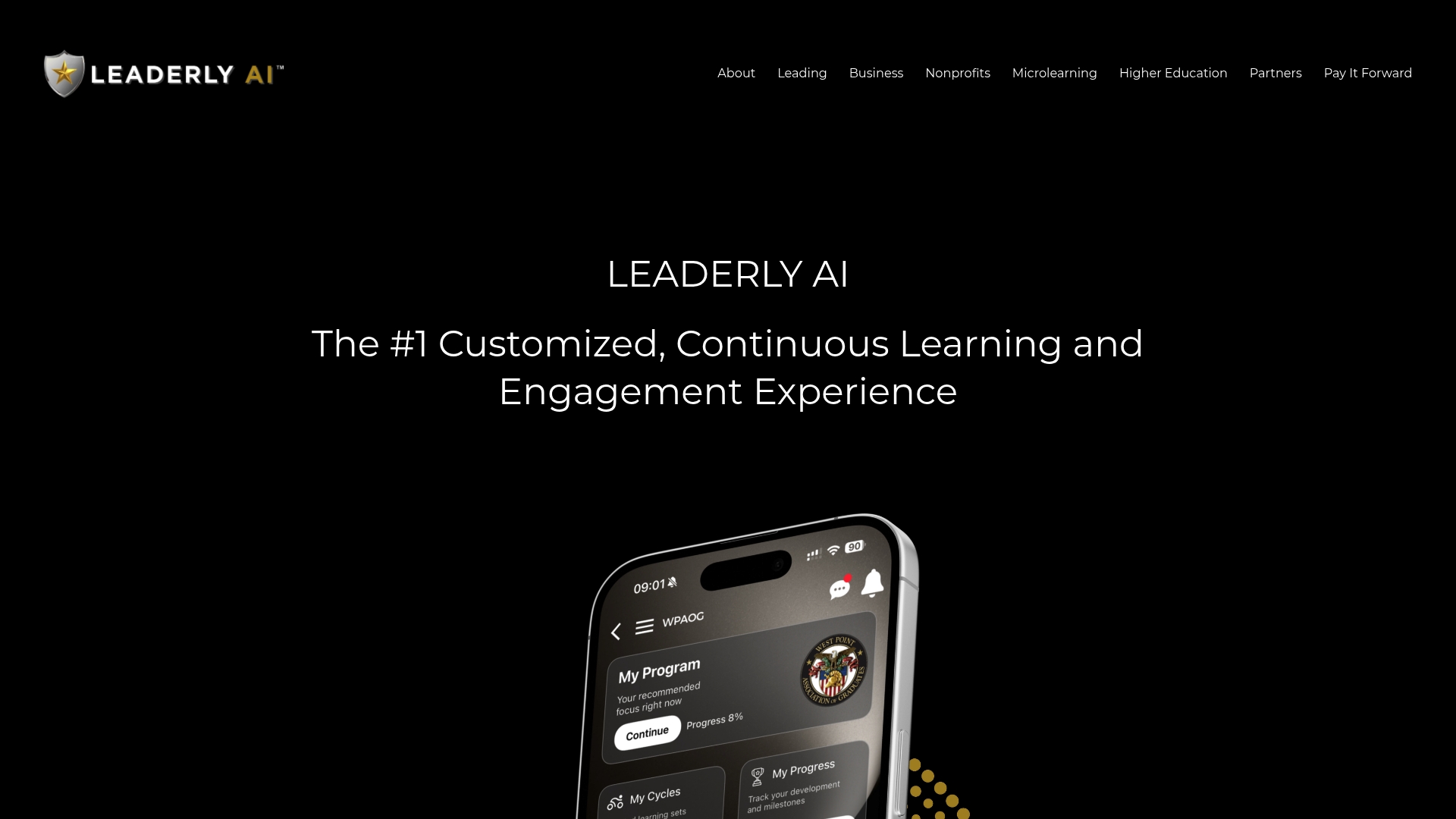
Leaderly AI is a mobile-first platform for organizations that delivers personalized leadership development, microlearning, behavioral habit-building exercises, customizable learning journeys, self-assessments (including DiSC, EQ and MBTI), analytics dashboards, gamified recognition, surveys and simulations. It serves corporate, nonprofit and educational settings, and it is designed to scale to all employees, not just managers.
If you are exploring how short lessons fit into leadership habits, start with our page on microlearning for leadership and our walkthrough of turning 500 pages into 40 two-minute lessons. For manager populations, see our write-up on adaptive learning pilots for managers.
Ready to pilot it?
If you lead HR or L&D and want to give every employee a path to better leadership, we can help you set up a first group. Explore Leaderly AI for organizations to see how journeys, assessments and analytics come together, or visit leaderlyapp.com to get started.
Pricing is tiered by organization size or user count, with custom plans available, so the right plan depends on your group.
FAQ
Can AI replace human leadership coaches?
No, and the research does not suggest it should. The PACIS review concludes that AI augments leadership development while empathy, ethical judgment and relational skills stay central, and Training Industry says no AI tool should replace the human component. The strongest programs pair AI practice with manager conversations and peer reflection.
Who should be included in an AI leadership development program?
Everyone who influences others, which is wider than people managers. The Conference Board recommends piloting carefully and then extending AI coaching to all workers and managers. Emerging leaders, individual contributors, volunteers and student leaders benefit from the same habit-building practice.
How long should a pilot run?
Eight to twelve weeks with a small, defined group is a practical window. It gives enough time to see engagement patterns, early behavior changes and manager feedback before you scale. Set the success measures, such as participation, assessment change and manager observations, before you start.
What risks should HR plan for?
Plan for data privacy, model transparency, the validity of what the AI measures, and human oversight. Academic and professional sources recommend ethical governance frameworks and supervision mechanisms. Tell employees what is collected and why, and name a human owner for the program.
Sources
- Leadership Development in the Age of Artificial Intelligence, Harvard Kennedy School
- PACIS 2026 Proceedings, Darvish and Klotz
- How AI Could Transform Leadership Development Evaluation, Training Industry
- High Tech + High Touch = Effective Leaders, Training Magazine
- Leadership Development for the Age of AI, Accenture
- How to Leverage AI Technology to Improve Leadership Development, Brandon Hall Group
- Mastercard's AI coaching tool, Charterworks
- How AI Can Help Leaders Grow Their EI In The Flow Of Work, Forbes
- Amplifying with AI, Harvard Business Impact
- A Coach for Every Worker, The Conference Board
- Humanizing the AI Transition, ATD
- The AI-powered future of digital transformation, Journal of Work-Applied Management
- Veterans to workplace: Keys to successful transition, PMC