
An adaptive assessment changes what it asks based on how you answer. A correct answer leads to a harder item, a wrong one to an easier item, and the test settles quickly on the level you actually perform at. For HR teams, educators and emerging leaders, that means shorter assessments, less wasted effort and results that point to a next step. We build Leaderly AI around the same idea: development that responds to the person instead of handing everyone the same content.
TL;DR
- An adaptive assessment picks each question from the previous answers, so each person gets a different, shorter path to a more precise result.
- It is a system, not just branching: it needs a calibrated question pool, real-time scoring, a rule for choosing the next item and a rule for stopping.
- In leadership work, adaptive ideas show up in simulations, 360-degree feedback, self-assessments and personalized learning paths.
- Results are only useful if they lead to an action plan, such as a short, targeted learning journey.
- If assessment results feed employment decisions, validate them for the job and keep human review in place.
Table of Contents
- What an adaptive assessment is
- How an adaptive assessment adjusts in real time
- What it takes to build one that works
- Examples of adaptive assessment in leadership development
- Turning results into development
- Using assessments fairly in the workplace
- How Leaderly AI supports adaptive development
- Our perspective
- FAQ
- Sources
What an adaptive assessment is
A traditional test is fixed-form: every person gets the same predetermined set of items. According to the Center for Assessment, an adaptive assessment instead gives different students different items, adjusting difficulty depending on whether earlier answers were right or wrong.
A useful way to picture it is a conversation. A good interviewer does not ask a senior manager the same opening questions as a new hire. After a strong answer, the interviewer goes deeper. After a hesitant one, the interviewer steps back and finds where the footing is. An adaptive assessment automates that instinct.
Adaptive assessment versus adaptive learning
The two terms get mixed up. A systematic review of assessment in adaptive learning separates them this way:
- Adaptive learning is a methodology that adjusts and personalizes the learning process, especially the content a learner sees.
- Adaptive assessment selects questions based on how the examinee performs, producing a short personalized test.
Montclair State University draws the same line from the teaching side: adaptive assessment changes the questions shown, while adaptive sequencing uses performance data to change what the learner sees next. The strongest programs connect both: the assessment finds the gap and the learning path closes it.
Why shorter can still be accurate
The same review reports that adaptive assessment can cut test length by at least 60 percent compared with conventional testing. The reason is simple. A fixed test wastes many items on questions that are far too easy or far too hard for a given person, and those items tell you little. An adaptive test spends its time near the person's real level.
How an adaptive assessment adjusts in real time
Stanford's reading-assessment team explains the mechanics of computer-adaptive testing: each item is selected from the participant's previous answers. After a correct response, the next item is generally slightly harder. After an incorrect response, it is easier. The process continues until the estimate of ability is precise enough.
Here is a simplified walk-through:
- Start in the middle. The assessment opens with an item of moderate difficulty. A review of adaptive testing notes that tests often start with a few mid-level items.
- Score immediately. Stanford notes that items must be scored right away so the next item can be selected.
- Update the estimate. After each answer, the test refines its estimate of the person's level.
- Choose the next item. The next question is picked to match that estimate.
- Stop. Adaptive tests include a process to end the test, such as reaching a target precision or a maximum length.
Two people can take the same adaptive assessment and see almost no overlap in questions. That is by design, and it also helps security, since Stanford lists enhanced test security among the advantages because each test is unique to the individual. The same page lists shorter testing times and reduced test anxiety from fewer irrelevant questions.
A worked example
Imagine a 15-question leadership judgment assessment on giving feedback. A new team lead answers the first scenario correctly, so the second is harder: a direct report who gets defensive. They get that right too, and the third involves delivering feedback across a power gap. They miss it, so the fourth steps back to a simpler version. By question 10, the assessment has circled the lead's level: strong on routine feedback, shaky when stakes rise. A colleague taking the same assessment might never see the hard scenarios at all and instead spend more time on fundamentals. Both get a result that fits them, and neither sits through 40 items.

What it takes to build one that works
Adaptive testing is more than harder-or-easier branching. The U.S. National Center for Education Evaluation describes a system with these parts:
| Component | What it does |
|---|---|
| Calibrated item pool | A bank of questions placed on a common difficulty scale |
| Response scoring | Scores each answer so the system can react |
| Item-selection mechanism | Chooses the next question from the current estimate |
| Stopping process | Ends the test once the result is precise enough |
| Reporting | Connects scores to what the person should do next |
The last row matters most for workplace learning. A score on its own does not change behavior. Reporting that relates the result to a development need does.
Delivery also matters. If assessments are taken remotely and carry stakes, integrity becomes a design question, and this discussion of AI proctoring in college exams is a useful look at what remote delivery involves. Low-stakes development assessments, where the goal is self-awareness rather than a pass or fail, put much less pressure on this.
Where adaptation does not fit
Not every measure should adapt. Stanford points out that timed fluency measures may keep the same or equated items, because response time is central to what is being measured. In leadership development the lesson is to match the format to the construct: adapt where you are measuring depth of judgment or knowledge, and keep items fixed where consistency across people is the point.
Examples of adaptive assessment in leadership development
Most leadership assessments are not computer-adaptive tests in the strict psychometric sense. They are, however, adaptive in spirit: the experience, depth or next step depends on the person's responses. These examples show the range.
360-degree feedback with a built-in adaptive framework
Penn State's Human Resources office describes its 360-degree feedback program, which uses the TalentSmart 360 EQ Refined assessment. It measures 22 skills: the first 10 make up Core Leadership and the last 12 are called Adaptive Leadership, and the tool includes online progress tracking. Here "adaptive" describes the skills measured, but it shows how a structured assessment can break leadership into parts a person can work on one at a time.
Scenario simulations
Training magazine reports that CarMax's leadership development program begins with a leader simulation assessment and a developmental debrief. Associates take the role of a corporate leader in a fictitious company, and the simulation measures how well they demonstrate a skill or behavior "in the moment." Simulations are a natural fit for adaptive design because each decision can change the next scenario.
Assessment feeding a personal action plan
The U.S. Army describes its Leader Self-Development Tool, which integrates assessments, guides users through reflection on their results, identifies areas to work on and builds a customized action plan with supporting resources, including interactive modules and handbooks. This is the pattern to copy: assess, reflect, then act.
Self-assessments plus personalized microlessons
This is where we work. Leaderly AI includes self-assessments such as DiSC, EQ and MBTI, and pairs them with personalized microlessons, behavioral habit-building exercises and customizable learning journeys. Our platform uses machine learning to tailor content as each person's journey evolves. If you want a practical primer on assessment that guides development rather than ranking people, see our guide to formative assessment in leadership and our explanation of competency-based assessments at work.
Turning results into development
The value of an adaptive assessment is what happens after it ends. Whether you are an HR leader planning for hundreds of employees, an educator or a veteran moving into civilian management, the same four steps apply.
- Name the gap in plain terms. "Struggles with high-stakes feedback" is actionable. "Scored 62" is not.
- Pick one or two behaviors. People change habits one at a time. A long list of weaknesses stalls progress.
- Match the format to the habit. Short, repeated practice beats a single long course for behaviors like feedback, delegation or listening. Our post on turning 500 pages into 40 two-minute lessons shows how short lessons are built.
- Reassess. A second pass shows whether the habit moved and decides what comes next.
For organizations, aggregate results are as useful as individual ones. They show which skills are thin across a team or cohort, so learning budgets go where the need is. Our analytics dashboards are built for that view.
The approach is also relevant to the shift toward continuous learning for non-managers. Our write-up on adaptive learning pilots for managers covers how personalization shows up in practice, and for the leadership concept itself you can read what adaptive leadership means and the three skills it requires.
Using assessments fairly in the workplace
Development assessments are low-stakes by nature. The moment results influence hiring, promotion or selection for a program, legal standards apply. In the United States, the Equal Employment Opportunity Commission's guidance on employment tests and selection procedures says that:
- Tests should be validated for the positions and purposes they are used for, be job-related, and produce results suited to that purpose.
- Employers remain responsible even when a vendor supplies validity documentation.
- If a procedure screens out a protected group, the employer should consider an equally effective alternative with less adverse impact.
- Test specifications should be updated as job requirements change.
For HR teams, a practical checklist follows from this:
- State up front whether results are for development only or will inform decisions.
- Keep results private to the individual and a coach or manager they choose, unless the program says otherwise.
- Review group-level results for patterns that suggest a question or format disadvantages a group.
- Offer accessible formats and clear instructions.
- Revisit the content when the role changes.
If you run programs in schools or universities, student data adds another layer. Our guide to vetting a FERPA-compliant LMS walks through the questions to ask. Questions about legal compliance for your specific program belong with your counsel.
How Leaderly AI supports adaptive development
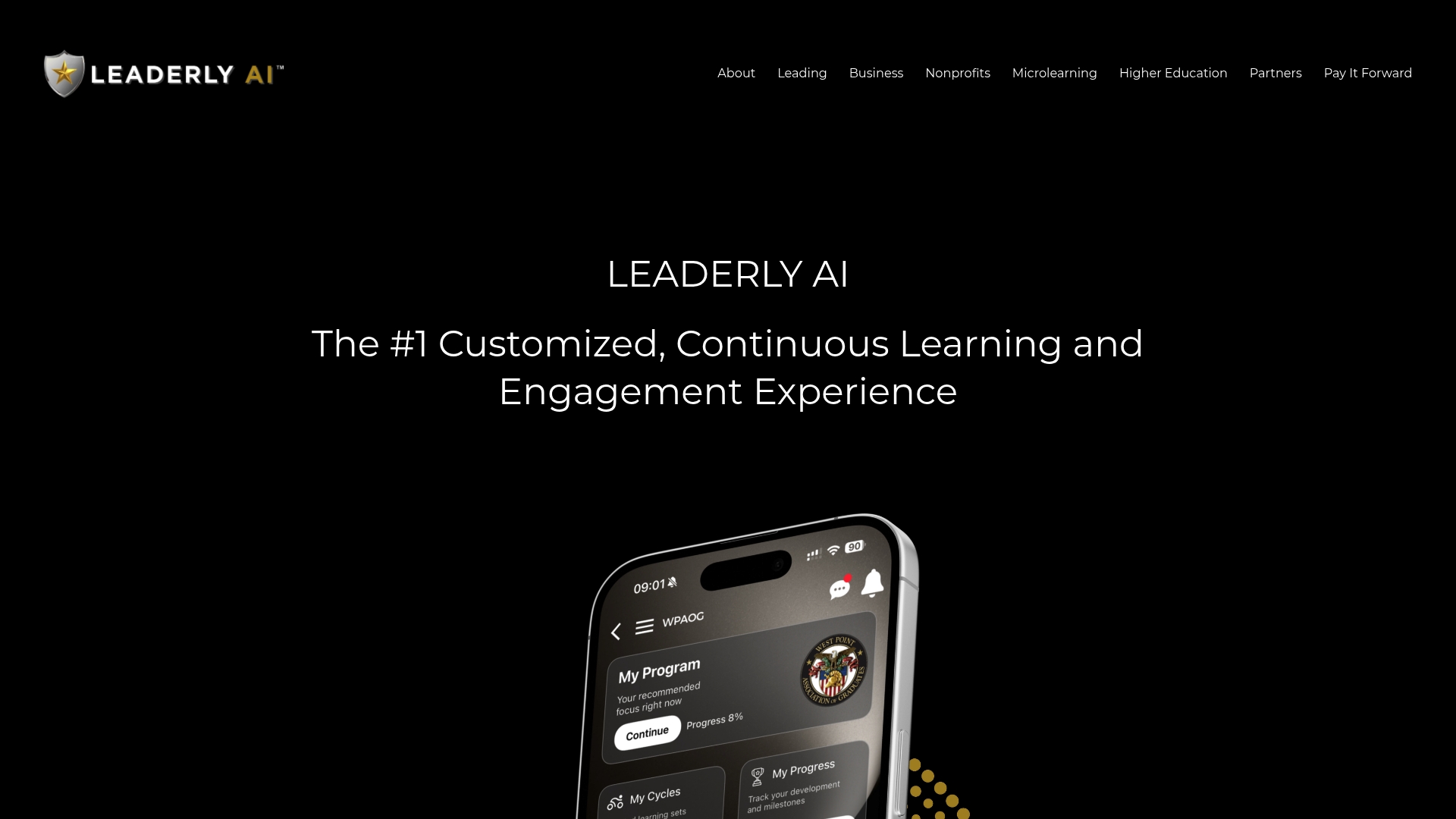
Leaderly AI is a mobile-first platform for organizations that delivers personalized, AI-driven leadership development to everyone on the team, not just managers. It brings together self-assessments (including DiSC, EQ and MBTI), personalized microlessons, behavioral habit-building exercises, simulations, surveys, gamified recognition and analytics dashboards, with content that HR teams and educators can customize.
There are versions for business teams, higher education and nonprofits. To see how it would fit your organization, start at leaderlyapp.com.
Our perspective
Most organizations already run assessments. The gap is what happens in the weeks after. A person gets a report, feels briefly informed, and goes back to work with the same habits.
We think the useful question is not "how accurate is the score?" but "what will this person do differently on Monday?" That is why we pair assessment with short, personalized practice. Microlessons are small enough to fit into a workday, and habit-building exercises turn insight into repetition. Because the content responds to each person's journey, a new supervisor and a seasoned director do not get the same material.
We also believe leadership development should not stop at the manager level. Emerging leaders, volunteers, faculty and students all lead something. When HR teams and educators can customize the experience and see where skills are growing, development becomes something everyone takes part in, and it scales without a large budget for live programs.
Adaptive thinking is at the center of that: meet people where they are, then move them forward one practical step at a time.
Drew
FAQ
What does an adaptive exam mean?
It is an exam whose questions change based on your earlier answers. Correct answers lead to harder questions and incorrect answers to easier ones. The exam ends once it has enough information to estimate your level.
Are adaptive assessments only for schools?
No. Education has the longest history with them, but the same logic applies to workplace learning. Simulations, structured feedback tools and self-assessments that lead into personalized learning paths all use the idea of responding to the individual.
Are adaptive assessments better than fixed tests?
They suit different jobs. The Center for Assessment frames the choice around purpose. Adaptive formats are efficient for measuring a broad range of ability and growth, and they shorten testing time. Fixed forms keep every person on identical items, which is useful where comparability on specific content is the goal.
How should HR use adaptive assessment results?
Use them to guide development first: identify one or two behaviors, assign short practice, and reassess. If results will ever inform selection or promotion, confirm they are validated for the job and consult your legal counsel, following the EEOC guidance on employment tests.
Sources
- Adaptive or Fixed-Form Assessments, Center for Assessment
- Computer Adaptive Testing, Stanford ROAR
- A Systematic Review on Assessment in Adaptive Learning
- Adaptive Learning, Montclair State University
- Computer-Adapted Testing, EBSCO Research Starters
- Implementation of Computerized Adaptive Testing, National Center for Education Evaluation
- 360 Degree Feedback, Penn State Human Resources
- CarMax's Leadership Development Program, Training Top 125
- Leader Self-Development Tool, U.S. Army
- Employment Tests and Selection Procedures, U.S. EEOC
- Generative AI in Proctoring College Examinations, PyrrhicPress.Org