
Leadership training runs from $35 for a self-paced online course to $80,000 or more for executive education, with most organizations landing between $1,200 and $18,500 per person per year depending on seniority. A practical rule of thumb: budget 5 to 10% of a leader's salary annually for meaningful development, and build in room for coaching, reinforcement, and the time leaders spend away from their day jobs.
TL;DR:
- Leadership training costs vary widely, from $35 for self-paced courses to over $80,000 for executive programs, depending on customization and format.
- Larger organizations typically spend about $1,200 per employee for foundational training, increasing to $7,200 for mid-level managers and $18,500 for executives annually.
- Hidden expenses such as travel, opportunity costs, and reinforcement can double or triple the initial quoted price of leadership development programs.
- Digital microlearning platforms can significantly reduce costs once training more than 50 to 100 employees per year, especially when scaled with annual subscriptions.
- Building a realistic budget involves defining clear objectives, choosing appropriate delivery methods, calculating all costs, and including measurement upfront to secure finance approval.
Table of Contents
- How Much Does Leadership Training Cost by Delivery Type?
- What's a Realistic Budget by Leader Level?
- What Actually Drives the Price of Leadership Training?
- How Do You Build a Leadership Training Budget That Finance Will Approve?
- Can Digital Microlearning Cut Your Leadership Training Costs?
- What Should You Do This Week to Estimate Your Program Cost?
- Where Leaderly AI Fits Into a Leadership Training Budget
- Sources
How Much Does Leadership Training Cost by Delivery Type?
Price scales with how much human attention and customization is baked into the format. A self-paced video course costs almost nothing per seat; a bespoke executive retreat with one-on-one coaching costs as much as a used car.
- Self-paced online courses: $35 to $500 per user, or a similar range per seat annually for platform access. You get pre-built content and no live facilitator, which keeps costs low but puts the burden of accountability on the learner.
- Virtual instructor-led training: $500 to $5,000 per participant, depending on session length and how much live interaction and coaching is built in.
- In-person workshops and seminars: $500 to $10,000 or more per participant. Facilitator travel, venue rental, and materials add up fast, though group pricing can bring the per-person cost down for larger cohorts.
- Multi-month blended programs: $1,500 to $8,000 per participant, typically bundling assessments, coaching check-ins, and spaced learning over several months.
- Executive education and MBA-style programs: $5,000 to $80,000-plus per participant. This tier often includes networking, university branding, and a credential, according to cost anchors compiled by TrainingCost.
- One-on-one executive coaching: typically billed monthly or per engagement, with total costs varying widely based on coach seniority and engagement length.
Pro Tip: Ask any vendor quoting a per-participant price whether that number includes materials, assessments, and follow-up coaching, or just the live session. Bundled quotes and stripped-down quotes can look identical on paper and cost twice as much once the extras show up as change orders.
What's a Realistic Budget by Leader Level?
Cost per person tracks closely with how much customization and one-on-one attention that leader's role demands. Foundational programs for a broad employee population look nothing like the bespoke coaching a chief operating officer receives.
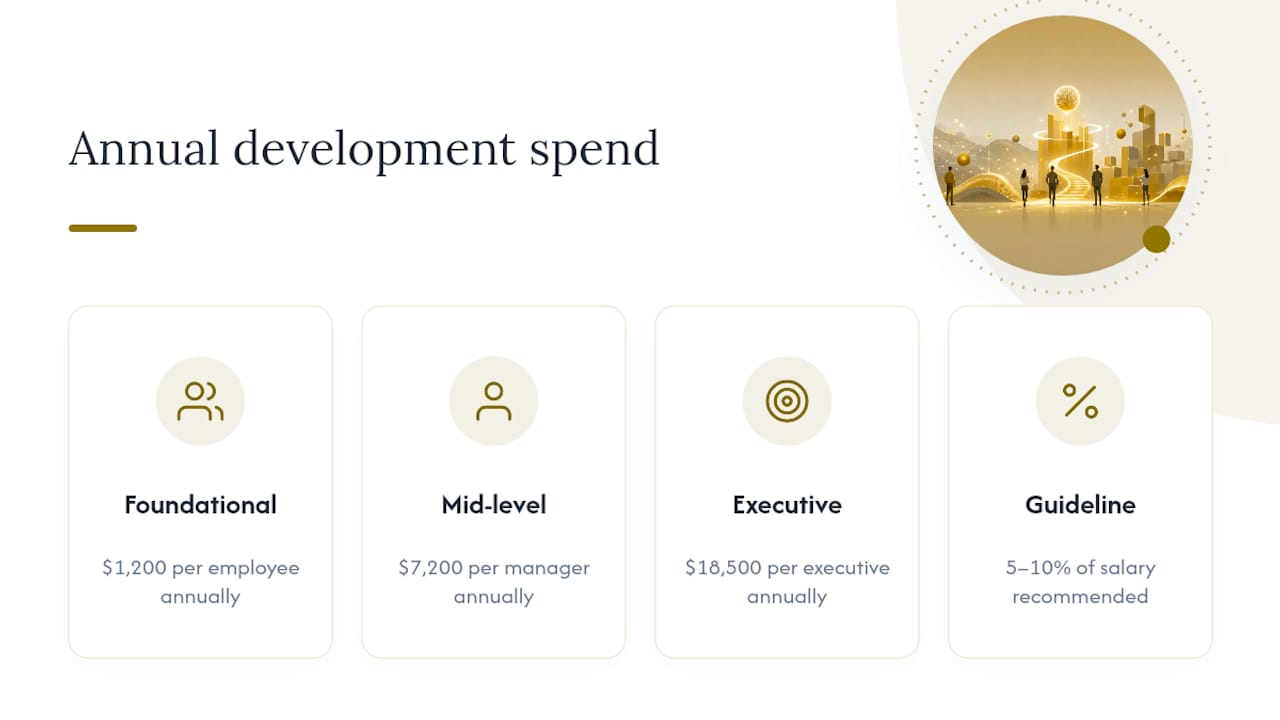
Industry data from JRG Partners puts average annual spend at roughly $1,200 per employee for foundational development, $7,200 per mid-level manager, and $18,500 per executive at large US corporations. Those figures line up closely with the 5 to 10% of salary guideline that The Metiss Group recommends as a starting point.
What Actually Drives the Price of Leadership Training?
The number on a vendor's quote is rarely the whole story. Four factors move price the most: how long the program runs, how customized the content is, which delivery format you choose, and how experienced the facilitator is. A generic two-hour webinar and a six-month cohort with a former Fortune 500 executive coaching each participant can carry the same "leadership training" label and a tenfold price gap.
Hidden costs matter just as much as the vendor invoice. Here's what to add to any budget beyond the sticker price:
- Travel, lodging, and facilities for in-person formats, which can rival the facilitation fee itself for multi-day events.
- Participant opportunity cost, calculated as training hours multiplied by each leader's loaded hourly rate. A director earning $150,000 a year who spends 24 hours in training represents real payroll cost even before the vendor bill arrives.
- Reinforcement and measurement, including LMS access, coaching follow-up, and evaluation, which commonly run 20% to 40% on top of the base program fee.
At senior levels, opportunity cost is often the single largest hidden line item in the entire budget, sometimes exceeding the program fee itself once you account for a C-suite leader's time. Group size cuts the other direction: smaller companies often pay more per learner because fixed costs like content development get spread across fewer people, according to TrainingCost's benchmark analysis.
How Do You Build a Leadership Training Budget That Finance Will Approve?
Four steps turn a vague training wish list into a number finance can actually approve. First, define the outcome you're buying, whether that's succession readiness, retention, or a specific skill gap. Second, pick your delivery mix based on that outcome, not on what's cheapest or most familiar. Third, calculate the all-in cost, including travel, opportunity cost, and reinforcement, not just the vendor invoice. Fourth, set a measurement plan before the program starts, not after.
- Reserve roughly 10% of the total budget for measurement: pre/post assessments, manager check-ins, and performance tracking tied to ROI metrics HR should already be watching.
- A small pilot (20 to 30 participants, one format) often runs $30,000 to $75,000 all-in.
- A scaled mid-level program (100-plus participants, blended delivery) commonly lands between $300,000 and $800,000 annually.
- An executive cohort of 10 to 15 leaders with individual coaching can run $150,000 to $280,000 a year on its own.
The 70-20-10 model, which allocates 70% of development to on-the-job experience, 20% coaching and peers, and 10% formal instruction, is worth citing in any proposal. It's the reason blended programs with reinforcement consistently outperform one-off workshops on both application and cost-effectiveness.
Can Digital Microlearning Cut Your Leadership Training Costs?
Subscription-based digital platforms flip the cost curve that per-event pricing creates. Instead of paying $500 to $10,000 every time you run a new cohort through a workshop, a per-user annual license spreads the cost of content and personalization across every employee who logs in, and the marginal cost of adding the next 50 people drops close to zero.
- Personalized microlearning delivers the "20% coaching and reinforcement" piece of the 70-20-10 model without flying in a facilitator every quarter.
- Subscription pricing beats per-event pricing once you're training more than roughly 50 to 100 people a year across multiple cohorts.
- Some digital platforms pair behavioral-science-based microlessons with analytics dashboards, so you're not guessing whether the spend is working.
Pro Tip: When you pilot a digital-first approach, cap the group at 20 to 50 participants and commit 5 to 10% of the pilot budget to measurement. That's enough scale to prove impact without betting the whole annual budget on an unproven rollout.
What Should You Do This Week to Estimate Your Program Cost?
Pull last year's training spend, list your leader headcount by level, and multiply by the per-person ranges above to get a rough draft number. Loop in finance early with assumptions attached, not just a total. Send finance three numbers: cost per participant, estimated hours away from work, and your reinforcement budget as a percentage of program fees.
— Drew
Where Leaderly AI Fits Into a Leadership Training Budget
Leaderly is built for the math above. Instead of paying per-event fees every time you run a new cohort through a workshop, you pay a per-user subscription that covers personalized microlearning, behavioral assessments, and analytics dashboards, which maps directly onto the "reinforcement and measurement" line item that eats 20% to 40% of most training budgets.

A sensible pilot looks like this: 20 to 50 participants, 90 days, with success measured by lesson completion, self-assessment score movement, and manager-reported behavior change. That's a small enough ask that finance can approve it without a full-year commitment, and it gives you real usage data before you scale. If you're deciding between funding another one-off workshop or testing a model that gets cheaper per person as your organization grows, start by reviewing how Leaderly builds people-centered leadership skills and request a pilot proposal sized to your leader headcount.
Sources
Anchor your business case with the ATD training cost benchmark of $846 per employee annually, Training Industry's 2024 spending report, and JRG Partners' leadership spending breakdown by leader level.
- Leadership Development Spending Statistics 2026 — JRG Partners LLC