
Use MBTI as a development and communication tool, not as a hiring or promotion filter. The research is clear on this: MBTI has limited predictive validity for leadership performance, so it is best used for coaching rather than selection. Two recommended actions are to read dimension scores rather than relying solely on four-letter labels, and to conduct a team conversation about individual work preferences.
TL;DR:
- MBTI scores should inform communication and coaching rather than be used for hiring or promotion decisions due to its weak predictive validity.
- Focus on observable behavior and preferences, such as decision-making speed or meeting engagement, during follow-up actions to drive real team development.
- Use research-backed tools like the Big Five for performance prediction and MBTI for team dialogue, respecting cultural differences and individual growth.
- Implement MBTI insights gradually through behavioral experiments and short-term follow-ups, avoiding static labels and fostering continuous adjustment.
- Reassess team preferences after significant organizational changes and treat MBTI as a snapshot, not a fixed characteristic, to ensure ongoing relevance.
Table of Contents
- What MBTI for Managers Actually Means in Practice
- MBTI Basics for Managers: The Four Dichotomies, Simplified
- What the Research Actually Says About MBTI and Leadership
- How MBTI Preferences Show Up in Leadership Styles
- Rolling Out MBTI on Your Team the Right Way
- An Honest Editorial Note on Where MBTI Fits
- Blending MBTI With DISC and the Big Five
- What MBTI Looks Like When It Actually Works on a Team
- Handling Skepticism About MBTI on Your Team
- When to Revisit MBTI as Your Team Changes
- Cultural Context Matters More Than Most MBTI Guides Admit
- Where This Actually Lands for Managers
- Turn MBTI Insight Into a Habit With Leaderlyapp
- Sources
What MBTI for Managers Actually Means in Practice
MBTI for managers isn't about sorting your team into 16 boxes and calling it a day. It's about using preference data as a starting point for better conversations. The instrument tells you tendencies, not capabilities, and tendencies are only useful when they change how you communicate, delegate, and give feedback.
Here's what to do with results once you have them:
- Use dimension scores in one-on-ones. Instead of saying "you're an INTJ," ask clarifying questions informed by where someone scores on E/I, S/N, T/F, and J/P. Someone with a strong Introversion preference might need agenda items sent ahead of a meeting so they can think before speaking.
- Run a 30 to 45 minute team workshop. Surface actual working-style agreements: How fast do we make decisions? Do we want a discussion-first or draft-first approach to problem-solving? How often does the team want feedback?
- Adjust meeting design around real preferences. Sensing-dominant team members often want a pre-read with specifics; intuitive types and those with a Perceiving preference tend to want open time to explore ideas before committing. Judging types want a clear list of next steps before the meeting ends.
- Pair every insight with a behavioral commitment and a follow-up. Pick one or two things to change, then check back in two to four weeks. Insight without follow-through evaporates fast.
Pro Tip: *Don't announce "your MBTI type" in a team channel. Frame it as "here's what I noticed about how you like to receive information" and let the team member confirm or correct it.
MBTI Basics for Managers: The Four Dichotomies, Simplified
You don't need a psychology degree to use this well. You need to understand four preference pairs and resist the urge to treat them as fixed personality boxes.
- Extraversion vs. Introversion (E/I). This is about where someone gets energy, not how confident they are. Extraverted team members often think out loud in meetings; introverted ones frequently do their best thinking beforehand or after, in writing.
- Sensing vs. Intuition (S/N). Sensing types generally want concrete, sequential information. Intuitive types tend to gravitate toward patterns, possibilities, and the "why" before the "how."
- Thinking vs. Feeling (T/F). This dichotomy shapes how someone weighs decisions, logical consistency versus impact on people, not whether they have emotions or care about others.
- Judging vs. Perceiving (J/P). Judging types like closure and plans; Perceiving types prefer to keep options open and adapt as new information comes in.
Dimension scores matter more than the final four-letter label. Someone who scores 55% on Thinking and 45% on Feeling behaves very differently from someone who scores 95% Thinking, even though MBTI would label both "T." Treat the score as a spectrum, watch the behavior, and adjust your read over time.
For a faster mental shortcut, group types into four temperaments: NT (strategic, analytical), NF (people-focused, vision-driven), ST (practical, execution-focused), and SF (relationship-oriented, detail-conscious). It's a rougher lens, but it speeds up interpretation when you're managing a dozen direct reports and can't memorize sixteen separate profiles.
What the Research Actually Says About MBTI and Leadership
Here's the uncomfortable part most MBTI training skips: the instrument is a weak predictor of leadership performance. A 2023 study in Frontiers in Psychology found that MBTI explained a very small portion of variance in leadership-related behaviors in a sample of several hundred participants.
MBTI type accounted for a minimal variance in leadership-related behaviors in the sample studied, indicating it is not a reliable tool to predict leadership effectiveness.
That 1% figure is worth sitting with. It means 99% of what makes someone effective in a leadership role, judgment under pressure, how they handle conflict, whether they follow through, comes from somewhere other than their four-letter type. Compare that to meta-analytic work on the Big Five, where traits like Conscientiousness and Extraversion show a meaningfully stronger relationship with job performance and leadership emergence.
Official guidance backs this framing. Myers-Briggs Foundation resources position the assessment for development and self-awareness work, not for predicting or selecting leaders. Practitioner sources echo the same point: MBTI's real value at work is the shared vocabulary it gives teams for talking about communication and working styles, not its accuracy as a forecasting tool.
The takeaway for managers is simple. Use MBTI as conversational scaffolding, a way to open dialogue about how people work best, and pair it with observable behaviors and feedback loops, which research on self-awareness consistently shows are more actionable than any personality label.
How MBTI Preferences Show Up in Leadership Styles
Once you understand the four dichotomies, the real skill is translating them into daily manager behavior, without turning your team into a set of stereotypes.
Extraversion vs. Introversion. Extraverted team members often volunteer first in meetings and process ideas verbally. Introverted team members frequently need processing time. If you notice someone going quiet, don't read it as disengagement, try following up privately: "You didn't jump in today, what's your take?"
Sensing vs. Intuition. Sensing-oriented people want the concrete plan and the data behind it. Intuitive people want to understand the bigger picture before they'll commit to specifics. Brief a Sensing-dominant employee with "here's exactly what's expected and by when." Brief an Intuition-dominant one with "here's the problem we're solving and why it matters," then let them work toward the how.
Thinking vs. Feeling. This shapes how feedback lands. A Thinking-oriented employee usually wants direct, logic-based feedback: "Here's what didn't work and why." A Feeling-oriented employee often needs the same substance wrapped in context about impact and relationships, not softened, just framed differently.
Judging vs. Perceiving. Judging types want firm deadlines and a plan they can execute against. Perceiving types tend to do their best work with some flexibility built in and can feel boxed in by rigid timelines set too early.
Grouped by temperament, the tendencies get even more practical, according to practitioner research on leadership contributions:
- NT (strategic types): Strong at problem-solving and systems thinking. Give them ambiguous, high-stakes problems and get out of the way.
- NF (people-focused types): Strong at vision-setting and developing others. Loop them into culture and talent conversations early.
- ST (execution types): Strong at turning plans into action reliably. Pair them with NT or NF colleagues on strategy work so nothing gets lost in translation.
- SF (relationship types): Strong at building trust and smoothing team friction. They're often your best early-warning system for morale problems.
Pro Tip: Verify before you act on any of this. Ask directly, "Do you prefer I send details ahead of meetings, or talk it through live?" Preferences on paper and preferences in practice don't always match, and the fastest way to lose credibility with MBTI is to assume instead of confirm.
Effective leaders also flex outside their default preferences when the situation calls for it, Myers-Briggs Company guidance makes this point explicitly. A strong Introvert can learn to run an energizing kickoff meeting. A strong Perceiving type can learn to hit a hard deadline. Type is a starting point, not a ceiling.
Rolling Out MBTI on Your Team the Right Way
Poor implementation is what gives MBTI its bad reputation in workplaces. A responsible rollout follows a short, deliberate sequence.
- Use a validated instrument or certified practitioner. Free online quizzes with unclear methodology produce unreliable results. If your organization is investing real time in this, invest in a legitimate assessment and get context on how to read it.
- Facilitate results in a low-stakes, non-evaluative setting. A workshop works better than an email with everyone's type attached. Give people space to react, question, and opt into sharing.
- Never use it for hiring or promotion decisions. This is the single biggest ethical line. MBTI results should never appear in a performance review or a promotion packet. Don't post a public "team type chart" either, treat individual results as confidential unless someone chooses to share.
- Measure impact with behavior, not type. Set two or three concrete goals per person, tied to the conversation, and check progress with a short follow-up survey a month later.
| Do this | Not this |
|---|---|
| Use dimension scores and observed behavior | Use rigid four-letter labels as job descriptions |
| Discuss results in private, opt-in settings | Post public "type charts" for the whole team |
| Tie insights to behavioral experiments and follow-ups | Treat the assessment as a one-time event |
| Use certified instruments and trained facilitation | Rely on free quizzes with no interpretive guidance |
| Apply MBTI to coaching and communication | Apply MBTI to hiring, firing, or promotion decisions |
Workshop facilitation quality matters more than most managers expect. If you've never run a structured team session before, guidance on facilitating team workshops that get results is worth reviewing before you schedule one.
An Honest Editorial Note on Where MBTI Fits
Leaderlyapp treats personality assessment as a starting conversation, not a verdict. When a manager runs an MBTI-informed workshop, the real value shows up afterward, in whether anyone changes a habit. That's why Leaderlyapp routes assessment results, including MBTI-style self-assessments alongside DiSC and EQ, into short microlessons and behavioral nudges rather than static reports that get read once and forgotten.
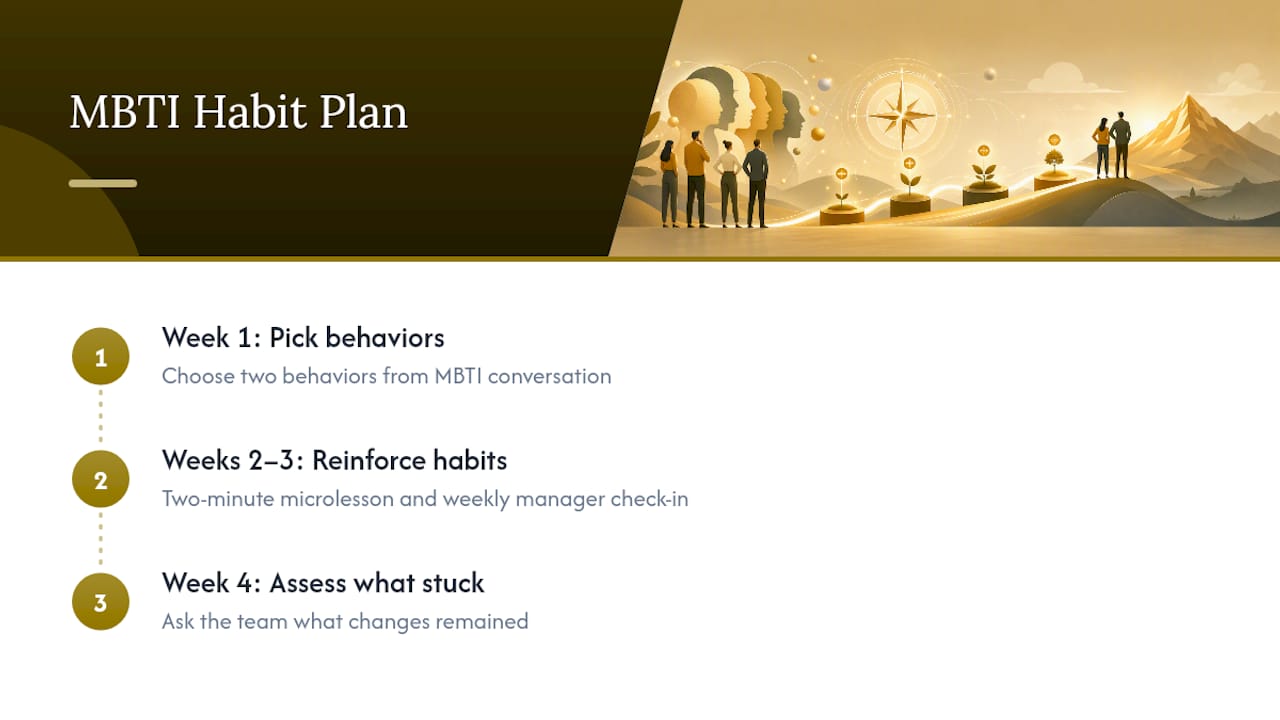
A simple four-week plan: pick two behaviors surfaced in your team's MBTI conversation, such as "send meeting pre-reads for Sensing-dominant teammates" and "build in reflection time before big decisions." Reinforce each with a two-minute microlesson and a manager check-in weekly. Four weeks later, ask what stuck.
Blending MBTI With DISC and the Big Five
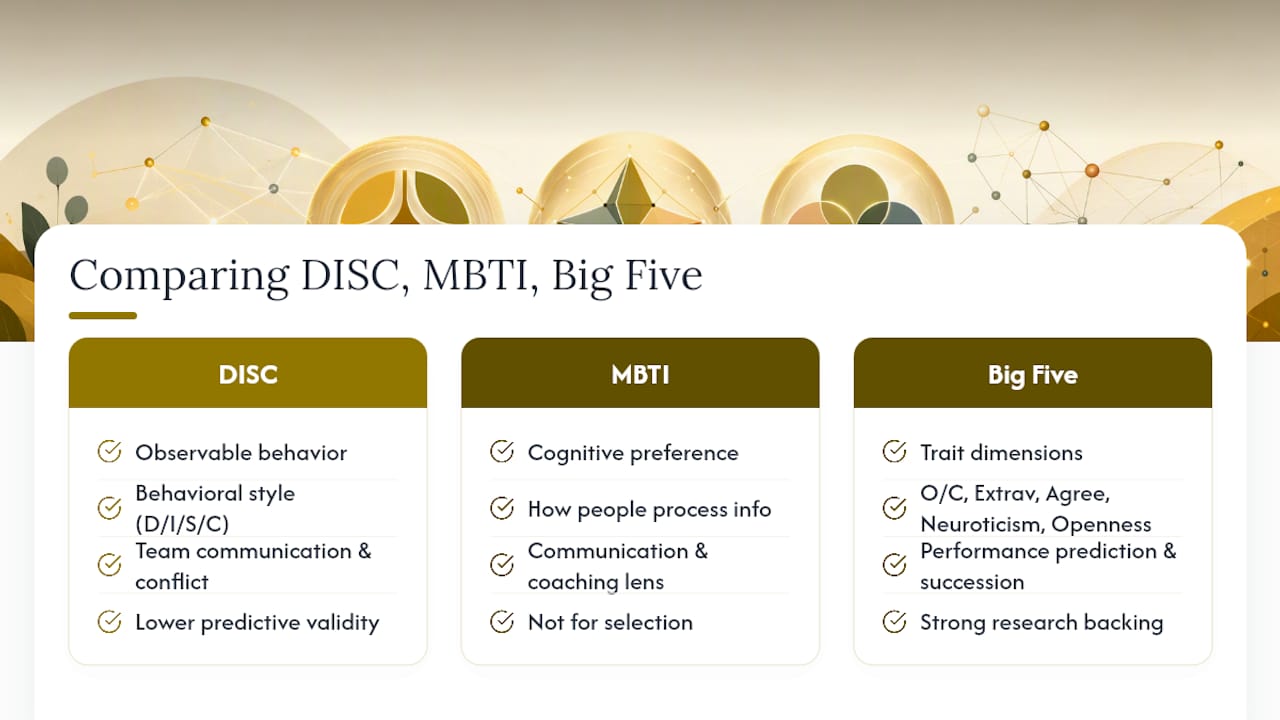
MBTI works best as part of a toolkit, not the whole toolkit. DISC and MBTI ask different questions: DISC measures observable behavioral style (Dominance, Influence, Steadiness, Conscientiousness), while MBTI measures cognitive preference, how someone processes information and makes decisions. A team member can show high "D" behavior on DISC in a crisis while still having a Feeling preference on MBTI that shapes how they'd rather deliver hard news. Using both gives you behavior and motivation in the same picture.
The Big Five (Openness, Conscientiousness, Extraversion, Agreeableness, Neuroticism) plays a different role entirely. It's the framework with the strongest research backing for predicting job performance and leadership emergence, which makes it the better tool if your organization genuinely needs predictive data, say, for succession planning discussions grounded in evidence rather than type folklore.
A practical way to combine them: use the Big Five or a validated 360-review process for anything touching performance evaluation or advancement conversations. Use MBTI and DISC for the softer, ongoing work, team communication norms, conflict de-escalation, coaching conversations. Keep the lines clear. Blending frameworks without blending their purposes is where most personality-at-work programs go wrong, layering three assessments on a team without ever deciding which one answers which question.
If your organization already runs DiSC or EQ assessments, don't scrap them for MBTI. Layer MBTI in as an additional lens for communication style specifically, and let the Leadership Style Assessment guide help you decide which instrument answers which question for your team.
What MBTI Looks Like When It Actually Works on a Team
The pattern in successful rollouts isn't complicated: managers who get real value from MBTI use it to solve a specific friction point, not as a generic team-bonding exercise.
Consider a common scenario in cross-functional teams: a product manager with a strong Intuition and Perceiving preference keeps clashing with an engineering lead who scores heavily Sensing and Judging. The product manager pitches ideas as open-ended possibilities; the engineering lead hears that as a lack of a real plan and pushes back hard in every meeting. Once both understand the pattern, sighting it as a preference mismatch rather than a personality conflict, the fix is almost mechanical: the product manager starts sending a one-page brief with concrete next steps before big discussions, and the engineering lead agrees to hold detailed critique until the second half of the meeting instead of the first five minutes.
Diverse, distributed teams see the biggest gains because MBTI gives people a shared vocabulary for differences that would otherwise get read as attitude or effort. A remote team spread across time zones, where some people process out loud on video calls and others need to draft written thoughts first, can use E/I preferences to redesign how decisions actually get made, less live debate, more async input windows before a final call.
None of this requires a big program. It requires one manager noticing a recurring friction point, naming it using MBTI vocabulary, and testing a small process change for a few weeks. The inspirational leader actions that actually move teams tend to be this specific, not sweeping culture initiatives.
Handling Skepticism About MBTI on Your Team
Someone on your team will roll their eyes at MBTI. That reaction is fair, and you shouldn't argue them out of it.
The strongest response isn't defending the instrument's validity, it's shrinking your claims about what it does. Don't say "this tells us who you really are." Say "this gives us shared language for how we prefer to communicate, and you can tell me where it's wrong." That framing invites correction instead of compliance, and it matches what the research actually supports: MBTI as a conversation starter, not a diagnostic truth.
Make participation genuinely optional. Forcing a skeptic through a personality workshop guarantees resentment and bad-faith answers that skew everyone's read on that person. Let them observe the first session, and offer a one-on-one option instead of the group format if that's what gets honest engagement.
Address the elephant in the room directly if someone brings up MBTI's weak scientific standing: acknowledge the research openly rather than oversell the tool. Say something like: "You're right that this doesn't predict performance well. That's exactly why we're not using it for reviews. We're using it because it gives us words for real differences in how we work." Skeptics usually soften once they realize you're not asking them to believe in the instrument, just to use its vocabulary for a specific, bounded purpose.
When to Revisit MBTI as Your Team Changes
Treat MBTI results as a snapshot of preferences at a point in time, not a permanent record. People change roles, take on new pressures, and shift how they show up at work, sometimes because of growth, sometimes because of burnout masking as a personality shift.
Revisit the conversation, not necessarily the formal assessment, whenever your team goes through a real structural change: a new manager, a merger of two teams with different norms, a shift to remote or hybrid work, or six months after a major reorg. You don't need to re-administer MBTI every time. Often a shorter working-agreements conversation, informed by what you already know about the team's preferences, does the job.
Full reassessment makes more sense on a longer cycle, once every year or two, or when someone's role changes dramatically enough that their working context is genuinely different. A software engineer promoted into people management is operating in a new environment; their preferences may express themselves differently in that context even if the underlying type hasn't shifted.
Keep a lightweight record of what agreements came out of each conversation, not the four-letter codes themselves, so you can track whether the norms you set actually held up. If the "send pre-reads" agreement from eight months ago quietly died, that's more useful information than any assessment score.
Cultural Context Matters More Than Most MBTI Guides Admit
MBTI was developed in a Western, largely American context, and its dichotomies carry cultural assumptions that don't translate cleanly everywhere. Extraversion, for instance, gets read as a leadership asset in a lot of American corporate culture. In several East Asian business contexts, a quieter, more Introverted communication style is often the cultural norm for authority figures, not a deviation from it.
Global managers should treat MBTI results as filtered through culture, not just individual psychology. A team member from a high context communication culture might score as Thinking on the assessment's logic but still deliver feedback far more indirectly than a low context, Feeling-scored colleague from a different background, because cultural norms around directness override the raw preference score.
Translation matters too. MBTI questions rely on idiom and self-reflection styles that don't always carry the same meaning once translated, and some cultures have different norms around self-disclosure on personality assessments generally, leading to score patterns that reflect survey-response culture as much as genuine preference.
The practical fix is the same one that solves most cross-cultural management problems: use MBTI results as a hypothesis to test through direct conversation, never as a conclusion. Ask team members from different cultural backgrounds how they'd want feedback delivered, rather than assuming a T or F score maps the same way it might for someone raised in a different communication culture.
Where This Actually Lands for Managers
The honest read on MBTI is that it's a communication tool wearing a scientific costume it never earned. A 1% predictive effect size on leadership behavior is not a reason to throw it out, it's a reason to stop pretending it measures something it doesn't.
What conventional MBTI training gets wrong is treating the four-letter type as the destination. The type is the opening line of a conversation, not the conclusion. Managers who get real value from this framework spend their time on the follow-up: the one-on-one clarifying question, the workshop where people negotiate actual working agreements, the four-week check-in on whether a behavioral change stuck.
Prioritize the parts of this article that involve watching behavior and adjusting your own approach, not the parts that involve labeling people. If you take one thing from the research, take this: pair every personality insight with an observable goal and a follow-up date. That habit does more for your team than getting anyone's exact type right ever will.
— Drew
Turn MBTI Insight Into a Habit With Leaderlyapp
Leaderlyapp is built for the exact gap this article keeps circling back to: managers get a personality insight, then have no system for turning it into lasting behavior change. Leaderlyapp's platform pairs self-assessments, including MBTI-style profiles alongside DiSC and EQ, with short microlessons and behavioral nudges that keep a specific action in front of a manager for weeks, not just for the length of one workshop.
For a team lead who just ran an MBTI conversation and doesn't want the insight to evaporate by next month, that follow-through is the whole point. Leaderlyapp's manager journeys track two or three behavioral commitments over time and surface analytics so HR and team leads can see whether coaching conversations are actually changing habits, not just generating a one-time "aha" in a meeting room. Pair that with resources like personalized leadership coaching for managers for a fuller picture of how ongoing development works in practice.
If you want to see how this looks for your own team, explore Leaderlyapp's approach to cultivating people centricity and request a walkthrough of how self-assessments connect to daily microlearning.
Sources
- How good is the Myers-Briggs Type Indicator for predicting leadership-related behaviors? — Frontiers in Psychology (2023)
- What self-awareness really is and how to cultivate it — Harvard Business Review