
Personalized leadership coaching is defined as a structured, one-on-one development process that tailors goals, feedback, and practice to a leader's specific context, strengths, and gaps. Unlike generic training programs, this approach, formally known as executive coaching in organizational psychology, drives measurable change in leadership behavior, emotional intelligence, and team performance. A 2023 meta-analysis confirmed that coaching outperforms traditional leadership seminars in senior-level behavior change. The benefits of personalized leadership coaching reach beyond the individual leader, reshaping team dynamics and organizational culture in ways that standard workshops simply cannot replicate.
1. Benefits of personalized leadership coaching on behavior and goal achievement
Personalized coaching produces statistically significant improvements in leader behavior, self-efficacy, and goal-directed action. The mechanism is straightforward: a coach works with a leader to identify specific behavioral targets, then holds that leader accountable through repeated cycles of practice and review. This is fundamentally different from a two-day seminar, where knowledge is delivered but rarely applied.
The behaviors most reliably improved through coaching include:
- Decision-making under pressure: Leaders learn to slow reactive thinking and apply structured frameworks.
- Communication clarity: Coaches surface language patterns that undermine authority or create confusion.
- Strategic thinking: Leaders practice zooming out from daily operations to evaluate longer-term priorities.
- Complex skill adoption: Coaching supports the transfer of newly learned skills into real leadership situations.
Accountability is the engine behind these gains. When a leader verbalizes a goal to a coach, the accountability built into sessions creates a social contract that e-learning and seminars cannot replicate. That commitment, revisited each session, drives follow-through.
Pro Tip: Bring a specific, real challenge to every coaching session. Leaders who arrive with concrete problems, not abstract goals, extract measurably stronger outcomes from each engagement.

2. How coaching builds emotional intelligence in leaders
Emotional intelligence is the single most cited factor in leadership effectiveness research, and coaching is the most direct method for developing it. The four components that coaching targets are self-awareness, empathy, emotional regulation, and social skill. Each one requires personalized feedback to improve, because leaders rarely see their own blind spots without an outside perspective.
Coaching helps leaders regulate stress responses before they damage team relationships. A leader who learns to pause before reacting to a missed deadline, for example, preserves psychological safety on the team. That safety directly predicts whether team members speak up, flag problems early, and collaborate across functions.
The impact on employee engagement is measurable. Leaders with higher emotional intelligence consistently produce stronger engagement survey scores and lower voluntary turnover on their teams. Understanding your own emotional intelligence leadership style is a practical first step before entering a coaching relationship.
Pro Tip: Request 360-degree feedback before your first coaching session. Seeing how colleagues rate your empathy and communication gives your coach a factual baseline, not just your self-perception.
3. Coaching reduces burnout and builds resilience
Executive coaching interventions reliably decrease burnout symptoms and improve resilience and work vigor in leaders. This finding matters because burnout in senior leaders cascades downward, affecting team morale, decision quality, and retention. Coaching addresses burnout at the source by helping leaders rebuild boundaries, prioritize recovery, and manage competing demands.
The table below summarizes coaching's documented effects on leader wellbeing:
| Wellbeing metric | Coaching effect |
|---|---|
| Burnout symptoms | Reliably decreased through boundary-setting and stress reframing |
| Work vigor | Increased through goal clarity and reduced role ambiguity |
| Resilience | Strengthened via iterative stress-response practice |
| Emotional regulation | Improved through self-awareness exercises and reflection cycles |
Resilience coaching works because it is iterative. A leader does not become resilient after one conversation. Real growth requires repeated cycles of action, reflection, and adjustment, and coaching provides the structure for exactly that process. The connection between resilience and sustained performance is well established: leaders who manage their own wellbeing consistently outperform those who do not over a multi-year horizon.
4. Impact on team dynamics and organizational outcomes
Leadership improvements do not stay contained to the individual. Coaching boosts cross-functional collaboration and communication, which shows up in team performance metrics within months of a coaching engagement beginning. The pathway is direct: a more self-aware leader communicates more clearly, resolves conflict faster, and creates conditions where team members perform at a higher level.
The table below contrasts individual leader outcomes with team and organizational outcomes from coaching:
| Outcome level | What changes |
|---|---|
| Individual leader | Decision-making, communication, self-awareness, resilience |
| Team dynamics | Engagement scores, psychological safety, conflict resolution speed |
| Organizational | Leadership pipeline strength, cross-department collaboration, retention |
Organizations that invest in coaching at the manager level, not just the executive level, build stronger leadership pipelines. Managers who receive personalized development are more likely to stay, more likely to develop their own direct reports, and more likely to model the behaviors that attract high performers. Coaching also reduces voluntary turnover by improving the quality of the manager-employee relationship, which research consistently identifies as the primary driver of retention.
The right time to invest in coaching is before a leader struggles visibly, not after. Proactive coaching during transitions, such as a promotion to a first management role or a move into a cross-functional leadership position, produces the strongest outcomes.
5. Why personalized coaching outperforms other development methods
Coaching is not therapy, mentoring, or training. Each serves a different purpose, and conflating them leads to mismatched expectations. Training delivers knowledge. Mentoring provides perspective from experience. Therapy addresses psychological health. Coaching converts existing knowledge and capability into sustained behavioral change through personalized, context-specific practice.
The most effective use of coaching is as a reinforcement layer following structured training programs. A leader who attends a communication skills workshop and then works with a coach to apply those skills in real situations retains and applies far more than a leader who attends the workshop alone. Knowledge retention through spaced, personalized practice is significantly stronger than one-time instruction.
The features that make coaching distinctively effective include:
- Personalization: Every session addresses the leader's actual challenges, not a generic curriculum.
- Iterative practice: Real behavioral change requires repeated cycles of action, reflection, and adjustment.
- Accountability: A coach holds leaders to goals they have verbalized, creating follow-through that self-directed learning rarely achieves.
- Working alliance: The trust between coach and leader is itself a predictor of coaching success. A strong relationship enables honest feedback.
Pro Tip: Practice the specific behavior your coach identified between sessions, not just during them. True growth occurs in the moments between conversations, when you apply new approaches under real pressure.
6. How coaching improves self-awareness and decision-making
Self-awareness is the foundation of every other leadership skill, and it is the area where coaching produces the fastest measurable gains. Coaching clients report better decision-making, stronger resilience, and healthier workplace relationships as direct outcomes of the coaching process. These are not soft outcomes. They translate into fewer costly errors, faster conflict resolution, and stronger team trust.
Decision-making improves because coaching surfaces the assumptions and emotional reactions that distort judgment under pressure. A leader who understands their own cognitive patterns, such as a tendency to avoid conflict or to over-rely on data before acting, can deliberately correct for those patterns in high-stakes moments. That kind of feedback-driven self-correction is what separates leaders who plateau from those who keep developing.
Coaching also improves how leaders are perceived by their teams. Studies find increased authentic leadership and change-oriented behavior in leaders who engage in coaching, as rated by colleagues and direct reports. That external validation matters because leadership effectiveness is ultimately measured by its impact on others, not by self-report.
7. What leaders need to do to get the most from coaching
Coaching success is not automatic. Success requires leader engagement, specific goal setting, openness to feedback, and consistent practice between sessions. Leaders who treat coaching as a passive experience, showing up without preparation and waiting to be told what to do, consistently underperform compared to those who arrive with clear intentions.
The highest-ROI coaching engagements share four characteristics. The leader brings specific, measurable goals. The leader is genuinely open to hearing uncomfortable feedback. The leader practices new behaviors in real situations between sessions. And the leader treats the coaching relationship as a partnership, not a service transaction.
Organizations also play a role. Coaching works best when it is integrated into a broader leadership development architecture that includes structured training, peer learning, and ongoing feedback. Coaching alone, without supporting systems, produces slower and less durable results than coaching embedded in a deliberate development program.
Key takeaways
Personalized leadership coaching drives sustained behavior change, stronger team dynamics, and measurable organizational outcomes because it combines accountability, personalization, and iterative practice in ways that no other development method replicates.
| Point | Details |
|---|---|
| Behavior change is measurable | Coaching produces statistically significant gains in goal-setting, communication, and decision-making. |
| Emotional intelligence drives team results | Leaders who develop self-awareness and empathy through coaching produce higher engagement and lower turnover. |
| Burnout reduction is documented | A 2023 meta-analysis confirms coaching decreases burnout symptoms and increases work vigor in leaders. |
| Coaching reinforces training | Coaching converts workshop knowledge into sustained behavioral change through personalized practice. |
| Leader engagement determines ROI | Leaders who bring specific goals and practice between sessions achieve the strongest development outcomes. |
What I've learned watching coaching work in the real world
The most common misconception I encounter is that coaching is remedial. Leaders assume it is something you do when you are struggling, not something high performers pursue deliberately. That belief costs organizations enormously. The leaders I have seen benefit most from coaching are already competent. They use coaching to sharpen the edges that separate good from genuinely excellent.
The second thing I have noticed is that leaders underestimate how much the coach-leader relationship matters. A technically skilled coach who does not connect with a particular leader's communication style will produce mediocre results. The working alliance is not a soft factor. It is a primary predictor of whether a leader will be honest enough in sessions to do real work.
My honest observation after watching coaching outcomes across many leadership contexts is this: leaders who commit to coaching with specific goals and genuine openness to feedback change faster than any training program can produce. The ones who treat it as a box to check get very little from it. Coaching rewards the leaders who are already curious about their own blind spots. If you are reading this article, you are probably already that kind of leader.
— Drew
How Leaderlyapp supports personalized leadership development
Leaderlyapp delivers the kind of personalized, continuous leadership development that coaching research consistently identifies as most effective.
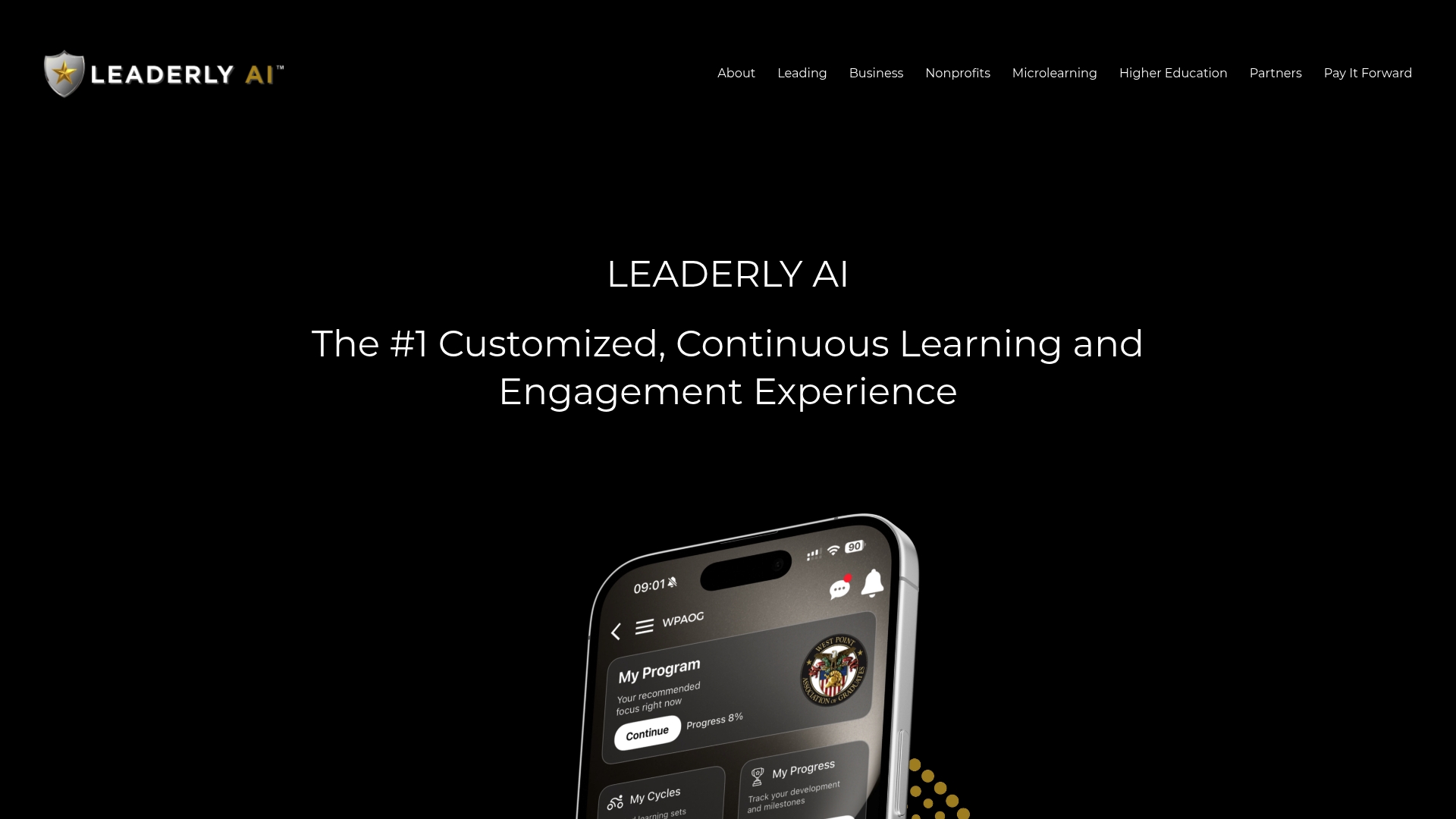
The platform uses machine learning to tailor microlessons and behavioral exercises to each leader's specific development stage, replicating the personalization that makes one-on-one coaching so effective at scale. Every leader receives a developmental blueprint that evolves as their skills grow, with real-time feedback built into each exercise. Leaderlyapp's approach is grounded in behavioral science, making it a practical complement to formal coaching engagements. Explore how Leaderlyapp supports people-centric leadership skills and start building the habits that sustained coaching outcomes depend on.
FAQ
What are the main benefits of personalized leadership coaching?
Personalized leadership coaching improves leadership behavior, emotional intelligence, resilience, and team dynamics through tailored, accountability-driven development. A 2023 meta-analysis confirms it outperforms traditional seminars in producing sustained behavior change.
How does coaching differ from leadership training?
Training delivers knowledge; coaching converts that knowledge into sustained behavioral change through personalized, iterative practice. Coaching works best as a reinforcement layer following structured training programs.
How long does it take to see results from executive coaching?
Behavioral improvements rated by colleagues and direct reports typically emerge within the first few months of a coaching engagement. Leaders who bring specific goals and practice between sessions see results faster.
Can coaching reduce burnout in leaders?
Yes. Executive coaching interventions reliably decrease burnout symptoms and improve work vigor, according to a 2023 meta-analysis published in Frontiers in Psychology. Coaching addresses burnout by helping leaders rebuild boundaries and manage competing demands.
What makes a coaching engagement successful?
Success requires the leader to bring specific goals, remain open to feedback, and practice new behaviors between sessions. The trust and working alliance between coach and leader is also a primary predictor of coaching effectiveness.