
Front line leader training prepares the people closest to your daily work, such as supervisors, team leads and first-time managers, to coach, communicate, give feedback and run a shift or a team well. The programs that work are short, practical and tied to the job, and they keep going after the first session. Below you will find the skills to build, the evidence for why it matters, how to deliver it to hundreds of leaders, and how to measure whether it paid off.
TL;DR
- Front line leaders shape engagement more than almost anything else. Gallup's research attributes at least 70% of the variance in engagement scores to managers.
- Training pays off in people terms. Gallup found frontline supervisors who trained in the past year were 79% more likely to be engaged and 19% less likely to feel burned out.
- Most supervisors are under-trained. Only 45% of surveyed frontline supervisors took part in supervisor training in the past year.
- One workshop is not enough. Pair short formal learning with real work, coaching and repetition (the 70-20-10 idea).
- Measure behavior and business outcomes, not course completions.
Table of Contents
- What front line leader training is
- Why it matters: the numbers
- What a front line leader does day to day
- Skills to build first
- Why one-off training fades, and what to do instead
- How to deliver front line leader training at scale
- A simple 90-day plan
- Measuring whether it worked
- Our perspective
- Putting it into practice with Leaderly
- FAQ
- Sources
What front line leader training is
A front line leader sits one or two layers above the people who do the core work. BCG describes these managers as often new to management, running core activities, directly affecting customer interactions, and serving as a talent pipeline for senior roles. Think shift supervisors, store and branch managers, team leads in a call center, charge nurses, crew foremen, and line supervisors in a plant.
Front line leader training is the structured development of those people. It usually covers a handful of areas:
- Moving from doing the work to leading others who do it.
- Communicating clearly, including difficult conversations.
- Coaching and giving feedback.
- Planning, delegating and prioritizing.
- Managing conflict and keeping a team engaged.
- Handling the people-side basics of the job, from onboarding to performance issues.
What separates good programs from forgettable ones is not the topic list. It is whether the learning fits the rhythm of a front line job, where leaders are on the floor, on the road or on a rotating schedule and cannot sit in a classroom for a week.
Why it matters: the numbers
Front line leaders are often promoted because they were excellent at the work, not because anyone taught them to lead. Gallup scientist Jim Harter has said that organizations routinely promote their best individual contributors into management, and he estimates that approach gets it right only about 30% of the time.
The stakes are high because of what managers influence:
- Gallup's research found that managers account for at least 70% of the variance in employee engagement scores.
- A 2020 SHRM survey found that 84 percent of U.S. workers say poorly trained people managers create a lot of unnecessary work and stress. Fifty-seven percent say managers at their workplace could benefit from training on how to be a better people manager.
- Gallup's 2025 survey of 1,214 U.S. frontline supervisors found that only 45% had trained in the past year, 32% had trained but not recently, and 23% had never taken part in supervisor training.
- In that same research, supervisors who trained in the past year were 79% more likely to be engaged, 19% less likely to feel burned out very often or always, and 11% less likely to be actively looking for a new job.
The last point deserves attention. Training does not only help the people the supervisor leads. It helps the supervisor stay, stay engaged and stay well.
Organizations also know there is a gap. In Gallup's 2025 employee development report, CHROs named leadership and management skills (84%) as the most important skills their organizations need to develop, yet fewer than half of U.S. employees (45%) took part in training to build new skills for their current job in 2024.

What a front line leader does day to day
The role differs by industry, but the daily work follows a common pattern. Front line leaders typically:
- Start the shift or the week with clarity. They set priorities, assign work and make sure people know what good looks like.
- Stay visible. They check in, answer questions and spot problems early rather than waiting for a report.
- Coach in the moment. A two-minute conversation after a task often teaches more than a quarterly review.
- Handle people issues. Scheduling, attendance, conflict, performance concerns and recognition all land on them first.
- Connect up and down. They translate strategy into daily tasks and carry honest feedback from the floor back to senior leaders.
- Keep the work moving. Quality, safety, customer interactions and output depend on their decisions.
That list is a practical way to design training. If a skill does not show up in a typical week, it probably does not belong in the first version of your program.
Skills to build first
Long curricula overwhelm new supervisors. Start with the skills that show up every day.
Communication and feedback
The Harris Poll survey of 1,001 U.S. hiring decision-makers, conducted for Express Employment Professionals in late 2024, points to a clear gap. While 86% of hiring managers feel supervisors have the tools they need, only 35% offer training on giving constructive criticism, 30% on discussing performance issues and 27% on setting professional boundaries. Seventy-two percent concede their companies should do more to support supervisors.

Those three topics are the uncomfortable ones, and they are where new leaders most often stall. Practice with realistic scenarios, not lectures.
Coaching
Coaching turns a leader from a task-assigner into a developer of people. It is also the skill that makes the rest of the training stick, because coaching conversations are where new behaviors get reinforced. If you want a deeper look at the mechanics, these coaching skills for leadership readiness are a useful place to build the habit.
Delegation and prioritization
New supervisors often keep doing the work themselves because it feels faster. Teaching them to delegate with clear expectations frees up time to lead. Our guide to improving delegation skills faster is a good starting point for that module.
Foundations of leadership
Before tactics, leaders benefit from a simple model of what leadership is. We outline three foundational pillars of leadership that work as an orientation for first-time leaders.
Engagement habits
Recognition, regular one-on-ones and genuine curiosity about people are small, repeatable actions. Our piece on leadership traits that drive engagement shows how those habits add up.
Self-awareness
Leaders who understand their own style and how others experience it adjust faster. Self-assessments of personality, emotional intelligence and communication style give new leaders a shared vocabulary and a starting point for development.
Why one-off training fades, and what to do instead
A two-day workshop feels like progress. A month later, the supervisor is back on the floor and old habits return. BCG's advice is to move away from "training" as the solution. It recommends understanding what front line leaders do every day, week, month and year, embedding development into their routines, and addressing the context they work in.
The 70-20-10 model gives a useful frame. AEM describes it as roughly 70% of learning from challenging experiences and problem solving, 20% from mentoring, coaching and learning from others, and 10% from formal learning. The takeaway for program design is to connect all three and support leaders as they apply what they learn in the flow of work.
In practice, that means:
| Part of the model | What it looks like for a front line leader |
|---|---|
| Experience (about 70%) | A stretch task, such as running the pre-shift huddle or leading a small improvement project, with a clear behavior to practice |
| Others (about 20%) | A manager who checks in on the practice, a peer group, or a mentor from another team |
| Formal learning (about 10%) | Short lessons, scenarios and assessments that introduce one idea at a time |
Our own research-minded reading of this is simple: the formal part should be small enough to fit in a break, and the rest should be built around the job. For more on why programs stall, see why leadership training fails at scale.
How to deliver front line leader training at scale
The hardest part is not designing a good program. It is reaching hundreds or thousands of leaders across shifts and locations without pulling them off the floor.
Keep each learning moment short
Microlessons of a few minutes fit between tasks and on a phone. They also support spaced repetition, which brings an idea back before it fades. Pair every lesson with one action the leader can take on their next shift.
Mix formats deliberately
A real-world example is Titan America's BUILD program, as reported by HR Tech Outlook. It was a six-month, six-module curriculum blending in-person training with hands-on learning and on-the-job reinforcement. Each cohort had 80 frontline leaders, Wave 1 graduated 81 leaders, and the program reported a 39% NPS and a cost of $244 per participant. The lesson is not to copy the format but to note the structure: spread out over months, practical, and reinforced at work.
Involve the manager of the manager
Training lands better when the leader's own boss expects the new behavior and asks about it. Riverside Public Utilities saw this in its supervisor program: participants who received high manager support back on the job achieved an ROI of 113%, against 42% for the program overall.
Make it a program, not an event
Our walkthrough of eight steps to an effective leadership development program covers goals, audience, content, delivery and review. If your front line population is large, also read how to reduce the leadership skills gap across the organization.
Include everyone who leads
Leadership does not start at the title. Team leads, senior operators and trainers influence peers daily. Opening development to them builds your pipeline before the promotion happens, a point BCG makes when it calls front line managers a talent pipeline.
A simple 90-day plan
If you are starting from nothing, this sequence is realistic for a small team and expandable later.
- Weeks 1 to 2: Listen. Shadow a few supervisors for a shift. Note where time goes and where conversations break down. Ask their managers what a strong supervisor does differently.
- Weeks 2 to 3: Pick three behaviors. For example: hold a short daily huddle, give one piece of specific feedback per week per person, and run a monthly one-on-one.
- Weeks 3 to 4: Baseline. Use a self-assessment and a short pulse survey of the team to see where you are.
- Weeks 4 to 10: Deliver in small steps. One microlesson and one practice action each week, with a manager check-in every two weeks.
- Weeks 10 to 12: Review. Re-run the pulse, gather stories and decide what to add next.
Keeping the first cycle small gives you real data to take to finance and operations leaders.
Measuring whether it worked
Completion rates tell you who clicked, not who changed. Look at three layers:
- Behavior: Are leaders holding the huddles and one-on-ones? Manager observation and short team surveys can tell you.
- People outcomes: Engagement, turnover and absenteeism on the teams of trained leaders compared with similar teams.
- Business outcomes: Quality, safety, customer satisfaction and productivity.
Case studies show what a rigorous measurement can look like. Training Industry reported that Riverside Public Utilities' supervisor program produced a 42% ROI over 14 months, meaning $1.42 returned for each $1 invested. A separate Training Industry case study reported that Calendly's customized leadership training yielded an estimated 29% improvement in performance and an estimated 706% ROI per participant three months after training. Those are results from specific organizations, not promises, but they show that the effect can be measured when you plan for it up front.
For a practical framework, see our guides on leadership training ROI metrics and leadership training analytics.
Our perspective
We built Leaderly around a simple belief: leadership development should reach every employee, not only the managers who get a budget line.
Front line leaders are the clearest case. They have the least time, the most people depending on them, and often the least formal preparation. A binder or a one-day course does not fit their week. Frequent, short, personalized lessons do, especially when each one ends with something they can try on the job.
That is why our approach combines behavioral science, microlearning and machine learning. The lessons are designed to adapt to each person's journey, and the exercises are designed to build habits rather than deliver information. HR teams and educators can customize the content and learning journeys, then see analytics on how people are engaging, so a program can scale without losing its relevance to the people in it.
If you take one thing from this article, let it be this: make the next small action easy, and make it repeat.
Drew
Putting it into practice with Leaderly
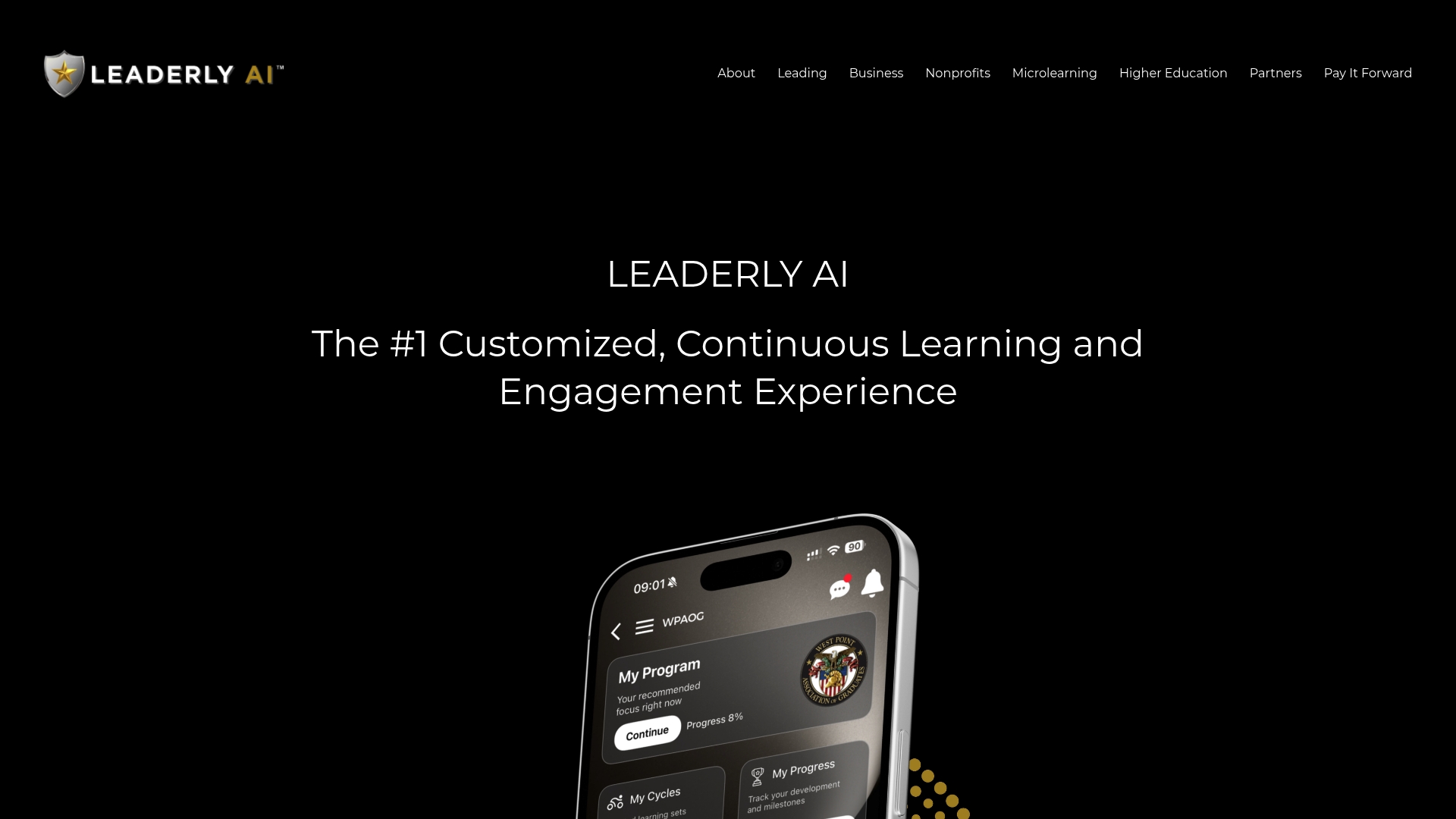
If you want to give front line leaders short, practical development that fits into their day, Leaderly AI is built for that. It is a mobile-first platform that delivers personalized microlessons, habit-building exercises, self-assessments (including DiSC, EQ and MBTI), surveys, simulations and analytics dashboards for HR teams. Learning journeys can be customized for your organization, so the content reflects the situations your supervisors face.
Nonprofits can see how it works for volunteers and staff on our nonprofit page, and colleges can explore Leaderly AI for higher education. For a microlearning overview, visit our microlearning page.
FAQ
What should a frontline leader do?
A frontline leader sets priorities, assigns work, coaches people in the moment, handles scheduling and people issues, and keeps quality and customer interactions on track. They also pass honest feedback from the floor up to senior leaders. BCG notes that these managers run core activities and have a major impact on productivity, engagement, attrition and customer satisfaction.
What is the 70-20-10 rule for leadership development?
It is a model that assigns about 70% of learning to challenging experiences and problem solving, 20% to mentoring and coaching, and 10% to formal learning, according to AEM. For front line leaders, it means pairing short lessons with real tasks and regular manager check-ins instead of relying on a single course.
How long should front line leader training last?
There is no single right length, but the examples above point toward spreading learning over weeks or months rather than a single event. Titan America's program ran six months, and short weekly microlessons with on-the-job practice can fit into a front line schedule. Start with three behaviors and a 90-day cycle, then expand.
How do you know if front line leader training is working?
Track behavior first, such as whether leaders hold huddles and one-on-ones, then team engagement and turnover, then business results such as quality and safety. Compare trained teams with similar untrained teams where you can, and gather manager observations alongside survey data.
Sources
- Employees Want a Lot More From Their Managers (Gallup)
- Survey: 84 Percent of U.S. Workers Blame Bad Managers for Creating Unnecessary Stress (SHRM)
- How Frontline Leaders Can Deliver Breakout Performance (BCG)
- Addressing the Barriers Blocking Employee Development (Gallup)
- The Supervisor Crisis and What Employers Must Do Now (Express Employment Professionals)
- Co-Authoring Success: How L&D Partnered with AI and HR (HR Tech Outlook)
- When Good Frontline Workers Make Bad Supervisors (Gallup)
- Gallup Scientist Says Most Companies Misread Culture (Forbes)
- Riverside Public Utilities: Supervisor Training ROI Case Study (Training Industry)
- Measurement Strategies: An ROI Case Study at Calendly (Training Industry)
- Leadership Development in Manufacturing: Training Alone Is No Longer Enough (AEM)
- Coaching Skills: Proven Ways to Build Leadership Readiness