Board leadership development is the ongoing work of helping board members understand their governance role and lead well in it. It starts with a solid orientation and continues with short, regular learning tied to the decisions your board actually faces. The strongest programs treat it as a habit built into every meeting. They don't treat it as a one-day event.
This guide covers what nonprofit board training should include, how to design a program for new and experienced members, which formats keep learning going year-round, and how to tell whether it is working.
TL;DR
- Board development is different from general leadership training: boards govern through strategy, policy and oversight. They don't run daily operations.
- Good programs have two parts: a thorough initial orientation and ongoing learning in many forms.
- Core content is fiduciary duties (care, loyalty, obedience), the board-staff relationship, finances, conflicts of interest and mission oversight.
- Short learning moments at every meeting often beat one long annual session.
- Measure progress with a board self-assessment and by checking how actively the board monitors its own performance.
Table of Contents
- What board leadership development means
- What nonprofit board training should cover
- How to design a board development program
- Formats that keep learning continuous
- Support your board and your wider team
- How to tell whether board training is working
- Who holds a nonprofit board accountable?
- FAQ
- Sources
What board leadership development means
Leadership training usually builds an individual's skills: communication, delegation, coaching. Board leadership development builds the capacity to govern. Harvard's professional education team describes the contrast clearly: executive leadership manages daily operations and implements strategy, while board service provides high-level governance, strategic direction and risk oversight.
That difference shapes what you teach. A board member who is a gifted manager can still struggle if they drift into operations or misunderstand their legal duties. SHRM's leadership material also separates developing an individual leader from building an organization's capability to perform the leadership tasks its mission requires. A board needs both: capable individuals and a group that works well together.
The mindset matters as well. Board members who treat learning as a lifelong habit tend to adapt more easily to new governance challenges. If you want a primer on that attitude, this piece on developing a growth mindset is a good starting point for volunteers and staff alike.

What nonprofit board training should cover
Most searches for nonprofit board training come down to one question: what do members need to know? Research and practitioner guidance agree on a core list.
Fiduciary duties
The University of Arizona Cooperative Extension's orientation guide says all board members share three duties: care, loyalty and obedience. Care means informed, thoughtful participation. Loyalty means acting in the organization's best interests and avoiding conflicts and personal gain. Obedience means adhering to the mission, bylaws and applicable law.

The independent-sector workbook published by the National Center for Family Philanthropy adds a practical point: individual members can be personally liable for breaches of fiduciary duty. Volunteer immunity laws give broad protection for acts within the scope of a volunteer's responsibilities, but they cannot prevent lawsuits. Questions about liability, indemnification and insurance in your state belong with your organization's attorney.
Governance versus management
The same Arizona guide explains that the board governs through strategy and policy rather than operational management. It approves the mission, strategic plan and major policies, evaluates progress, and hires, supports and evaluates the executive director. Many board problems trace back to blurred lines here, so spend real time on it.
Organization-specific knowledge
The National Council of Nonprofits offers a sample orientation outline that goes well beyond theory. It includes the mission and history, biographies of the board and key staff, the conflict-of-interest policy and questionnaire, recent financial reports and audits, bylaws, the IRS determination letter, a summary of D&O insurance, the whistleblower policy, committee charters and the year's meeting calendar.
Gaps boards report
A study by Judith Millesen and Joanne Carman used data from 800 board members across 42 performing arts nonprofits. It found boards wanted better training and orientation, clearer roles, tailored recruitment and time to build collegiality. Notice that two of those five needs are about relationships, not legal knowledge. Build time for both into your plan.
How to design a board development program
Board development has two main pieces, according to the Aspen Institute guide by Bobbie Good: the initial orientation and ongoing trainings of various forms. It also notes that supporting continuous learning is a defining trait of boards that excel. Here is a workable sequence.
- Write a clear job description. The NCFP workbook says every board member should have one, and that orientation should set expectations for board performance and fiduciary responsibility.
- State giving and fundraising expectations early. The National Council of Nonprofits recommends sharing a tailored position description that covers personal giving and fundraising. It also suggests the board chair make a follow-up call after someone agrees to serve and before their first meeting.
- Run a real orientation. Use the outline above, and consider a visit to see the mission in action. Invite the whole board so veterans get a refresher. That reinforces a culture of continuous learning.
- Pair new members with a mentor. Mentoring works best inside a structured onboarding process, and a board mentor can introduce the culture, people and issues of the organization.
- Schedule learning into the year. Decide in advance which topics each meeting will cover, and leave room for urgent issues.
- Review and adjust annually. Ask what members still don't understand and update the plan.
Orientation does help. A Walden University dissertation interviewed five board members of human service nonprofits in Santa Rosa, California. They reported greater knowledge of their roles and more confidence after an initial orientation. It is a small study, but it matches what many chairs see in practice.
Different tracks for new and experienced members
New members need the basics and the organization's story. Experienced members need something different: fresh issues, harder case discussions and chances to lead. Give veterans roles as mentors, committee chairs or session facilitators. Teaching is one of the best ways to deepen your own understanding.
Formats that keep learning continuous
A single annual retreat is easy to schedule and easy to forget. The Aspen guide describes "developmental moments": 10 to 15 minute periods built into each monthly board meeting for education. It also lists retreats and outside workshops as options.
A Harvard Law School corporate governance article describes a similar shift in board education: away from episodic sessions and toward ongoing briefings on critical issues at every meeting. It suggests mixing presentations from staff and outside experts, with peer discussion such as roundtables. That article addresses company boards, but the principle carries over to nonprofits.
Here is how common formats compare.
| Format | Best for | Watch out for |
|---|---|---|
| Orientation session | New members, shared baseline | Forgotten within months if nothing follows |
| 10 to 15 minute meeting segment | Steady reinforcement, current issues | Needs a named owner and a calendar |
| Annual retreat | Strategy, relationship building | One-off impact without follow-up |
| Mentoring pairs | Culture and context | Mentors need a simple guide |
| Self-paced or mobile microlearning | Busy volunteers, flexible timing | Needs a reason to return, such as discussion at meetings |
What about the 70-20-10 rule?
The 70-20-10 model came out of research by Morgan McCall, Michael Lombardo and Robert Eichinger at the Center for Creative Leadership. It holds that people get roughly 70% of their learning from job experiences, 20% from other people and 10% from formal education. Treat it as a rough guide to where development happens, not a precise formula.
For a board, the translation is useful. The "70" is the real work: reviewing the budget, chairing a committee, taking part in a CEO evaluation. The "20" is mentoring, peer discussion and feedback. The "10" is the orientation and training sessions. If your program is all formal training, add stretch roles and conversations.
Our perspective on board development
We see the same pattern in the organizations we work with: learning that happens once rarely changes behavior. Leadership grows through small, repeated actions, which is why we built Leaderly around behavioral science, frequent microlessons and personalization that adapts to each person's journey.
For a board, that means moving from an annual training day to a rhythm. A few minutes of focused learning before each meeting, a practical exercise tied to a real decision, and a self-assessment that shows each member where to grow. Volunteers are busy. Short, mobile-friendly learning fits their lives, and it keeps governance on their minds between meetings.
We also believe leadership development shouldn't be reserved for managers. Board members, staff, volunteers and emerging leaders all shape a nonprofit's culture. When all of them build leadership habits together, the board and the organization pull in the same direction.
Drew
Support your board and your wider team
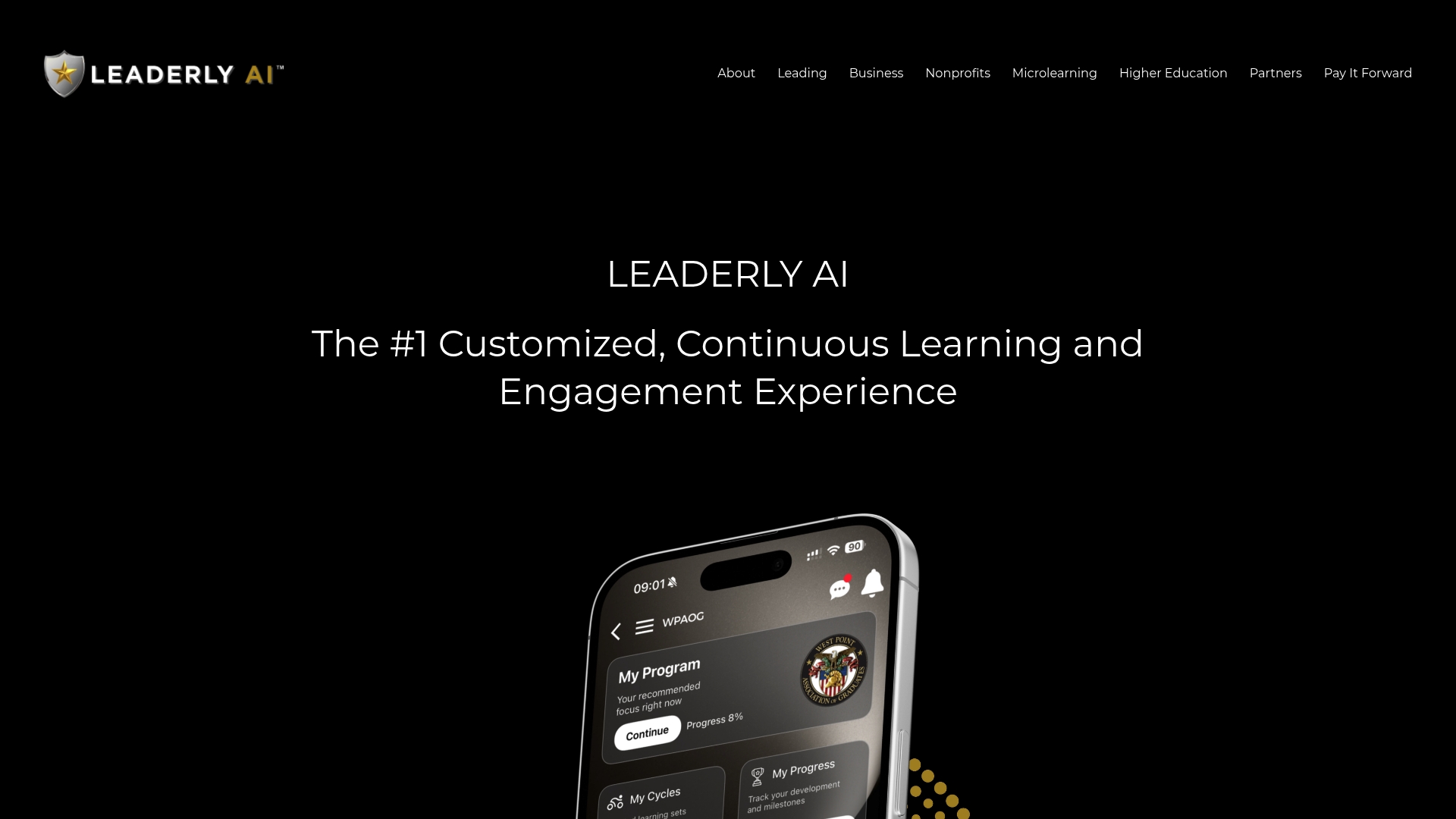
Board members don't govern in isolation. They depend on staff and volunteers who understand the mission and lead well day to day. Leaderly AI for Nonprofits is a mobile-first platform that delivers personalized microlessons, habit-building exercises, self-assessments (including DiSC, EQ and MBTI) and analytics dashboards. Organizations can tailor customizable learning journeys for the people they serve. You can see how it works on the Leaderly AI for Nonprofits page.
If you're planning a pilot, our guide to scalable nonprofit leadership development explains how a cohort-based rollout can work, and our article on volunteer leadership training covers what to teach. When you're ready to talk, get started with Leaderly.
How to tell whether board training is working
Many boards never check. The Urban Institute's study by Francie Ostrower found that fewer than one-fifth of respondents said their board very actively monitors its own performance, and 45 percent said their boards are not even somewhat active in doing so. A simple measurement habit puts you ahead.
- Run a board self-assessment each year. The Millesen and Carman study used a self-assessment covering nine areas: mission, strategy, funding and public image, board composition, program oversight, financial oversight, CEO oversight, board structure and meetings. You can borrow that structure.
- Compare year over year. Look for movement in the areas you trained on.
- Track participation. Watch attendance at learning sessions and how many members take on committee or mentoring roles.
- Ask members directly. Short surveys after each session show what is clear and what isn't.
- Watch behavior in meetings. Fewer operational detours and sharper financial questions are good signs.
Who holds a nonprofit board accountable
In the United States, accountability comes from several directions. According to the Urban Institute report, state attorneys general typically handle investigation and litigation, and the IRS may revoke tax exemption for noncompliance with federal tax law. The board itself retains ultimate responsibility for the organization and its fiduciary obligations. That is why training on duties, conflicts of interest and oversight is a core part of board development and not an optional extra.
FAQ
What does a leadership board do?
A nonprofit board sets direction and oversees the organization. It approves the mission, strategic plan and major policies, monitors progress, and hires, supports and evaluates the executive director. It leaves day-to-day operations to staff.
What is the 70-20-10 rule for leadership development?
It is a model suggesting that most development comes from on-the-job experience (70%), then from other people (20%) and last from formal training (10%). It is a guide, not a strict ratio. For boards, it means pairing training with real responsibilities and peer conversations.
How often should a board do training?
Build it into the regular rhythm. Many boards pair an orientation for new members with short learning segments at each meeting, plus an annual review of what to cover next. The Aspen guide suggests 10 to 15 minutes per monthly meeting.
Who holds a nonprofit board accountable?
State attorneys general typically investigate and litigate, and the IRS can revoke tax exemption for federal tax-law violations. The board also holds ultimate responsibility itself, and members can be personally liable for breaches of their duties.
Sources
- Board Readiness: Positioning Yourself for Board Service, Harvard
- Leadership Development: Growing Talent Strategically, SHRM and SIOP
- Serving with Purpose: A Nonprofit Board Orientation Guide, University of Arizona Cooperative Extension
- Steering Your Board Toward Good Governance and Ethical Practice, NCFP
- Board Orientation, National Council of Nonprofits
- Building Capacity in Nonprofit Boards, Millesen and Carman
- Successful Boards, Sustainable Organizations, Aspen Institute
- Nonprofit Board Members' Perceptions of the Initial Orientation, Walden University
- Enhancing Board Performance through Dynamic Board Development, Harvard Law School Forum
- The 70-20-10 Model for Learning and Development, Training Industry
- Boards as an Accountability Mechanism, Urban Institute
- Developing Your Growth Mindset Into A Lifelong Advantage