
Start with a structured cohort program or an executive certificate that pairs coursework with applied, on-the-job projects, then anchor it to a written succession plan. Free webinars and one-off workshops build awareness, but they rarely change behavior on their own. If you need something that scales across a whole staff without a big price tag, a microlearning cohort model, built for continuous practice, is worth a look.
TL;DR:
- Effective nonprofit leadership training should include applied projects, ongoing coaching, and behavior assessments to ensure lasting skill development.
- Microlearning models paired with manager support and regular evaluations foster habit formation and reduce dropout rates in leadership programs.
- Selecting a program requires verifying how it measures behavioral change, tracks applied projects, and aligns with organizational priorities before enrollment.
- Building a leadership pipeline benefits from integrating succession planning with development efforts, focusing on internal promotions and documenting tacit knowledge.
- Investing in scalable, cohort-based programs like Leaderlyapp can develop skills across staff levels and improve retention without the high costs of university certificates.
Table of Contents
- Types of Leadership Training Programs for Nonprofits
- What Should Nonprofit Leadership Training Actually Deliver?
- Design Features That Predict Whether Training Actually Sticks
- How Do You Choose the Right Leadership Program?
- Building a Leadership Pipeline Through Succession Planning
- A Scalable Model: Cohorts Plus Microlearning
- Funding and Budgeting for Leadership Development
- Why Sponsoring One Cohort Now Beats Waiting for the Perfect Plan
- Try Leaderlyapp for Nonprofit Leadership Training
- Sources
- FAQ
Types of Leadership Training Programs for Nonprofits
Not every nonprofit needs the same format, and picking the wrong one wastes both money and staff patience. Free, self-paced courses work fine for exposing frontline staff to basic management concepts, but they rarely change how someone actually leads a team. Paid certificate programs, often run through universities or sector associations, go deeper and carry credibility with boards, though they usually run several months and cost more per participant. Cohort programs sit in the middle: a defined group moves through content together over 8 to 12 weeks, often blending virtual sessions with applied assignments tied to real organizational goals.
- Free/self-paced courses: good for broad staff awareness, weak on behavior change
- University certificates: strong credibility, longer timelines, higher cost per leader
- Cohort programs: applied projects plus peer accountability, typically 8 to 12 weeks
- Workshops: fast and cheap, but effects fade without follow-up
- Internal microlearning: scalable across large staff or volunteer bases, budget-friendly per person
Smaller nonprofits with tight budgets often start with microlearning or a single certificate for the executive director. Larger organizations facing multiple retirements in the next few years usually need cohort programs that build a pipeline, not just polish one person's skills.
What Should Nonprofit Leadership Training Actually Deliver?
The measure of a good program isn't attendance. It's whether specific competencies show up differently in how someone runs meetings, manages a budget, or handles a board conflict six months later. High-impact nonprofits align seven interdependent elements, including mission clarity, strategy, and board governance, to move past relying on one heroic leader and toward systemic performance.
Programs should build competency in these areas:
- Mission and strategy alignment: leaders can translate mission into a three-year operating plan
- Governance and board relations: leaders prepare board materials that drive decisions, not just updates
- Financial and performance management: leaders read a budget variance report and act on it
- People and talent management: leaders run a difficult performance conversation without avoiding it
- Fundraising stewardship: leaders can talk to a major donor about outcomes, not just needs
- Insight and courage: leaders make an unpopular but necessary call under pressure
Statistic Callout: A significant portion of nonprofit leaders expect to leave their roles in the coming years, according to research on nonprofit succession planning, which is exactly why competency building can't wait for a crisis.
Design Features That Predict Whether Training Actually Sticks
Most nonprofit leadership training fails for a boring reason: it's a single event with no follow through. Programs that change behavior share a common structure, and it isn't complicated to build.
- Scaffolded content plus applied projects. Short learning units, paired with a real project tied to an organizational priority, beat one long workshop every time.
- Manager involvement. A supervisor who checks in on the applied project doubles the odds the new skill survives contact with a busy week.
- Coaching or peer cohorts. Learning alongside colleagues facing the same board dynamics or funding pressure speeds up adoption.
- Pre and post assessment. Measuring behavior change, not just satisfaction scores, tells you if the program worked.
- Executive sponsorship and protected time. If leadership doesn't block calendar time for the work, the program becomes optional and gets skipped.
Bridgespan's research on organizational effectiveness makes a similar point: leadership only translates into results when it's converted into explicit priorities, decision rights, and people systems that survive after the training ends.
Pro Tip: Ask any program you're considering how they measure behavior change six months after graduation, not just what participants said in the exit survey. If they don't have an answer, that's a design gap, not a minor detail.
How Do You Choose the Right Leadership Program?
Selecting a program comes down to five questions you should be able to answer before signing a contract: Does it map to your strategic priorities? Can you measure outcomes, not just attendance? Does it scale as your staff grows? What's the real cost per leader, including staff time away from work? And what happens to graduates after the program ends?
Ask providers directly for proof, not marketing copy:
- Can you share an example of an applied project a past cohort completed?
- What's your framework for measuring behavior change after the program?
- What alumni support exists after graduation, like continued coaching or peer groups?
- What's your typical cohort size, and how does that affect the depth of feedback each leader gets?
A program that can't describe how it measures change, or can't name a single applied project a past participant completed, is optimizing for enrollment numbers, not leadership outcomes.
Red flags include vague promises about "transformational" outcomes with no measurement plan, cohorts so large that individual feedback becomes impossible, and providers who can't explain how the curriculum connects to management systems rather than inspirational content alone. Leadership training that focuses only on vision while ignoring management capability tends to fade fast once the workshop ends.
Building a Leadership Pipeline Through Succession Planning
Leadership development and succession planning work best as one continuous process, not two separate projects that never talk to each other. Organizations that integrate the two retain institutional knowledge and handle transitions with far less disruption than those treating succession as a once-a-decade scramble, according to research on nonprofit succession planning gaps.

Start with three concrete steps: identify which roles carry the most institutional risk if the person left tomorrow, build a multi-year development plan for at least one internal candidate per critical role, and document the tacit knowledge those leaders carry so it doesn't walk out the door with them.
Track progress with a handful of metrics:
- Succession coverage: percentage of critical roles with at least one ready successor
- Internal promotion rate: how often leadership vacancies get filled from within
- Bench depth: number of staff actively developing toward a leadership role
Statistic Callout: Only a minority of U.S. nonprofits report having a formal succession plan, according to research on leadership development and succession, leaving most organizations exposed the moment a longtime executive director gives notice.
A Scalable Model: Cohorts Plus Microlearning
One practical answer to the "hero leader" problem is a model that spreads leadership skill building across an entire staff instead of concentrating it in one executive. Leaderlyapp runs this through an 8 to 12 week cohort structure built around short daily microlessons rather than infrequent long sessions.
- Personalized content that adapts as each user progresses, using machine learning rather than a fixed curriculum for everyone
- Built-in self-assessments, including DiSC, EQ, and MBTI, to establish a starting point
- Analytics dashboards that let HR or executive teams track engagement and skill growth across a cohort
- Practical exercises tied to daily work rather than abstract case studies
Scaffolded microlearning paired with coaching and manager involvement reduces the drop-off that plagues single workshops, since small frequent learning units build habits instead of asking people to absorb everything in one sitting. That combination of habit formation and applied practice is what separates a program people finish from one they forget by Friday.
Funding and Budgeting for Leadership Development
Leadership training competes for dollars against program delivery, and it usually loses that fight unless someone makes the budget case explicitly. The strongest argument is a defensive one: turnover and burnout cost more than training does, and a vacant executive director search can stall an organization for months.
Build the budget in layers rather than one lump request. A baseline layer might fund microlearning access for all staff at a low per-person cost. A second layer covers cohort programs or certificates for emerging leaders identified through your succession planning work. A third, smaller layer reserves funds for executive coaching tied to your most critical roles. Practitioner advice on avoiding the "hero leader" trap specifically points to coaching, accelerators, and cohort-based training as the budget lines that prevent over-reliance on one person.
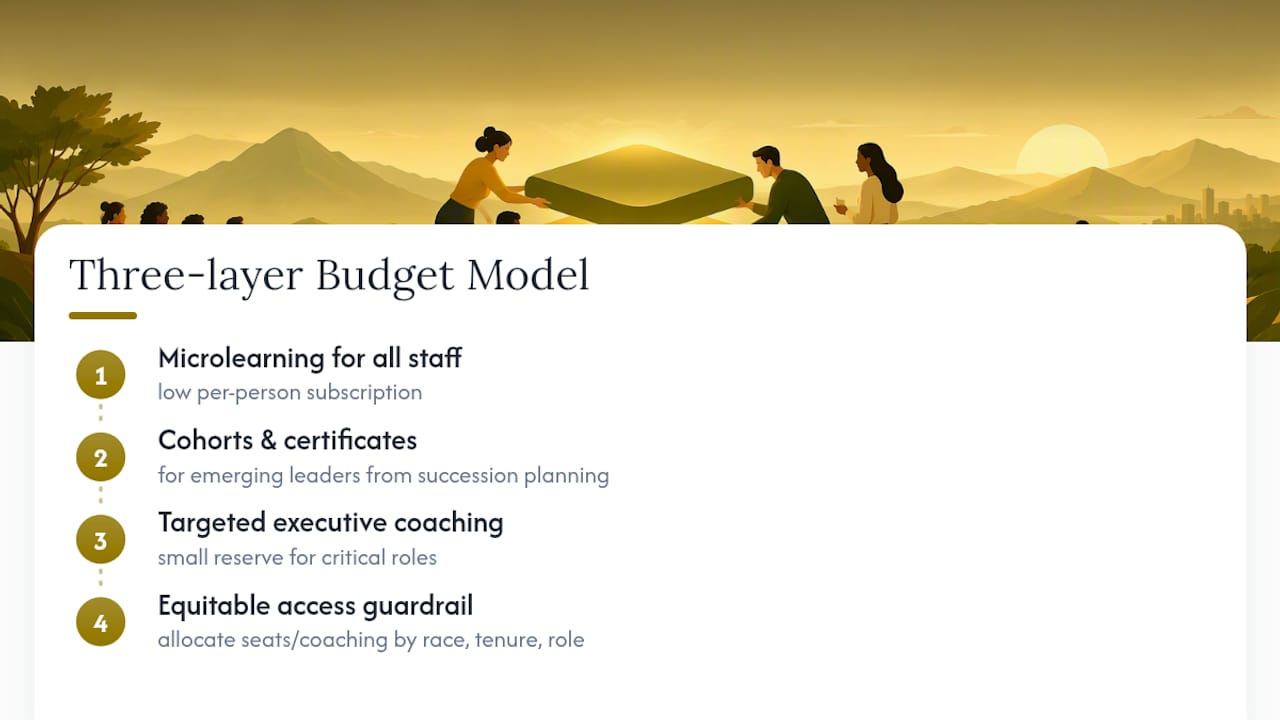
Grant funders increasingly accept capacity-building line items, so don't assume leadership development has to come entirely from unrestricted funds. Some foundations fund it directly as part of organizational effectiveness grants. Diversity, equity, and inclusion principles belong in this budget conversation too: allocate seats and coaching access equitably across race, tenure, and role level, not just to the people already positioned closest to the executive suite. A budget that only funds the director's coaching while ignoring program managers and team leads simply recreates the hero leader problem at a smaller scale.
Consider also how leadership development connects to your broader talent strategy, including how you attract and retain staff in the first place. A sustainable talent acquisition approach that treats hiring and development as connected investments tends to reduce the churn that makes leadership gaps worse.
Why Sponsoring One Cohort Now Beats Waiting for the Perfect Plan
If you take one thing from this, sponsor a single cohort or pilot tied to a defined priority this quarter instead of waiting for a comprehensive strategy. Retention improves, succession gets clearer, and you get measurable progress against something concrete rather than another planning document that sits unread.
— Drew
Try Leaderlyapp for Nonprofit Leadership Training
Leaderlyapp gives nonprofits a way to build leadership skill across an entire staff, not just the executive director, without the cost of sending every manager through a university program. The 8 to 12 week cohort model combines daily microlessons, adaptive content that adjusts to each person's progress, and built-in assessments like DiSC and EQ, so your team develops through consistent practice instead of a single long workshop.
Analytics dashboards let executive directors and HR leads see engagement and skill growth across the whole cohort, which makes it easier to report progress to your board. If your organization runs corporate partnerships or shares programs across affiliated groups, the co-branded impact programs option extends that same model further. Reach out through the Leaderly AI for Nonprofits page to request pilot details for your organization.
Sources
- Filling essential gaps in nonprofit leadership (SSIR)
- The effective organization: five questions to translate leadership into strong management (Bridgespan)
- Understanding the lack of leadership succession planning in nonprofit organizations (Nonprofit Management and Leadership, Wiley)
- The hero leader trap: why some nonprofits struggle to scale (Forbes)
FAQ
What Are the Core Leadership Competencies Nonprofits Need?
Nonprofits need leaders who can align mission with strategy, manage board relationships, oversee finances and performance, develop talent, sustain donor relationships, and make courageous decisions under pressure. High-impact organizations treat these as interdependent elements rather than isolated skills, since weakness in one area, like governance, tends to undermine strategy execution elsewhere.
What Is the 80/20 Rule for Nonprofits?
The Pareto principle, applied to nonprofits, suggests that a small share of donors, activities, or programs often accounts for much of the impact or revenue, so leaders should focus disproportionate attention there. Definitions vary by organization and context, so treat it as a prioritization heuristic rather than a fixed formula.
What Are Some Examples of Effective Leadership Training?
Effective examples include multi-week cohort programs with applied projects, university-affiliated nonprofit management certificates, and scalable microlearning models like the 8 to 12 week cohort structure Leaderlyapp runs for nonprofit staff. Single one-day workshops without follow-up coaching or measurement tend to produce weaker, shorter-lived results.
How Much Does Leaderlyapp Cost for Nonprofits?
Pricing for Leaderlyapp's nonprofit offering is not published and depends on organization size and program scope. Current pricing details are available directly through the Leaderly AI for Nonprofits page.
How Do You Measure the Impact of Leadership Training?
Measure impact through pre and post assessments of specific competencies, tracking behavior change six months after program completion rather than relying only on satisfaction surveys. Programs with applied projects and manager involvement make measurement easier because outcomes tie directly to observable work, like a completed board report or a revised budget process.