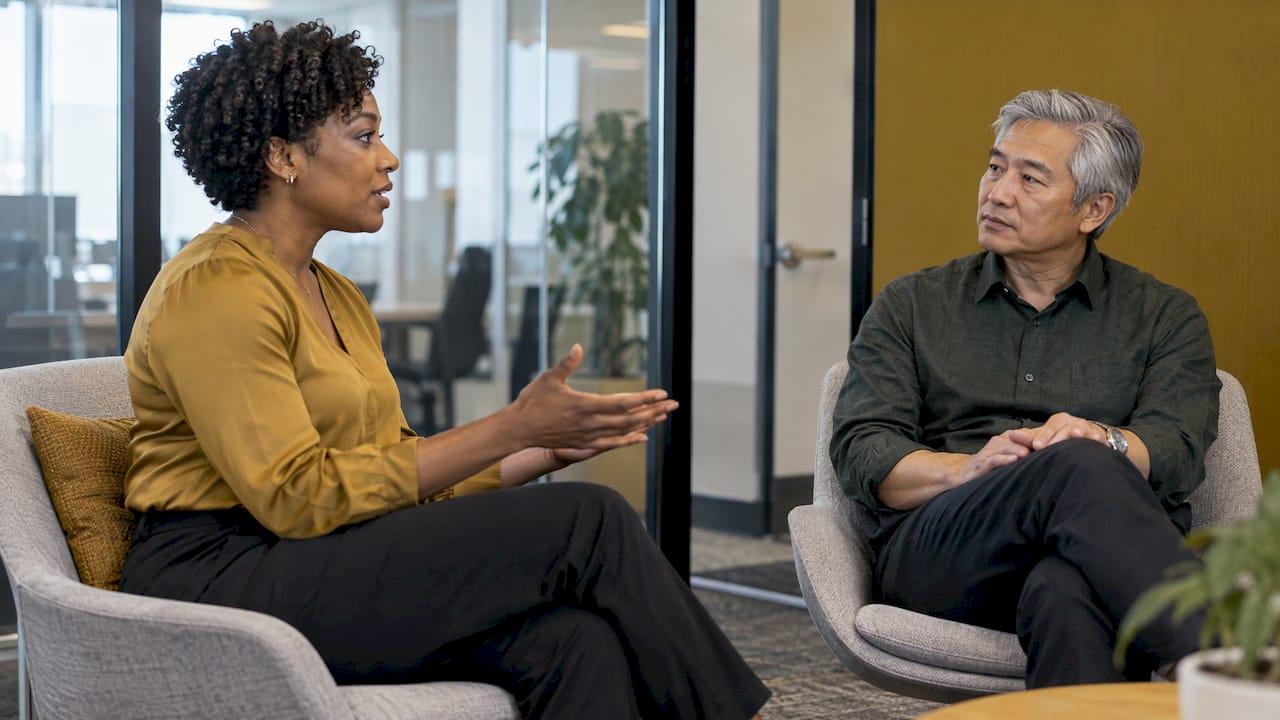
Effective manager EQ training builds four specific skills (self-awareness, self-regulation, empathy and relationship skills) through repeated practice on real situations, not a one-day lecture. The research points the same way: training that includes feedback, role play and follow-up changes behavior, and training that only explains the concept mostly does not. For HR teams, that makes the design question simple: how do you give every manager short, frequent, personalized practice? That is the job Leaderly AI was built for, with mobile microlessons, assessments and habit-building exercises that reach all employees, not just the managers a workshop budget can cover.
TL;DR
- Emotional intelligence for managers comes down to four skills: self-awareness, self-regulation, social awareness and social skills.
- A 2024 meta-analysis of workplace emotional-competency training found moderate, lasting effects, but noted that most programs lean on lectures with little practice or individual feedback.
- Strong programs run in four phases: preparation, training, transfer to the job, and evaluation after at least two months.
- Practice works best when it is focused on a few high-stakes conversations each day, not every interaction.
- Short mobile microlessons, self-assessments and analytics let HR scale this to every manager and emerging leader.
Table of Contents
- What EQ means for a manager
- The four skills your training should build
- Why one-off workshops fall short
- How to design manager EQ training in four phases
- EQ in everyday manager situations
- Practice that fits a manager's week
- Where Leaderly fits
- How to tell whether the training worked
- For educators and veterans moving into civilian leadership
- FAQ
- Sources
What EQ means for a manager
Emotional intelligence (EQ, or EI) is the ability to handle your own emotions and other people's so you can reach meaningful goals. The Yale Center for Emotional Intelligence, as summarized by Yale School of Medicine in 2025, reports that emotionally intelligent workers perform better, earn more merit-based raises and gain more recognition. The same summary says leaders who act with EI create climates where employees are more motivated, more aware of growth opportunities and more creative.
For a manager, that translates into ordinary moments: how you react when a project slips, how you notice that a quiet team member is overloaded, how you deliver a hard message without losing the person. Ron Siegel told the Harvard Gazette that technical expertise is relatively easy to acquire, while people who understand one another and get along are the harder thing. Emotional misunderstandings, he noted, waste resources.
That is why managers are the natural first audience for EQ training. A manager sets the emotional tone for a team. Goleman, Boyatzis and McKee argue in HBR Working Knowledge that the team leader has more power than anyone else to set the norms that drive harmony and collaboration.
The four skills your training should build
The Harvard Gazette's 2025 overview names four core components of workplace emotional intelligence. They make a practical curriculum, because each one can be practiced and observed.
| Skill | What it means | What it looks like in a manager |
|---|---|---|
| Self-awareness | Noticing your own thoughts and feelings | Recognizing frustration before a one-on-one starts |
| Self-regulation | Managing emotions without being overwhelmed | Pausing before replying to a tense email |
| Social awareness (empathy) | Noticing what is going on in others | Reading that a team member's silence signals worry, not agreement |
| Social skills | Working in teams, resolving conflict, helping people cooperate | Running a disagreement to a decision everyone can live with |
A useful training plan names which of these four a given manager needs most, and starts there. The 2024 BMC Psychology meta-analysis recommends exactly this kind of precision: define training goals tightly and link them to targeted facets of emotional competence rather than aiming at broad ideas like "more empathy." "Listen without interrupting in weekly one-on-ones" is a goal a manager can practice. "Be more emotionally intelligent" is not.
Self-assessment is a sensible first step because it shows where to focus. Leaderly includes self-assessments, among them DiSC, EQ and MBTI, so a manager can see their starting point and then work on it in short lessons.
Why one-off workshops fall short
Most people who have sat through a leadership workshop know the pattern: a good day, some notes, then a return to the inbox. The evidence explains why.
A 2024 systematic review and meta-analysis in BMC Psychology looked at workplace emotional-competency training. It found moderate effects (SMD = 0.44 across 50 studies, and 0.46 across 27 controlled trials) that persisted more than three months, with managers benefiting as much as other groups. So training works. The same review also notes that most workplace EI training relies mainly on lectures, with limited practice, coaching or individual feedback.

The Rutgers researchers Emmerling, Cowan and Adler explain the mechanism: a lecture can raise understanding of emotional intelligence but cannot by itself change behavior, because changing emotional habits requires people to actually engage in the new pattern of thought, feeling and action. Their report states that 360-degree multi-rater assessment plus experiential methods (role plays, group discussions, simulations) work better than lecturing or assigned reading.
The practical conclusion for HR: the event is the smallest part of the program. What matters is what happens in the weeks after it.
How to design manager EQ training in four phases
The Rutgers technical report and the widely used best-practice guidelines built on Goleman and Cherniss's work describe the same arc: preparation, training, transfer and maintenance, and evaluation. Here is how to turn that into a plan.
- Prepare. Start with a baseline. A self-assessment or a 360-degree review (feedback from the manager's boss, peers and reports) shows each person's strengths and gaps. Have each manager choose one or two skills and write a goal broken into small steps. Goals that are specific and manageable keep motivation up.
- Train through practice. Use role plays, listening exercises, simulations and discussion of real cases. The American Express Financial Advisors program documented by the Emotional Intelligence Consortium used small-group discussion, writing exercises, demonstrations and role plays, plus hard-message delivery practice and mental rehearsal.
- Transfer to the job. This is where most programs lose their effect. Managers need prompts and exercises tied to their actual week, with feedback from peers or supervisors. The best-practice guidelines call for sustained on-the-job practice and ongoing feedback.
- Evaluate. Measure at least two months after training and ideally at one year, using job-based measures such as performance, absenteeism and grievances, per the same guidelines.
Spacing helps too. The longest-running example in the research, the American Express program running since 1994, splits its most rigorously evaluated versions into two segments one to two months apart: self-awareness and self-management first, interpersonal effectiveness second. It also reports a 13.5% improvement for trained advisors on an optimism measure versus 0.9% for controls, and higher sales growth at trained sites.
A case from Italy shows the same logic at smaller scale. In UCB Pharma's program, 15 managers completed a two-day workshop and then spent three months applying their skills with their own teams using a coach-supported toolkit; the authors report improved relational efficiency in 98% of cases. The workshop was the start, not the program.
EQ in everyday manager situations
Training sticks when managers can see themselves in the scenarios. Mental Health America's guide for managers offers concrete do and don't scripts. Several are worth building into any curriculum:
- Communication styles differ. Learn each team member's style instead of expecting everyone to adapt to yours.
- An overwhelmed employee needs validation first. Acknowledge the feeling and discuss redistributing the workload, rather than reacting defensively.
- Give context and schedule meetings in advance. Surprise meetings raise anxiety without helping anyone.
- New responsibilities take time. Say so, and ask for feedback on the training you provided.
- Address performance in private. Use a one-on-one, not a public scolding.
Two more habits come from the leadership research. Goleman, Boyatzis and McKee recommend short check-in sessions before meetings so members whose mood is off can say so, and they advise acting on subtle emotional signals as a sign that an issue should be engaged rather than avoided.
A January 2026 HBR tip on "wise empathy" adds a useful caution: read the emotional context before you react, because empathy expressed the wrong way can leave people feeling unseen or burned out. Matching the response to the situation is itself a trainable skill, and it is best learned through scenarios and simulations rather than slides.
Practice that fits a manager's week
The most common reason managers drop EQ practice is time. The APA's practical review of EI models gives a realistic answer. Dana Ackley, quoted there, emphasizes that the goal is sustainable behavior change rather than assessment, and that focusing on selected high-stakes encounters makes the task manageable and rewards the manager where it counts. Success in those moments then builds the motivation to continue.
The same review describes daily methods that fit a busy calendar:
- Keep an encounter log to notice when you are listening and when you are just rehearsing your reply.
- Pick one or two important meetings each day to practice reading emotional cues and active listening.
- Reframe unhelpful self-talk.
- Use breathing or progressive muscle relaxation before difficult conversations, and mentally rehearse them.
- Write a personal action plan and revisit it.
Reflection after real events completes the loop. Notes on how a manager steered a team through a tense stretch, such as leading a team through uncertainty, turn experience into learning when the manager asks what they felt, what they did and what they would change.
This is where microlearning earns its place. A five-minute lesson and an exercise on a phone, delivered before a scheduled difficult conversation, fits the "one or two high-stakes moments" approach far better than a binder. Leaderly's microlearning is built on that rhythm of frequent short lessons and practical exercises.
Where Leaderly fits
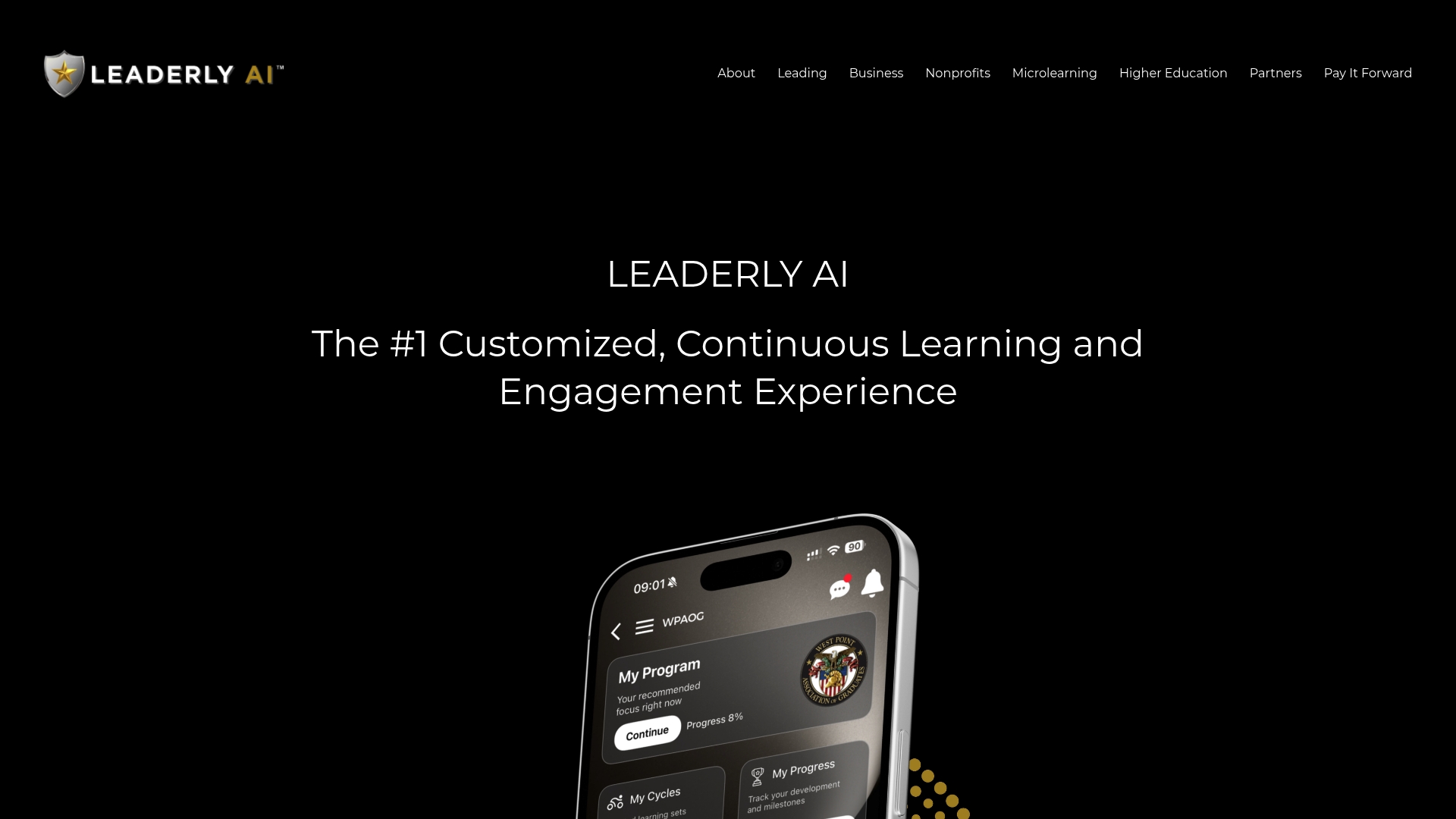
Leaderly AI is a mobile-first platform that gives organizations personalized microlessons and behavior-based exercises for leadership habits, with customizable learning journeys, self-assessments (including DiSC, EQ and MBTI), simulations, surveys and analytics dashboards. Content personalizes through machine learning as each user progresses, and HR or educators can customize programs and scale them to all employees, not only managers.
For an HR team, that maps onto the four phases above: assessments for the baseline, microlessons and simulations for practice, exercises that carry into the working week, and dashboards to track progress. Organizations can explore Leaderly AI for business or see the versions for nonprofits and higher education.
Emerging leaders benefit just as much as current managers. EQ habits built before the promotion are in place on day one of the new role.
How to tell whether the training worked
HR teams are right to ask for evidence. The research offers several measures and a few honest benchmarks.
- Measured EQ. A 2019 randomized experimental study of a 30-hour business-oriented course for senior managers provided experimental evidence that structured EI training can improve measured emotional intelligence.
- Multi-rater scores. The Emotional Intelligence Consortium's evaluation of a one-year program found reassessment scores higher on 19 of 20 competencies, about a 24% improvement, using baseline and follow-up multi-rater assessments.
- Team outcomes. A field study by Luthans and Peterson combined 360-degree feedback with structured self-awareness coaching for 20 managers and found improved manager and employee satisfaction, commitment and turnover intentions over a three-month follow-up.
- Job-based measures. Track performance, absenteeism and grievances at two months and again at one year, as the best-practice guidelines suggest.
Set expectations by choosing the measure that matches your goal. In a seven-month program for 11 nurse managers at one hospital, EI skill scores improved significantly, while patient satisfaction and leader communication scores did not move in that window. Skills change first, and broader outcomes take longer, so report both on a timeline.
In practice, a simple dashboard that shows lesson completion, assessment shifts and survey results by team gives HR the early signals long before annual numbers arrive. Leaderly's analytics dashboards and surveys are designed for that kind of tracking.
For educators and veterans moving into civilian leadership

Educators who want leadership training for faculty or students, and veterans stepping into civilian management, share a need: concrete, practiced skill, not theory. A 2026 Liberty University doctoral study of Army leaders in transition reports that emotional intelligence is continuously refined through coaching, leadership training and self-assessment, and that active listening and asking colleagues for feedback give concrete input for improvement. A USC dissertation on Navy veterans' experience with the Transition Assistance Program adds that hands-on, mastery-based practice works best and that empathy, conflict resolution, stress management and communication training would fill a gap in civilian workplace adjustment.
The design principles are the same as for any manager: assess, practice in short cycles, get feedback.
What we think about manager EQ
We built Leaderly because leadership development has usually been rationed. A few senior people get the offsite and the coach, and everyone else gets a slide deck. EQ shows why that fails. Nobody becomes more self-aware in a single day. They become more self-aware by noticing, trying something small and noticing again.
That is why we focus on habits. Short microlessons, practical exercises and assessments that adapt as a person progresses give managers something they can use before their next one-on-one. And because the tools are easy for HR or educators to customize, the program can reach every employee, including the emerging leaders who will manage next year.
If you are planning manager EQ training, start with the follow-through. Decide what managers will do in the weeks after the first session, then choose the format that makes it easy.
Drew
FAQ
What should emotional intelligence training for managers include?
It should cover self-awareness, self-regulation, social awareness and social skills, starting with an assessment of where each manager stands. Then add role plays, simulations and real-situation practice with feedback. Finish with on-the-job follow-up and a measurement at two months or later.
Does EQ training really work for managers?
A 2024 meta-analysis of 50 pre-post studies found a moderate average effect, and controlled trials showed a similar effect that lasted beyond three months. Managers benefited as much as other groups. Results are strongest when training includes practice and individual feedback.
How long does EQ training for managers take?
Program lengths in the research range widely: a 30-hour course for senior managers, a two-day workshop followed by three months of applied work, and multi-day programs split into two segments one to two months apart. The common thread is a period of practice after the initial sessions rather than a single event.
How can I lead with emotional intelligence tomorrow?
Pick one or two important conversations and prepare for them. Read the emotional context before you respond, listen for feelings as well as facts, and hold performance feedback for a private one-on-one. Short check-ins at the start of meetings also help your team say what is on their minds.
Is EQ training only for senior managers?
No. The research includes new managers, field managers and veterans in civilian roles, and emerging leaders gain from building habits early. Programs that reach every employee make EQ a shared team norm rather than one person's skill.
Sources
- Workplace Success Starts with Emotional Intelligence, Yale School of Medicine
- What is emotional intelligence, and why is it crucial in the workplace, Harvard Gazette
- Primal Leadership: Realizing the Power of Emotional Intelligence, HBS Working Knowledge
- Training emotional competencies at the workplace, BMC Psychology
- Emmerling, Cowan and Adler technical report, Emotional Intelligence Consortium
- Guidelines for Best Practice, emotional intelligence in the workplace
- Emotional Competence Training, American Express Financial Advisors
- UCB Pharma Italy EQ program case study, Journal of Entrepreneurship and Business Innovation
- Educate Managers About EQ, Mental Health America
- Practice Wise Empathy as a Leader, Harvard Business Review
- Emotional Intelligence: A Practical Review of Models, APA
- How to lead a team through uncertainty
- Can emotional intelligence be improved? A randomized experimental study, PMC
- Mastering Emotional Intelligence program evaluation, Emotional Intelligence Consortium
- 360-degree feedback with systematic coaching, Luthans and Peterson
- Impacts of Emotional Intelligence Skill Development, George Washington University
- The Lived Experiences of U.S. Army Leaders Transitioning, Liberty University