
Learning culture change means shifting an organization from treating training as a scheduled event to treating learning as a daily habit built into how work gets done, and it starts with leaders who model that habit themselves. The three moves that matter most in the first 90 days: leaders demonstrate learning behavior in public, teams get protected time to apply new skills, and every learning activity ties to a real work outcome rather than a completion certificate. Organizations that identified learning and development as their top retention lever in 2023 weren't guessing. They'd seen what happens when they don't invest.
If you're building the case for your CHRO or L&D sponsor, start here:
- Model learning publicly. Share what you tried, what failed, and what you're doing differently.
- Protect learning time on the calendar, not just in the policy handbook.
- Connect every microlesson or workshop to a specific task, deliverable, or metric.
Key Takeaways
Learning culture change succeeds when leaders model learning publicly, teams get protected time to apply it, and every metric tracks application instead of activity.
| Point | Details |
|---|---|
| Leaders model learning first | Managers who teach and coach rather than delegate build stronger team problem-solving over time. |
| Protect learning time on the calendar | A recurring, unmovable block beats an occasional optional session that gets bumped by meetings. |
| Track application, not completion | Measure skill velocity and applied learning rate rather than course completion percentages. |
| Expect a year or more for visible change | Early signals show up in a quarter; real behavior shift takes over a year. |
| Leaderlyapp operationalizes the playbook | Microlessons, leader coaching prompts, and analytics dashboards track applied learning inside daily workflows. |
Table of Contents
- What Does a Learning Culture Look Like in Daily Work?
- The Business Case: Why Shifting Your Culture Matters Now
- A Prioritized Playbook: Building Blocks and Steps to Shift Culture
- Leaders as Learning Facilitators: What the Research Actually Says
- Measure, Sustain, and Demonstrate ROI
- Common Pitfalls and How to Avoid Them
- Leaderly's Perspective: How We Approach Culture Change
- Put the Playbook to Work With Leaderly
- Sources
What Does a Learning Culture Look Like in Daily Work?
Forget the image of a training room. A real learning culture shows up in the fifteen minutes after a client call when a sales rep jots down what worked, or in the standup where a developer explains a bug fix to two teammates who didn't know that pattern existed. The operational difference is simple: event-based training happens to people on a schedule someone else set. Embedded learning happens through the work itself, continuously, often without anyone calling it "training" at all.
Three formats do most of the heavy lifting:
- Microlearning — five-to-ten-minute lessons delivered at the moment of need, not stockpiled in a quarterly course catalog.
- After-action reviews — a short debrief at the close of a project or sprint, covering what worked, what didn't, and what skill gap showed up.
- Job rotations — short-term moves into adjacent roles that build cross-functional fluency without a permanent transfer.
A product team at a mid-size software company built this into their sprint retro: the last five minutes are reserved for one person to teach the group something they learned that week, technical or not. No slide deck, no sign-up sheet. Six months in, three engineers had picked up skills outside their original role, and nobody had to leave their desk to get there.
The Business Case: Why Shifting Your Culture Matters Now
Retention is the easiest number to defend in a budget meeting, and it's also the most understated benefit. Organizations naming learning and development as their top retention strategy in 2023 weren't chasing a trend. They'd run the math on replacement costs versus development costs and the development side won.
Skill obsolescence is the quieter risk, and it's accelerating. The World Economic Forum's Future of Jobs Report tracks how fast required skills are shifting, and the pace is not slowing down. Add generative AI into the mix, and the demand changes shape entirely: organizations adopting AI need continuous, iterative learning loops, not annual refreshers, because the tools and the risks both change month to month.
For the board or C-suite conversation, three metrics carry weight:
- Internal mobility rate — how often open roles get filled from inside versus an external search.
- Time-to-productivity for new hires and internal transfers.
- Innovation throughput — new ideas piloted per quarter, which tends to rise when learning is embedded in daily work rather than boxed into occasional courses.
A Prioritized Playbook: Building Blocks and Steps to Shift Culture
Culture change fails when it's treated as one big initiative instead of six interdependent habits running in parallel. Here's the order that tends to work, with a first move and a metric for each.
-
Leadership modeling. Culture takes its cues from the top, and leaders who act as teacher-coaches rather than delegators build stronger team problem-solving over time. Start this week: have every manager share one thing they learned or got wrong in the last team meeting. Track over 90 days: percentage of managers who've done this at least twice a month.
-
Protected learning time. If learning only happens when the calendar is empty, it never happens. Start this week: block a recurring 30-minute slot on every team calendar labeled "learning," not "optional." Track: percentage of that time actually used versus reclaimed by meetings.
-
Learning-in-work rituals. This is where the five-minute after-action review earns its keep. At the close of any project, ask three questions: what worked, what didn't, what skill gap showed up. SHRM's research on building learning cultures points to this kind of structured, scheduled reflection as more effective than sporadic feedback. Track: percentage of projects with a completed after-action review.
-
Job rotation and cross-training. A 90-day rotation gives someone enough time to genuinely learn an adjacent function without disrupting their primary team for too long. Start this week: identify one pilot pair of roles that could swap for a quarter. Track: number of employees who've rotated in the last year.
-
Recognition tied to application. Recognizing people for finishing a course misses the point. Recognize them for using what they learned. Start this week: add a "applied a new skill" category to your existing recognition program. Track: number of recognitions tied to a specific skill applied on the job.
-
Enabling technology. A learning platform that tracks completion but not application is measuring the wrong thing. Start this week: audit your current tools for whether they capture behavior change, not just clicks. Track: percentage of learning activities linked to a documented outcome.
Pro Tip: Run the after-action review as a standing five-minute agenda item, not a special event. The moment it needs its own meeting invite, attendance drops.
Leaders as Learning Facilitators: What the Research Actually Says
Longitudinal work inside companies like LEGO and Velux found something counterintuitive: leaders who slow down to teach problem-solving skills end up moving faster later, because their teams stop bringing every issue back to them. MIT Sloan Management Review calls this "go slow to go fast," and it runs against most managers' instinct to just solve the problem themselves and move on.

Part of the method is A3 thinking, a structured approach to walking someone through root-cause analysis instead of handing them the answer. It's slower in the moment. It compounds over quarters.
A simple three-question script does most of the work without requiring a manager to become a trained coach overnight:
That sequence forces reflection, then application, then ownership, in under two minutes.
The real obstacle is scale. Not every senior leader has time to run structured coaching sessions across a large team. The fix isn't asking leaders to do more. It's:
- Training a smaller group of team leads to run the three-question script, so senior leaders model it occasionally rather than constantly.
- Building the questions into existing rituals (retros, one-on-ones) instead of creating a new meeting.
- Using peer and manager coaching formats to spread facilitation across more people than just the top of the org chart.
Measure, Sustain, and Demonstrate ROI
Skip the vanity metrics. Course completion rates tell you almost nothing about whether learning stuck. The metrics that hold up in a board deck are engagement (are people opting into learning, not just assigned to it), internal fill rate (what percentage of open roles get filled from inside), skill velocity (how fast someone becomes productive in a new skill or role), manager coaching frequency, and applied learning rate (the share of learning activities that show up in actual work output).
Set SMART targets against each one and tie them to an existing business KPI your CFO already tracks. If internal fill rate is 20%, a fair 12-month target might be 30%, tied directly to reduced external recruiting spend.
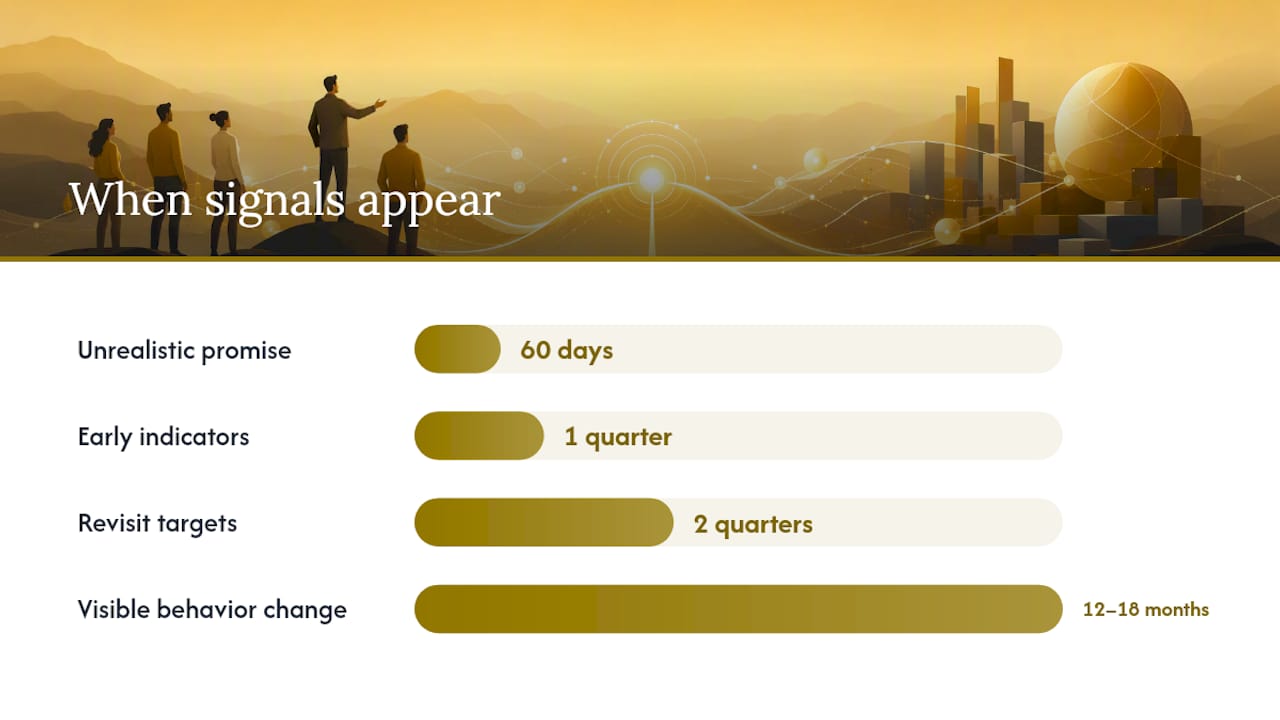
Timeline expectations matter more than most leaders admit going in. Early indicators, like platform adoption and manager coaching frequency, tend to show up within a single quarter. Visible behavior change, the kind a skeptical VP would actually notice in a meeting, usually takes 12 to 18 months. Anyone promising a culture shift in 60 days is selling something.
- Report early wins (adoption, participation) monthly to keep momentum visible.
- Report behavior and outcome metrics (fill rate, skill velocity) quarterly.
- Revisit targets every two quarters, since a target set before rollout rarely survives contact with real data.
Common Pitfalls and How to Avoid Them
The most common failure is treating learning as a parallel track instead of part of the job itself. If a lesson doesn't connect to a task someone's doing this week, it gets skipped the moment things get busy. The fix: build learning-in-work rituals, like the after-action review, directly into existing meetings rather than a separate calendar item.
The second failure is a leadership gap. If managers don't model learning or protect time for it, employees read the mismatch instantly. Put a learning commitment on every manager's scorecard, not just their team's.
The third is measuring activity instead of application. Completion rates and login counts feel productive to report but say nothing about whether skills changed outcomes. Tie every learning KPI to a business metric it's supposed to move.
Leaderly's Perspective: How We Approach Culture Change
Culture change sticks when learning happens inside the tools people already use, not in a separate app they have to remember to open. Leaderlyapp builds microlessons and leader coaching prompts directly into daily workflows, so the three-question reflection script and skill-velocity tracking aren't extra work, they're the work. One organization using Leaderlyapp protected a recurring learning block on team calendars and used the platform's analytics to watch skill velocity move quarter over quarter, not just completion counts.
— Drew
Put the Playbook to Work With Leaderly
Leaderlyapp is built for exactly the operational plan above: protected learning time, leader-facilitated coaching, and metrics that track applied skill, not just course completions.
Three concrete things you can do with it starting this quarter. First, use the microlearning engine to deliver five-minute lessons at the moment someone actually needs them, instead of stockpiling a course catalog nobody opens. Second, give managers structured coaching prompts, close to the three-question script MIT Sloan researchers found effective, so facilitation scales past your senior leadership team. Third, use the analytics dashboard to track skill velocity and applied learning rate instead of completion percentages, so your CHRO gets a number that actually moves the retention conversation forward.
If you're ready to see how this fits your organization's size and structure, visit Leaderly's platform overview to explore how microlearning and leader facilitation come together, or check The Future of Leadership Development for a deeper look at where this is headed.
Sources
- Leaders’ critical role in building a learning culture — MIT Sloan Management Review
- 5 keys to building a learning culture — SHRM (guide PDF)
- Training and development an integral part of employee recruitment and retention — VendorDirectory (SHRM)
- The future of jobs report 2025 — World Economic Forum