
Leadership development strengthens culture by shaping the everyday behaviors that create psychological safety, consistent decision norms, and the kind of repeatable ways of working that actually survive a reorg. When organizations invest in developing leaders at scale, the cultural payoff is measurable and durable.
The short version:
- Leaders who receive structured development role-model the norms that become team-wide expectations
- Scaled programs increase engagement, reduce voluntary turnover, and improve talent pipeline depth
- Organizations with mature leadership development report stronger change-readiness than those without, according to CCL
- Psychological safety, which McKinsey identifies as a primary driver of inclusion and experimentation, starts with senior-leader behavior and cascades down
- Harvard Business Impact research finds that transformations succeed when leader-driven culture change spreads beyond the executive suite
- Platforms like Leaderlyapp make continuous, personalized development accessible at every level, not just for the top tier
Table of Contents
- How leadership development actually changes culture
- Concrete outcomes you can expect from leadership development
- Design principles for programs that actually shift culture
- How to measure cultural impact and prove ROI
- Prioritized actions for the next 30, 90, and 180 days
- How Leaderlyapp helps embed leadership habits at scale
- Key Takeaways
- Why leadership development deserves a seat at the strategy table
- Start your leadership development pilot with Leaderlyapp
- Useful sources and further reading
How leadership development actually changes culture
Culture does not change because an organization posts new values on the wall. It changes when leaders behave differently, consistently, in front of their teams. That is the core mechanism, and it operates through several specific levers.
Role-modeling as social proof. When a senior leader publicly admits a mistake or asks for input before deciding, they signal what is acceptable. Teams observe and mirror those behaviors. This is not soft psychology; it is how norms propagate. Leader behavior sets the reference point for what "normal" looks like on a team, and development programs that target specific behaviors accelerate that signal.
Psychological safety through deliberate skill-building. McKinsey's research shows that senior leaders who demonstrate inclusive behaviors increase the likelihood that their direct reports will do the same. But those behaviors — inviting dissent, showing situational humility, enabling experimentation — do not emerge naturally under pressure. They require practice. Leadership development that focuses on a small set of skills, such as open dialogue and sponsorship, predicts positive safety-related behaviors better than broad, unfocused curricula.
Communication volume and repetition. Wharton's guidance on culture change is blunt: leaders vastly underestimate how much communication is required. New language, repeated metaphors, and consistent role-modeling are mandatory for signals to stick. One town hall does not move culture. Fifty consistent micro-interactions might. Development programs that build communication skills in leaders give them the tools to sustain that volume.
Decision norms that scale. When leaders across an organization make decisions in recognizably similar ways — transparent reasoning, clear accountability, inclusive input — those patterns become cultural infrastructure. Development programs that practice decision-making scenarios create that consistency.
Structural reinforcement. New behaviors get "untrained" fast when the incentive system rewards the old ones. MDPI research confirms that cultural environments and support structures must be aligned with development efforts, or the system simply reverses the gains. Performance appraisals, hiring criteria, and promotion decisions all need to reflect the behaviors the program is trying to build.
Pro Tip: Engage middle managers as active change facilitators from day one, not as a second wave. They are the daily culture carriers. Senior-only programs leave the largest behavioral surface area untouched.
Concrete outcomes you can expect from leadership development
The benefits of leadership development on culture are not abstract. They show up in metrics that HR teams already track.
Employee engagement and productivity. CCL's research links leadership development directly to improved engagement, and engaged organizations consistently outperform peers on profitability and productivity. The mechanism is straightforward: when leaders are developed to coach, recognize, and communicate clearly, their teams feel seen and motivated.

Retention and talent pipeline depth. CCL's scaled-program white paper shows that development increases leaders' ability to retain talent and strengthen internal promotion pipelines. Voluntary turnover is expensive. When employees see a credible path to growth, they stay. When they do not, they leave for organizations that offer one.
Change-readiness and strategy execution. Organizations with strategic leadership development programs report stronger change-readiness than those with less mature programs, per CCL. Harvard Business Impact's synthesis reinforces this: transformations that endure begin with leader-driven culture change and spread across leadership levels, not just the C-suite.

Innovation and learning velocity. Psychological safety, built through leader development, is the precondition for experimentation. Teams that feel safe to raise ideas and flag failures iterate faster. That is a competitive advantage in any market that rewards speed.
Inclusion and equitable opportunity. Scaled development programs give a broader population access to growth, sponsorship, and visibility. That directly supports equity, diversity, and inclusion objectives by creating more pathways and more leaders who know how to sponsor others.
KPIs to track:
- Employee engagement score (quarterly pulse or annual survey)
- Voluntary turnover rate (monthly, segmented by level)
- eNPS (employee Net Promoter Score, biannual)
- Internal promotion rate (annual, by cohort)
- Change adoption speed (project-level, tracked against milestones)
A mid-size professional services firm that piloted a cohorted leadership program across its middle-management layer reported measurable engagement score improvement within two quarters, alongside a reduction in voluntary departures from that cohort. The common factor: managers received specific coaching on recognition and career conversations, two behaviors that directly address the top reasons employees leave.
Design principles for programs that actually shift culture
One-off workshops do not move culture. Systems do. Here is how to build one.
-
Anchor to strategy and target behaviors. Choose three to five specific leadership behaviors that matter for your culture goals. "Be a better leader" is not a behavior. "Invite dissent before finalizing decisions" is. Programs that concentrate on a few skills predict better outcomes than those that try to cover everything.
-
Build a system, not a program. Combine formal learning with on-the-job practice, peer coaching, behavioral nudges, and measurement. Mature development systems outperform isolated programs because behavior change requires repetition across contexts, not a single learning event.
-
Segment by level. Frontline leaders need different experiences than senior executives. Frontline development should focus on team-level behaviors: recognition, feedback, psychological safety. Senior development should focus on culture signaling, sponsorship, and decision modeling. Middle managers need both, plus change facilitation skills.
-
Tie learning to incentives and performance management. If your performance review does not assess the behaviors your program is building, you are sending a mixed signal. Align team objectives and appraisal criteria with the target behaviors so the system reinforces rather than undermines the development investment.
-
Sequence realistically. A pilot with one cohort in months one through three, expansion to additional cohorts in months four through nine, and full integration into talent processes by month twelve is a realistic arc. Culture change measured in quarters, not weeks.
-
Avoid the most common failure modes. Fragmented efforts with no shared framework, lack of visible sponsorship from the top, and insufficient repetition of key messages are the three most reliable predictors of program failure. Why leadership training fails at scale is worth reading before you finalize your design.
-
Use a design checklist. Before launch, confirm: target behaviors are defined and observable; learning modalities include practice, not just content; measurement plan exists; incentive alignment is confirmed; executive sponsor is named and briefed.
Pro Tip: IMD's culture transformation research identifies a "Direction, Alignment, Commitment" relational process as the distinguishing feature of programs that create sustained culture coalitions. Build DAC into your cohort design from the start, not as an afterthought.
How to measure cultural impact and prove ROI
Measurement is where most programs lose credibility. The fix is a clear framework before launch, not a scramble for data afterward.
| Culture Outcome | Metric | Instrument | Cadence |
|---|---|---|---|
| Engagement | Engagement score | Annual survey + quarterly pulse | Quarterly |
| Psychological safety | Safety sub-score | Team climate survey | Biannual |
| Retention | Voluntary turnover rate | HRIS data | Monthly |
| Talent pipeline | Internal promotion rate | Talent review data | Annual |
| Change adoption | Milestone completion rate | Project tracking | Per initiative |
| Employee advocacy | eNPS | Pulse survey | Biannual |
Attribution is the hard part. Leadership development rarely operates in isolation; other HR initiatives, market conditions, and business cycles all affect the same metrics. Three approaches reduce the noise:
- Cohort rollouts: Launch the program with one group first, compare outcomes against a comparable group that has not yet participated. The difference is your attributable signal.
- Contribution analysis: Document the logic chain from program activities to behavior changes to culture metrics. When the chain holds, you have a defensible attribution story even without a control group.
- Baseline before launch. Wharton recommends quantitatively measuring current cultural values before any intervention. Without a baseline, you cannot claim change.
Common pitfalls:
- Measuring too early (culture shifts take months to show in survey data)
- Using a single instrument when multiple data sources triangulate better
- Ignoring confounding interventions (a simultaneous restructure will contaminate your engagement data)
- Treating eNPS as the only signal when turnover and promotion data tell a more complete story
CCL's research on scaled leadership programs consistently shows that organizations with strategic development report stronger outcomes across these metrics, but the programs that can prove it are the ones that built measurement into the design from day one.
Prioritized actions for the next 30, 90, and 180 days
Culture change has a pace. Here is how to move at the right speed without losing momentum.
30 days: Assess and pilot
- Run a culture snapshot: pulse survey, exit interview review, and a short leader behavior audit to establish your baseline.
- Define three to five target leadership behaviors aligned to your strategy.
- Select a pilot cohort of 15–30 middle managers — the level with the highest daily cultural surface area.
- Brief your executive sponsor and draft a short communication they can send to the pilot group.
90 days: Scale and align
- Launch cohorted learning for the pilot group, combining structured content with peer practice and behavioral nudges.
- Align one HR process — performance reviews or promotion criteria — to reflect the target behaviors.
- Begin tracking your KPIs: engagement pulse, voluntary turnover for the cohort, and any available safety survey data.
- Hold a mid-point check-in with the cohort and the executive sponsor to surface early wins and blockers.
180 days: Embed and expand
- Integrate the program into your talent processes: onboarding, succession planning, and hiring criteria.
- Share early impact data with senior leadership to build the case for expansion.
- Expand to the next leadership level, using lessons from the pilot cohort to refine the design.
- Establish a quarterly measurement cadence and assign ownership to a people analytics lead.
Sample communication snippet for a pilot launch:
How Leaderlyapp helps embed leadership habits at scale
The design and measurement principles above require a delivery mechanism that works at scale, across levels, and without requiring a dedicated L&D team to rebuild content every quarter. That is the problem Leaderlyapp is built to solve.
What the platform does:
- Delivers personalized microlessons that adapt to each leader's development stage and behavioral gaps
- Sends behavioral nudges between learning sessions to reinforce practice in real work contexts
- Supports manager coaching with structured conversation guides and reflection prompts
- Provides analytics that map to the KPIs in the measurement framework above: engagement signals, behavior adoption, and learning velocity
- Scales across frontline, middle, and senior leaders without requiring separate program builds for each level
Those features map directly to the design principles covered earlier. Nudges handle the repetition problem Wharton identifies. Analytics handle the attribution problem. Personalized paths handle the segmentation requirement. The people-centric leadership development approach Leaderlyapp uses means the content evolves with each user rather than delivering the same module to a VP and a team lead.
For organizations running the 30/90/180 playbook above, Leaderlyapp fits naturally into the pilot phase: a cohort of 15–30 managers can begin personalized learning within days, with behavioral data available to HR within the first month.
Pro Tip: Use Leaderlyapp's analytics dashboard as your early-warning system. If nudge engagement drops in week three of a cohort, that is a leading indicator of disengagement before it shows up in your quarterly pulse survey. Catching it early lets you intervene before the data looks bad.
Key Takeaways
Leadership development is the most direct lever organizations have for shaping culture at scale, and the evidence from McKinsey, CCL, Wharton, and Harvard Business Impact consistently points to the same conclusion: programs that target specific behaviors, engage leaders across levels, and align with supporting systems produce measurable cultural gains.
| Point | Details |
|---|---|
| Behavior specificity matters | Target three to five observable leader behaviors; broad curricula predict weaker outcomes than focused ones. |
| Systems reinforce or reverse gains | Align incentives, performance reviews, and hiring criteria with target behaviors or the system will undo the program. |
| Middle managers are the cultural multiplier | Engaging middle management early creates a culture coalition that sustains change beyond the pilot cohort. |
| Measure before you launch | Establish a baseline using pulse surveys and HRIS data; without it, attribution is impossible and ROI is undefendable. |
| Leaderlyapp as your pilot vehicle | Leaderlyapp delivers personalized microlessons, behavioral nudges, and analytics that map directly to the 30/90/180 playbook. |
Why leadership development deserves a seat at the strategy table
Most organizations treat leadership development as a training budget line. The evidence says it should be treated as a culture infrastructure investment, with the same multi-year commitment you would give to a technology platform or a brand repositioning.
The research from McKinsey, CCL, and Harvard Business Impact is consistent: culture change that sticks starts with leader behavior, spreads through middle management, and gets reinforced by systems. Programs that skip any one of those three conditions tend to produce short-term enthusiasm and long-term reversion. The organizations that get it right treat development as a continuous process, not an annual event.
The trade-off worth naming: speed versus depth. A fast, broad rollout reaches more leaders sooner but risks shallow behavior change. A slower, cohorted approach builds deeper habits but takes longer to show cultural impact. The 30/90/180 playbook in this article is designed to thread that needle: start focused, prove it works, then scale with confidence.
For decision-makers who want to move from checkbox training to genuine cultural transformation, the starting point is not a bigger budget. It is a clearer set of target behaviors, a measurement plan, and a delivery mechanism that sustains practice between sessions. That combination is what separates programs that change culture from programs that fill a calendar.
Start your leadership development pilot with Leaderlyapp
If the 30/90/180 playbook resonates but the implementation feels like a heavy lift, Leaderlyapp removes the friction. Instead of building a custom program from scratch, your pilot cohort gets personalized microlessons and behavioral nudges from day one, with analytics that give HR a real-time view of adoption and engagement.
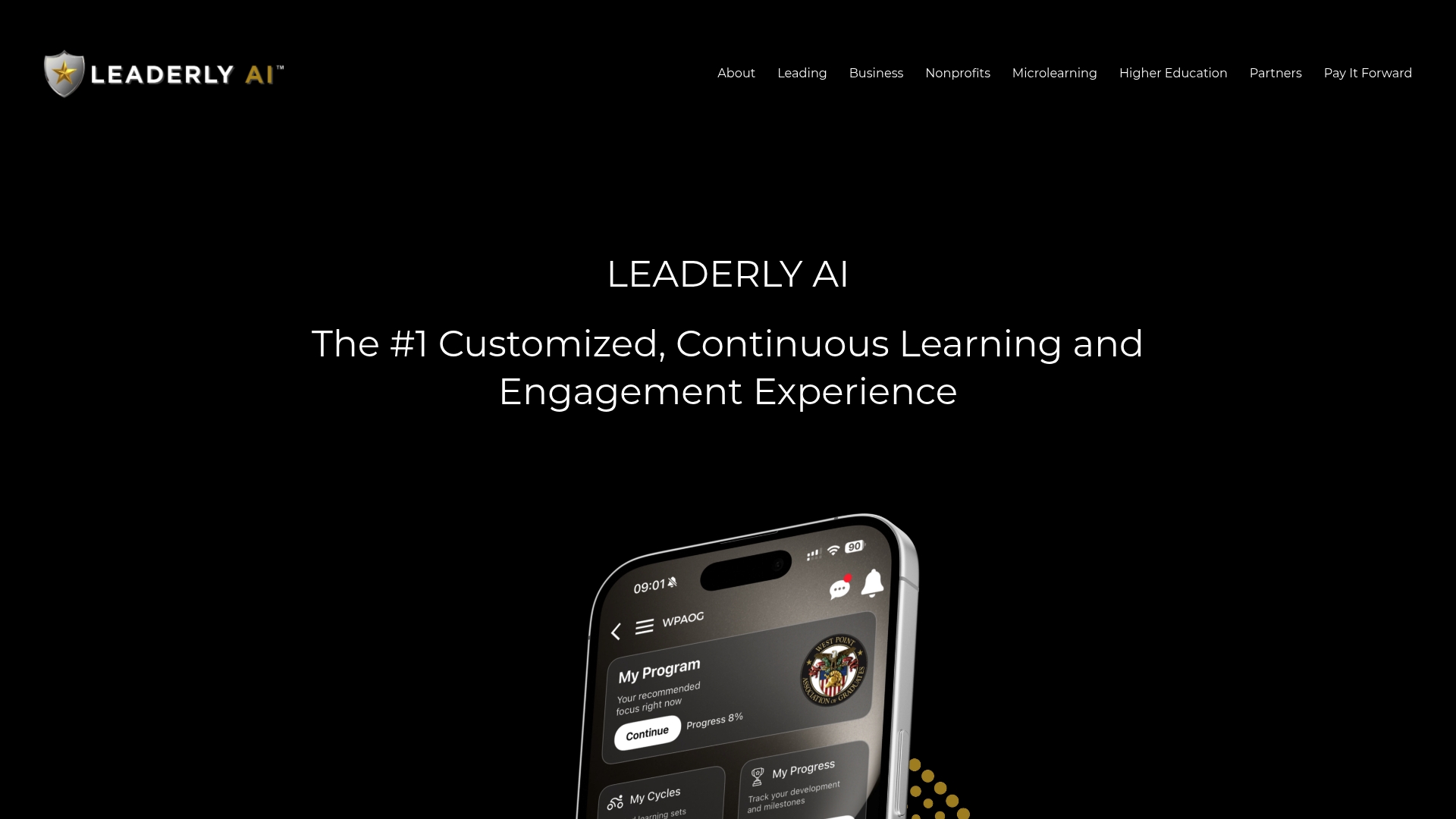
The concrete difference: Leaderlyapp scales across every leadership level without requiring separate content builds for each one. A frontline manager and a senior director receive different learning paths, calibrated to their behavioral gaps, from the same platform. That is the scalability gap most internal programs cannot close without significant L&D resources.
For a 90-day pilot, the setup is straightforward: define your target behaviors, select your cohort, and let the platform handle personalization, nudges, and measurement. Your people analytics lead gets the data; your leaders get the practice. To see how it fits your organization's culture priorities, explore Leaderlyapp's approach or visit leaderlyapp.com to request a demo.
Useful sources and further reading
- How Does Leadership Influence Organizational Culture? — Harvard Business School Online: Foundational HBS piece on the mechanisms by which leaders shape culture; useful for grounding the role-modeling and norm-setting arguments.
- Psychological Safety and the Critical Role of Leadership Development — McKinsey: Survey-based evidence on how senior-leader behavior drives psychological safety and why focused skill development outperforms broad curricula.
- The Importance of Leadership Development: Why Invest? — CCL: CCL's synthesis of engagement, profitability, and change-readiness outcomes linked to leadership investment.
- Scaling Leadership Development Powers Engagement, Retention, and ROI — CCL White Paper: Detailed white paper on system design characteristics and scaled program effects on retention and talent pipelines.
- Transformation That Endures: How Leaders Create a Culture That Seeks Change — Harvard Business Impact: Synthesis of large-scale transformation research; argues for broad leadership engagement and learning velocity as success factors.
- Managing Cultural Change — Wharton Nano Tools for Leaders: Practical guidance on measurement, stakeholder involvement, and the communication volume required for culture change.
- The Seven Stages of Culture Transformation — IMD: Case-study-based framework for culture transformation; highlights the role of middle managers and the DAC relational process.
- Why Leadership Development Fails to Scale — MDPI: Research on the "Optimizing System" failure mode; explains why incentives and structures must be redesigned alongside leader development.