
Inclusive leadership training teaches leaders to build fair, respectful teams where people feel heard, through skills like listening, bias awareness, inclusive decision-making and addressing exclusionary behavior. The training that sticks is spread over time, built on real scenarios from your own organization, and measured by behavior, not attendance. Below you'll find what to cover, how to deliver it, and how to tell whether it is working.
TL;DR
- Inclusive leadership training builds everyday leader skills: self-awareness, active listening, psychological safety, inviting contributions and making room for dissent.
- One-time sessions are the norm in the research, yet reviews of DEI training studies point to longitudinal designs that combine skill building with organizational change.
- Behavior changes more when inclusion is personally relevant, easy to do and built into work leaders already do.
- Measure behaviors and team outcomes, not just who showed up.
- Short, repeated practice, delivered to every employee and not only managers, is the most practical way to scale it.
Table of Contents
- What inclusive leadership training is
- The skills inclusive leaders need
- The 5 C's and the three components, explained
- Why one-off workshops fall short
- How to design training that changes behavior
- A practical 12-week plan
- How to tell whether it is working
- Who should be trained
- Bringing it to your organization with Leaderly
- Common mistakes to avoid
- FAQ
- Sources
What inclusive leadership training is
Inclusive leadership training develops a leader's ability to create fair, respectful and participatory teams. SHRM's guidance on inclusion and diversity places it among the capabilities organizations build to support inclusion, talent, engagement, retention, innovation and risk management. It typically covers listening, inclusive decision-making, communication, bias awareness and how to address exclusionary behavior.
It is different from a compliance module. Compliance training tells people what not to do. Inclusive leadership training teaches a manager what to do on a Tuesday afternoon: who to ask for input in a meeting, how to respond when one voice keeps dominating, how to give feedback that is fair and specific.
Organizations invest in it for a mix of reasons. Some want better engagement and retention. Some want stronger decisions because more perspectives reach the table. Others want to reduce the risk that exclusionary behavior goes unaddressed. The same research that supports these goals also warns that one-off awareness sessions rarely establish lasting behavior change, which shapes everything that follows in this guide.
The skills inclusive leaders need
The Leading Inclusively Field Guide from Johns Hopkins Carey Business School describes leaders who value differences while building a shared identity, create trust, listen actively, invite contributions and make room for dissenting perspectives in decisions. Put in training terms, that gives you a skill list you can actually teach and practice:
| Skill | What it looks like at work |
|---|---|
| Self-awareness and bias awareness | Noticing which people you default to for stretch assignments, and why |
| Humility and curiosity | Asking "what am I missing?" before deciding |
| Active listening | Summarizing a colleague's point before responding |
| Cultural intelligence | Adjusting communication across backgrounds and working styles |
| Psychological safety | Responding to mistakes and questions in ways that keep people speaking up |
| Inviting contributions | Calling on quieter team members, using written input before a meeting |
| Inclusive decision-making | Documenting dissent and explaining how it shaped the outcome |
| Adapting to individuals | Flexing support to each person's needs while protecting belonging |
SHRM adds behaviors that are easy to overlook: addressing inappropriate conduct, explaining decisions transparently, and providing fair feedback and development opportunities. These matter because inclusion is felt most in the moments of feedback, promotion and assignment.
For a deeper look at the traits, our own guides on the characteristics of inclusive leaders and ten ways to be a more inclusive leader turn these into daily habits.
The 5 C's and the three components, explained
Two questions come up constantly. The first is about the "5 C's of inclusive leadership." You will find several versions of this checklist, and they are not the same from one author to the next. Treat any 5 C's list as a memory aid, not a research standard. If you adopt one, make sure each letter maps to a behavior a leader can practice and a colleague can observe.
The second is about the "three core components." The research gives a clearer answer. A 2022 systematic review of 107 inclusive-leadership papers organizes the field across three levels: employee, team and organization. Across those levels, it describes inclusive leadership through four dimensions:
- Fostering uniqueness: valuing what makes each person different.
- Strengthening belonging: helping people feel part of the group.
- Showing appreciation: recognizing contributions.
- Supporting organizational inclusion efforts: backing the wider programs and policies.
These four dimensions make a useful design frame for a curriculum. Each one can be turned into a short scenario, a reflection prompt and a behavior to try this week.
Why one-off workshops fall short
The evidence on single sessions is sobering. A 2023 systematic review by Wang and colleagues covered 15 DEI-training studies and 8 antiracism-training studies published between 2000 and 2022. In 75% of the antiracism studies and 66.6% of the DEI studies, training was a one-time session, and randomized designs were uncommon at 13%. The authors' recommendation: use longitudinal training, combine skill building with organizational development, and evaluate behavioral and organizational change.

Gartner's research on inclusive leadership points the same way. In its survey, 77% of organizations offered unconscious-bias training and 79% said it was only somewhat effective at mitigating bias. Those figures describe Gartner's survey sample, not every employer, but they match what many HR teams report: awareness is easy to create and hard to convert into behavior.
The lesson is not that training is pointless. It is that the format matters more than the topic.
How to design training that changes behavior
Pulling together the research, a few design principles stand out.
Spread learning over time
The U.S. Office of Personnel Management reports that effective leadership development combines multiple developmental experiences and should be tailored to the individual rather than relying on one approach. SHRM likewise recommends ongoing training with refreshers and practical tools.
In practice that means replacing the annual half-day with a rhythm: a short lesson, a behavior to try, a reflection, a check-in a few weeks later. Blended formats that mix self-paced content with live practice work well for adult learners in any field, as this guide to blended learning for adults shows from the language-learning side.
Use your own scenarios
Both SHRM and Gartner recommend organization-specific scenarios. A generic case about a fictional company gets nods. A scenario about how your own team runs its Monday planning meeting gets honest discussion. Build role-specific versions too: a frontline supervisor, a hiring manager and a senior executive face different inclusion moments.
Make it part of the work
Gartner's perspective is that behavior change is more likely when inclusion is personally relevant, easy to enact and built into existing workflows, not taught as a standalone bias concept. Examples include a structured interview scorecard, a rule that meeting invitations state who owns each decision, or a standing agenda item asking whose perspective is missing.
Add practice with feedback
OPM's literature review says assignments leading people from varied cultures, genders and racial or ethnic backgrounds can develop inclusive leadership, especially when paired with supervisor, peer and subordinate feedback and reflective practice. Experience alone does not teach. Experience plus feedback plus reflection does.
Connect it to a larger plan
SHRM describes an inclusion strategy as a structured, multiyear plan that integrates inclusion into governance, analytics, the employee lifecycle, culture, capability building and legal and compliance guardrails. Training is one part. If hiring, promotion and recognition systems contradict what leaders learn in class, the system wins. Our article on steps your organization should take to get inclusive leadership right covers that organizational layer.
A practical 12-week plan
Here is a simple structure any HR team can adapt. It assumes short weekly touchpoints of 10 to 15 minutes, plus a monthly conversation.
- Weeks 1 to 2: Baseline. Run a self-assessment and a short pulse survey on inclusion in each team. Ask leaders to pick one behavior they want to improve.
- Weeks 3 to 5: Listening and inviting. Weekly microlessons on active listening and drawing out quieter voices. Each leader tries one technique in a real meeting and notes what happened.
- Weeks 6 to 8: Fair decisions and feedback. Practice explaining decisions transparently, documenting dissent and giving equitable feedback. Use scenarios drawn from your own promotion and assignment processes.
- Weeks 9 to 10: Addressing exclusion. Role-play responses to a dismissive comment, an interrupted colleague or an inequitable workload split. Clarify when to escalate to HR.
- Weeks 11 to 12: Reflect and re-measure. Repeat the pulse survey, gather peer feedback and agree on next-quarter commitments.
Then keep going. A refresher rhythm every quarter beats a big relaunch every year.
If you work in education, our cohort blueprint for higher ed leadership development and guide to integrating leadership into an academic program show how the same pacing works with faculty and students.
How to tell whether it is working
Attendance and satisfaction scores are easy to collect and say little about change. SHRM recommends evaluating impact rather than attendance alone, and the Wang review recommends standardized outcomes and rigorous methods that prioritize behavioral and organizational change over individual knowledge.
A workable measurement set:
- Behavior: peer or direct-report ratings on listening, fairness of feedback and inviting input, taken before and after.
- Team experience: pulse survey items on belonging, psychological safety and whether people believe their input shapes decisions.
- Process: who gets stretch assignments, who speaks in meetings, how interview and promotion decisions distribute across groups.
- Retention and engagement: trends by team, compared with teams whose leaders have not yet started.
The stakes are real. Gartner reports that teams high in both gender diversity and inclusion performed 40% better than teams that were diverse but not highly inclusive. That is one study's finding, but it is a good reason to track inclusion as a team outcome and not just a values statement.
Comparing a trained group with a group yet to start, or tracking the same people over time, gives you far more than a single end-of-course survey.
Who should be trained

Most programs start with people managers, and that is sensible: they control assignments, feedback and daily climate. But inclusion is also shaped by peers, project leads, mentors and faculty. Programs that reach every employee build a shared vocabulary, so a manager's effort is not undone by a team that has never discussed it.
This is also where cost matters. Cohort workshops with outside facilitators are hard to extend beyond a few dozen leaders a year. Short, mobile microlessons can reach frontline staff, volunteers or students without pulling them off the floor.
Our perspective
We built Leaderly on a simple belief: inclusion is a habit, and habits form through small, repeated, relevant actions, not through a single day in a conference room.
That is why we pair behavioral science with frequent microlessons and practical exercises. A leader gets a short prompt, tries a behavior with their own team, and reflects on what happened. Our machine learning personalizes what comes next, so the path evolves with each person's journey instead of handing everyone the same slide deck.
We also think inclusive leadership should not be reserved for people with "manager" in their title. When emerging leaders, seasoned professionals, volunteers and faculty all practice listening, inviting contributions and fair feedback, the culture shifts faster. Built-in assessments, analytics and surveys let HR see where behavior is moving, which is the evidence the research says matters most.
The most useful inclusive leadership program is the one people are still doing six months later.
Drew
Bringing it to your organization with Leaderly
If you are an HR leader, nonprofit director or education administrator looking to make inclusive leadership a continuous practice, Leaderly AI is a mobile-first platform that delivers personalized microlessons, behavioral exercises, self-assessments such as DiSC, EQ and MBTI, surveys, simulations and analytics dashboards. HR or educators can customize learning journeys so inclusion content reflects your own scenarios and roles.
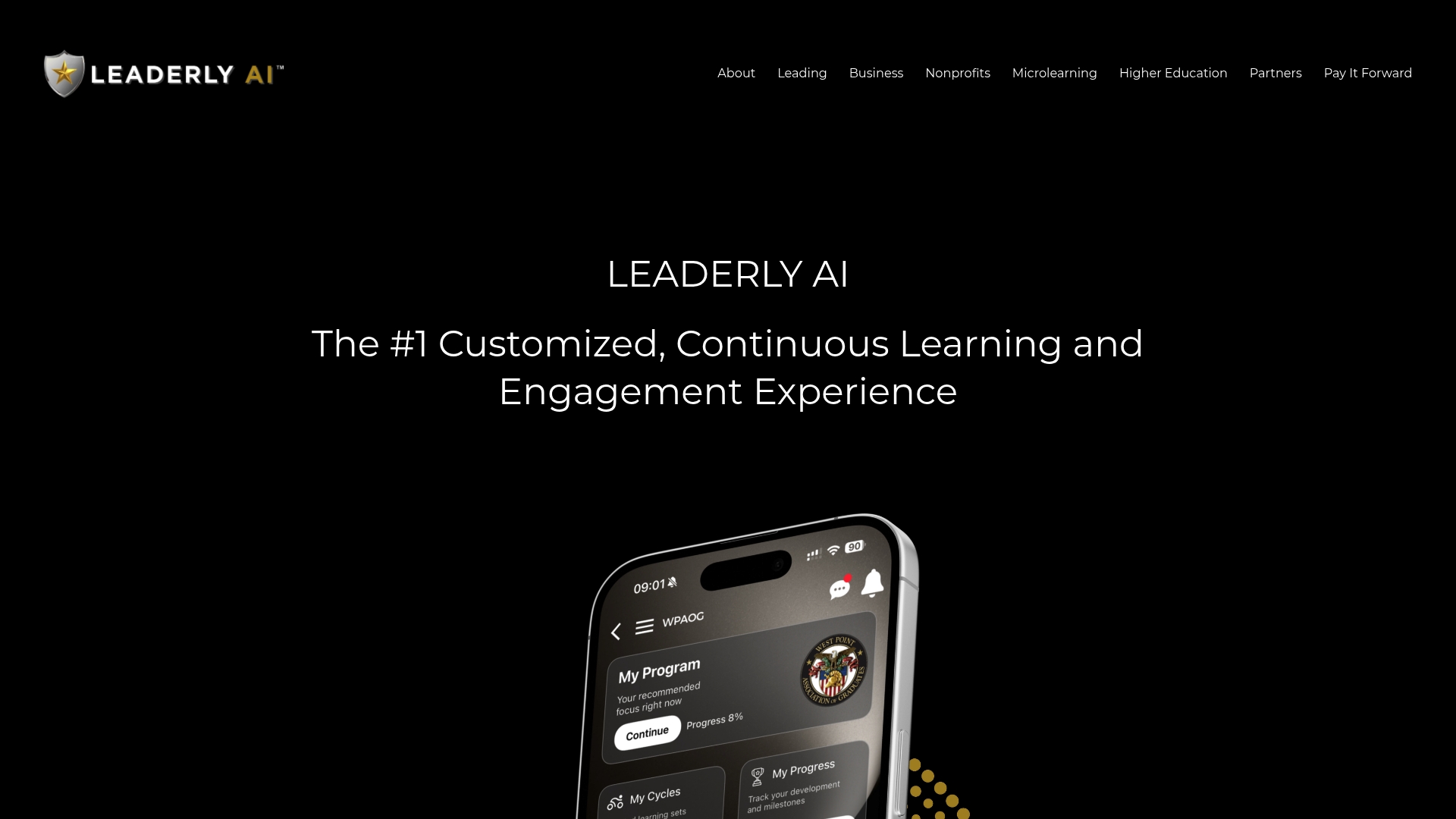
We also offer versions shaped for higher education and nonprofits, and co-branded impact programs for organizations that want to extend leadership development to their communities. Pricing is scaled to organization size, so get in touch through the Leaderly site to talk through your needs.
Common mistakes to avoid
- Teaching bias as an abstract concept. Gartner's perspective favors making inclusive behavior actionable inside ordinary leadership work.
- Training only senior leaders. Culture is built at every level.
- Ignoring the systems. If hiring and promotion processes are opaque, training will feel hollow. Embedding bias mitigation into existing processes is part of Gartner's recommendation.
- Measuring only completion. Track what people do and how teams feel.
- Stopping after launch. Build in refreshers and revisit scenarios as your workforce and work arrangements change.
- Skipping legal guidance. Inclusion programs sit near employment law. Have counsel or your compliance team review program design, particularly anything touching hiring or promotion criteria, since U.S. rules and guidance can change.
For more on building the wider environment, see our pieces on creating a more diverse, engaged and inclusive workplace and the behaviors that make an inclusive leader.
FAQ
What is inclusive leadership training?
It is development that helps leaders create fair, respectful and participatory teams. Core topics include self-awareness, bias awareness, active listening, psychological safety, inclusive decision-making and addressing exclusionary behavior. The best versions run over weeks or months and include practice, feedback and measurement.
How long should inclusive leadership training take?
There is no single correct length, but the research favors longitudinal designs over one-time sessions. A 10 to 15 minute weekly rhythm over at least a quarter, followed by regular refreshers, gives leaders time to try behaviors and reflect on them.
What are the three core components of inclusive leadership?
A 2022 systematic review organizes inclusive leadership across three levels: employee, team and organization. It describes four dimensions across them: fostering uniqueness, strengthening belonging, showing appreciation and supporting organizational inclusion efforts.
Should inclusive leadership training be mandatory?
That depends on your culture, goals and legal guidance, so involve HR and counsel. What the research stresses is relevance: training works better when it is tied to people's actual roles, uses your own scenarios and fits into existing workflows.
How do we measure results?
Track behaviors through peer and direct-report feedback, team pulse surveys on belonging and psychological safety, and process data like assignments and promotions. Compare before and after, and where possible compare against teams not yet trained.
Sources
- Inclusion & Diversity in the Workplace: Understanding and Implementing an Effective Strategy, SHRM
- Leading Inclusively Field Guide, Johns Hopkins Carey Business School
- About and beyond leading uniqueness and belongingness: A systematic review of inclusive leadership
- A systematic review of diversity, equity, and inclusion and antiracism training studies
- Matrix of Leadership Competencies by Developmental Experience, U.S. Office of Personnel Management
- Building Inclusive Leadership to Enable Future Success, Gartner