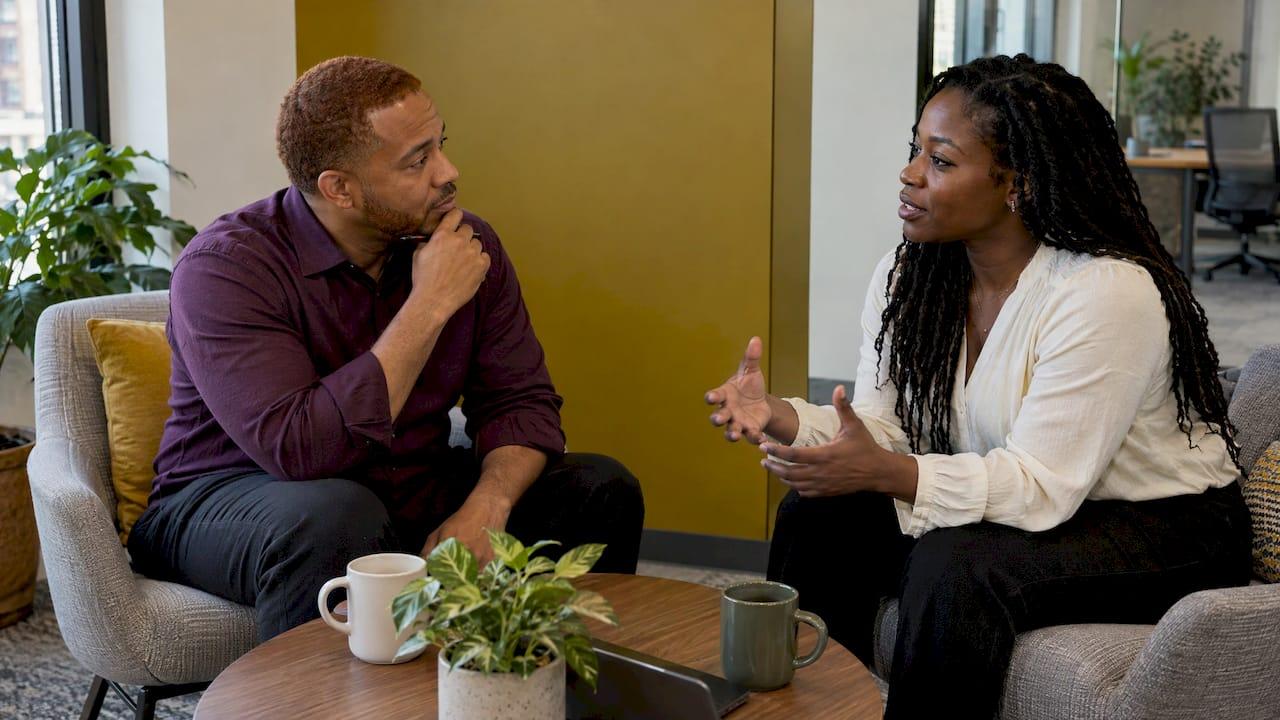
A DiSC profile example is easiest to understand as a short portrait: how one person with a given style makes decisions, runs a meeting, handles conflict and leads. Below you get a portrait for each of the four styles (Dominance, Influence, Steadiness, Conscientiousness), two blended profiles, and what each style tends to look like in a leadership role. The point is not to label people. It is to give you a shared vocabulary so a team can talk about how it works, and to turn that vocabulary into daily habits. That second step is what we build Leaderly AI for: personalized microlessons and self-assessments that put DiSC insight in front of every employee, not only managers.
The portraits below are illustrative composites written for this article, not real people or case studies.
TL;DR
- DiSC sorts workplace behavior into four styles: Dominance (results and action), Influence (enthusiasm and collaboration), Steadiness (stability and support) and Conscientiousness (accuracy and quality).
- Everyone blends all four styles. A real profile is usually a primary style plus a strong secondary one, such as D/C or S/i.
- Each style leads well in its own way and has a predictable blind spot. Leaders grow by stretching toward the styles they use least.
- DiSC describes preferences, not ability. Experience, education and maturity shape behavior too.
- Insight only changes behavior when it is practiced. Short, repeated exercises beat a one-time workshop.
Table of Contents
- What a DiSC profile actually describes
- Four DiSC profile examples
- Blended profile examples
- DiSC leadership styles at a glance
- Which DiSC style is the best leader?
- How styles change under pressure
- Using DiSC examples with your team
- Who gets the most from DiSC examples
- Our perspective
- Turn DiSC insight into daily leadership habits
- FAQ
- Sources
What a DiSC profile actually describes
DiSC is a behavioral model. It describes how a person tends to act, communicate and respond to change at work. It does not measure intelligence, skill or potential.
The U.S. Office of Justice Programs summarizes the four styles this way: Dominance emphasizes results and action, Influence thrives on enthusiasm and collaboration, Steadiness values stability and support, and Conscientiousness focuses on accuracy and quality. The same page notes that Steadiness individuals prefer gradual, well-explained transitions, while Dominant personalities adapt quickly when a change fits their goals.
The styles sit on a map built from two dimensions. According to the University of Chicago's overview of Everything DiSC, one dimension runs from active and outspoken to thoughtful and reflective, and the other from accepting and warm to questioning and skeptical. That is why D and i styles feel fast-moving and outspoken, while S and C styles feel more measured.

Two points from the same University of Chicago page matter before you read any example. All styles and priorities are equally valuable. And everyone blends all four styles, with work style also shaped by life experience, education and maturity. A profile is a starting hypothesis about a person, never a verdict.
Four DiSC profile examples
Example 1: Dominance (D), the results driver
Meet Marcus, a regional operations director (illustrative). In a meeting he asks "What's the decision and who owns it?" within the first two minutes. He volunteers for the hard project, delegates the daily work, and gets restless when a discussion circles.
Career guidance from Indeed describes high-D employees as focused, self-reliant self-starters who take risks, see the big picture and prefer fast-paced, task-oriented work. The same guide notes they can struggle with details and planning, and that forceful, impatient behavior can intimidate others.
As a leader: Marcus sets direction quickly and makes teams feel momentum. His growth edge is slowing down enough to ask for input, so quieter team members do not stay silent.
Working with a D: Lead with the bottom line, bring options rather than problems, and keep updates short.
Example 2: Influence (i), the energizer
Meet Priya, a customer success manager (illustrative). She opens every call with a personal check-in, remembers birthdays, and can rally a team after a rough quarter. Her inbox, however, is a mess, and she would rather talk through a plan than write it down.
The same Indeed guide describes high-i employees as energetic, sociable communicators who highlight positives in difficult situations and thrive in people-oriented, team-based roles. It also notes they struggle with consistent, predictable routines and need regular interaction with others.
As a leader: Priya builds belonging and excitement and is good at selling a vision. Her growth edge is follow-through: turning enthusiasm into owners, dates and written commitments.
Working with an i: Make time for conversation, recognize contributions publicly, and agree on next steps in writing afterward.

Example 3: Steadiness (S), the stabilizer
Meet Daniel, a team lead in a hospital billing department (illustrative). He is the person colleagues quietly go to when they are stressed. He rarely interrupts, prefers to hear everyone before weighing in, and keeps the team's processes running smoothly.
The Office of Justice Programs page above notes that Steadiness individuals prefer gradual, well-explained transitions. That is the key to understanding Daniel: sudden reorganizations are hard for him, but a change explained step by step earns his full support.
As a leader: Daniel creates trust and a calm, supportive team. His growth edge is speaking up early when he disagrees, instead of absorbing friction to keep the peace.
Working with an S: Give advance notice of changes, explain the reasons, and ask directly for their opinion, because they may not volunteer it.
Example 4: Conscientiousness (C), the quality guardian
Meet Elena, a finance manager (illustrative). She checks the numbers twice, asks "How do we know that's true?" and writes documentation others rely on. She is uncomfortable shipping something that is not right.
In DiSC terms, Conscientiousness focuses on accuracy and quality, and on the map it sits on the thoughtful, questioning side.
As a leader: Elena sets high standards and catches errors before they become expensive. Her growth edge is deciding with imperfect information and giving people room to do work in their own way.
Working with a C: Bring data, give time to think, and avoid pressuring them for an instant answer.
Blended profile examples
Most people do not live in one corner. Because everyone blends all four styles, a person usually shows a primary style with a strong secondary pull. Two common blends show how different a single letter can look.
D/C: the driven analyst
This leader combines urgency with rigor. Picture a product director who wants a bold roadmap but insists on the data behind it. Teams get clarity and high standards, but may feel little warmth. The stretch move is to add relationship time to the weekly rhythm: one real conversation per direct report that has nothing to do with deliverables.
S/i: the supportive connector
This leader is warm, patient and approachable. Think of a school principal who knows every family and keeps the staff calm through a hard year. The risk is conflict avoidance and slow decisions. The stretch move is to name a decision deadline in advance and communicate it, so kindness does not turn into drift.
If you would like to see how the letters combine in a full profile, our guide to DiSC versus MBTI explains what each assessment captures and where the two overlap.
DiSC leadership styles at a glance
The table summarizes how each style tends to lead. Treat it as a map of tendencies, not a rulebook.
| Style | Leadership strength | Typical blind spot | Best stretch habit |
|---|---|---|---|
| D (Dominance) | Fast direction and accountability | Can overrun quieter voices | Ask two questions before deciding |
| i (Influence) | Vision, morale and persuasion | Loose follow-through | Confirm owners and dates in writing |
| S (Steadiness) | Trust, consistency and listening | Avoids tension and sudden calls | Share disagreement early |
| C (Conscientiousness) | Quality, analysis and standards | Over-analysis and perfectionism | Set a good-enough threshold |
The University of Colorado Boulder connects style to leadership practice through its DiSC Work of Leaders program, which uses a Vision, Alignment and Execution framework with three drivers for each step. The idea is useful beyond that course: every leader has to set direction, bring people along and deliver, and each DiSC style finds one of those three steps more natural than the others.
Which DiSC style is the best leader?
None. This is the most common misunderstanding, and the University of Chicago page is explicit that all styles and priorities are equally valuable.
A better question is which style a situation calls for. A crisis may need D-style decisiveness. A merger may need S-style steadiness to keep people connected. A product launch may need i-style energy, and a compliance audit needs C-style precision. Leaders who do well over time are not the ones with a particular letter. They are the ones who can borrow from the other styles when the moment needs it.
That ability is often called leadership range. Our five-step micro practice plan for DiSC leaders walks through building it with small repeated actions rather than one big training event.
How styles change under pressure
Two people with the same profile can look very different on a good day and a bad one. Pressure tends to exaggerate a person's natural style: a D becomes blunt, an i becomes scattered, an S goes quiet and withdraws, a C becomes critical or stuck in detail. This is a pattern worth watching for rather than a fixed rule, and the research on how DiSC behaves under stress is far thinner than the research on the basic styles, so use it as a prompt for conversation, not a diagnosis.
A practical habit: ask team members what their style looks like when they are stressed and what they would like colleagues to do. Simply naming it often lowers the temperature.
Using DiSC examples with your team
Examples are only valuable if they change what people do on Monday morning. Here is a sequence that works for HR teams, educators and managers alike.
- Start with self-awareness. Each person completes a DiSC assessment and reads their own results first, before anyone compares.
- Share voluntarily. Let people choose how much to reveal. A style is a conversation starter, not a label for a file.
- Translate styles into requests. "I need the headline first" or "I need a day to think" is more useful than "I'm a D" or "I'm a C."
- Pick one stretch behavior. A D practices asking questions, an S practices voicing disagreement, and so on.
- Repeat in short bursts. Habits form through frequent small practice, not an annual workshop.
For leaders adapting how they work to different people and settings, we also collect perspectives on adapting your leadership style to fit any situation.
Adapting communication to each style
- With D: Short, direct, outcome-first. Offer choices.
- With i: Warm, conversational, with space for ideas. Follow up in writing.
- With S: Calm, unhurried, with context and advance notice.
- With C: Precise, with evidence and time to review.
This matters even more for distributed teams, where tone is easier to misread. Our roundup of leaders on communicating remotely shows how different leaders handle it.
Technology leaders and operating rhythm
Style also shapes how a manager sets up the rhythm of a team: which meetings exist, how decisions are recorded, who sees what. If you are formalizing that rhythm, a management operating system is a helpful frame, and DiSC gives you language to check whether the system works for a D who hates long meetings as well as a C who wants everything documented.
Who gets the most from DiSC examples
HR professionals can use style portraits to design development programs that make sense to every employee, not just managers. Emerging leaders can find the blind spot attached to their natural style early, before it becomes a reputation. Educators can use them in leadership courses so students practice with real scenarios. Veterans moving into civilian roles often find DiSC a useful translation tool: it gives plain words for how people in a mixed civilian team prefer to receive direction, make decisions and handle disagreement, which differs from a chain of command.
Our perspective
Most organizations treat DiSC as an event: a workshop, a colorful report, a few weeks of nodding agreement, and then a PDF that nobody opens again. The examples in a profile are only the start. Behavior changes when people practice a small thing, often, in the flow of their real work.
That is why we built Leaderly AI around microlessons, habit-building exercises and self-assessments including DiSC, EQ and MBTI. A D can practice asking one more question before deciding. An S can practice raising a concern early. The content is personalized with machine learning, so it evolves with each person's journey instead of handing everyone the same lesson.
We also believe leadership development should not be reserved for managers. Emerging leaders, front-line staff, volunteers and students all lead in some moment, and the platform is designed to scale to all of them, with analytics dashboards that help HR see what is being learned and practiced.
The best DiSC example is not in a report. It is the moment someone on your team does something they would not naturally do, because they now understand the person across from them.
Drew Bartkiewicz
Turn DiSC insight into daily leadership habits
Leaderly AI is a mobile-first platform for organizations that combines self-assessments such as DiSC, personalized microlessons, practical exercises and analytics, so leadership development reaches every employee, not only managers. We offer versions for businesses, nonprofits and higher education. To see how it could work for your people, start at Leaderly AI.
FAQ
What is a DiSC profile?
A DiSC profile is a report describing your behavioral tendencies across four styles: Dominance, Influence, Steadiness and Conscientiousness. It shows your primary style and how you blend the others. It describes preferences in communication and decision-making, not skills or intelligence.
What is the rarest DiSC style?
There is no single reliable answer. Published figures vary by assessment and sample, so treat any claim about a rarest or most common style cautiously. What matters more is that every team contains a mix, and that each style adds something different.
Can a person have more than one DiSC style?
Yes. Everyone blends all four styles, and most people tend strongly toward one or two. A D/C or S/i profile is common, and your behavior can shift with the role, the pressure and your experience.
Which DiSC leadership style is best?
No style is better. Each leads well in different situations and has its own blind spot. Effective leaders learn to borrow from styles they use less often, which is why practice matters more than the label.
Is DiSC the same as MBTI?
No. DiSC focuses on observable workplace behavior and communication, while MBTI focuses on personality preferences such as how you take in information and decide. Many organizations use both, and our comparison of DiSC and MBTI explains when each fits.
Sources
- U.S. Office of Justice Programs: Improving Teamwork, Communication, and Productivity in the Workplace
- University of Chicago Center for Leadership and Involvement: Everything DiSC
- University of Colorado Boulder Human Resources: DiSC Leadership
- Indeed Career Guide: The 4 DISC Personality Types
- Raremind: Management Operating System