
DiSC does not crown one leadership style as the best. It maps behavioral tendencies across four dimensions, and the strongest leaders learn to flex across styles rather than lean on one by default. If you want results, get your DiSC report, find your dominant tendency, and pick exactly one behavior to practice this week.
TL;DR:
- High-D leaders make quick decisions but may overlook team input, especially in a crisis where commanding behavior is essential.
- High-I leaders energize teams and sell visions, yet might avoid addressing difficult accountability conversations that impact long-term results.
- High-S leaders foster trust but can delay necessary change or avoid conflict to maintain team comfort, impacting agility.
- High-C leaders identify errors and ensure accuracy but risk slowing momentum or over-analyzing decisions, especially in fast-moving situations.
- Behavior change from a DiSC profile requires consistent practice, feedback, and scaling habits, not just reading the report or completing the assessment.
Table of Contents
- What Disc for Leaders Actually Measures
- How Each DiSC Style Shows Up in Leadership
- Turning a DiSC Profile Into Daily Practice
- Scripts You Can Use This Week, By Style
- What It Costs to Buy and Scale DiSC Across a Team
- A Note on Using DiSC Inside Continuous Development
- Scaling DiSC-Driven Development With Leaderly AI
- Sources
- FAQ
What Disc for Leaders Actually Measures
DiSC is a behavioral-preference instrument. It tells you how you tend to communicate, decide, and influence others under normal conditions, not how skilled or capable you are. That distinction matters when you're reading your own report or handing one to a direct report.
The four core dimensions each carry a distinct leadership signature:
- Dominance (D): drives fast decisions and results but can steamroll input from quieter team members.
- Influence (I): builds energy and buy-in but sometimes avoids the hard conversation that needs to happen.
- Steadiness (S): creates stability and trust but may delay necessary change to keep the peace.
- Conscientiousness (C): brings rigor and accuracy but can slow momentum chasing the last detail.
Major DiSC publisher materials package these into eight leadership-type labels: pioneering and commanding lean heavily on D, energizing and affirming skew toward I, inclusive and humble map to S, and deliberate and resolute reflect C at different intensities. The labels are marketing language for the same four underlying dimensions, just split finer for readability.
One caution worth repeating: assessment vendors and reviewers are explicit that DISC was never built as a hiring filter. It measures preference, not competence, and using it to screen candidates invites both legal risk and bad hires. Treat it as a development tool for people already on your team, not a gate for people trying to join it.
How Each DiSC Style Shows Up in Leadership
Every dimension brings a real advantage into a leadership role, and every dimension has a blind spot that shows up right on schedule.
A high-D leader moves fast and owns tough calls, but often mistakes silence for agreement instead of hesitation. A high-I leader rallies a room and sells a vision, yet can dodge the accountability conversation a struggling employee actually needs. A high-S leader steadies a team through chaos, but sometimes protects comfort at the expense of a change that has to happen. A high-C leader catches the errors nobody else sees, but can bury a good decision under one more round of analysis.
The switch points are situational, not personal:
- Crisis moments call for more command, even from naturally collaborative leaders.
- Scaling phases call for more coaching and delegation, even from naturally directive leaders.
- Change initiatives call for more inclusion, even from naturally results-driven leaders.
Leadership research summarized by Psychology backs this up directly: leaders who can shift between styles as conditions change tend to produce healthier team climates than leaders who ride one dominant style regardless of context. Range, not purity, is the trait that predicts better outcomes.
Turning a DiSC Profile Into Daily Practice
A report sitting in a folder changes nothing. Behavior changes when a profile turns into a repeatable habit, and that takes a process, not a poster on the wall.
- Read your headline, then pick one behavior. Don't try to rewire your whole style. Choose the single blind spot costing you the most right now, like a high-D leader who interrupts before others finish a thought.
- Turn it into a weekly micro-habit. Something small enough to track: "In every 1:1 this week, I ask one question before offering a solution."
- Practice it out loud before you need it. Short role-play sessions, even five minutes with a peer, build the muscle memory that a slide deck never will. Structured facilitation, not a one-time workshop, is what makes the shift stick.
- Collect quick feedback and adjust. A simple team pulse question or a direct "how did that land?" after a tense conversation tells you whether the habit is actually landing differently.
- Measure it and scale it. Track the habit over weeks, not days, and use short recurring prompts to keep it alive after the novelty fades.
Pro Tip: Pick a behavior your team will actually notice within two weeks. If nobody can tell the difference, the habit was too small to matter or too vague to practice.
Forbes Coaches Council members make a related point worth internalizing: personality informs leadership tendencies but doesn't guarantee performance on its own. Talent gets developed through repetition, not discovered fully formed in a report. Structured exercises that translate DISC results into behavior change work because they force the practice step that a static profile skips entirely.
Scripts You Can Use This Week, By Style
Language matters more than most leaders admit. The same feedback lands completely differently depending on how it's phrased for the person receiving it.
Opening a 1:1: a high-D employee wants "Here's the outcome we need, what's your read?" A high-I employee responds better to "Catch me up, how's the team energy this week?" A high-S employee needs "No rush, what's actually on your mind?" A high-C employee wants "Walk me through your reasoning on this one."

Corrective feedback follows the same logic. Be blunt and brief with a D. Be warm but specific with an I, since vague praise reads as empty. Be reassuring and concrete with an S, who may hear criticism as a bigger threat than intended. Be evidence-based with a C, who will pick apart feedback that isn't backed by specifics.
Delegation checklist: give a D the outcome and get out of the way. Give an I public visibility alongside the task. Give an S time to process before committing. Give a C the full context and the reasoning behind the deadline.
The most common failure: a directive leader delegating to a C without explaining why, which reads as arbitrary and triggers over-analysis instead of action.
What It Costs to Buy and Scale DiSC Across a Team
Retail pricing for a single DiSC profile typically runs $60 to $90 per person, with facilitator certification running roughly $1,895 on top of that for organizations that want to run sessions internally.
The profile itself is the cheap part. The real cost driver is facilitation: the coaching, role-play, and follow-up practice that convert a PDF into a changed habit. Skip that investment and you've bought an expensive personality label. Certification makes sense once you're running sessions across dozens of leaders regularly; below that scale, an external facilitator or a structured leadership development program usually costs less per outcome.
A Note on Using DiSC Inside Continuous Development
Profiles change behavior only when paired with real practice and honest feedback. A DiSC report is a starting map of your tendencies, never a fixed identity to hide behind.
— Drew
Scaling DiSC-Driven Development With Leaderly AI
Some programs turn a one-time DiSC report into an ongoing habit, not a filed-away PDF. Beyond the assessment stage, these programs may offer microlessons tied to specific dimensions, habit prompts to practice the chosen behaviors, and analytics dashboards to track habit adoption across teams.
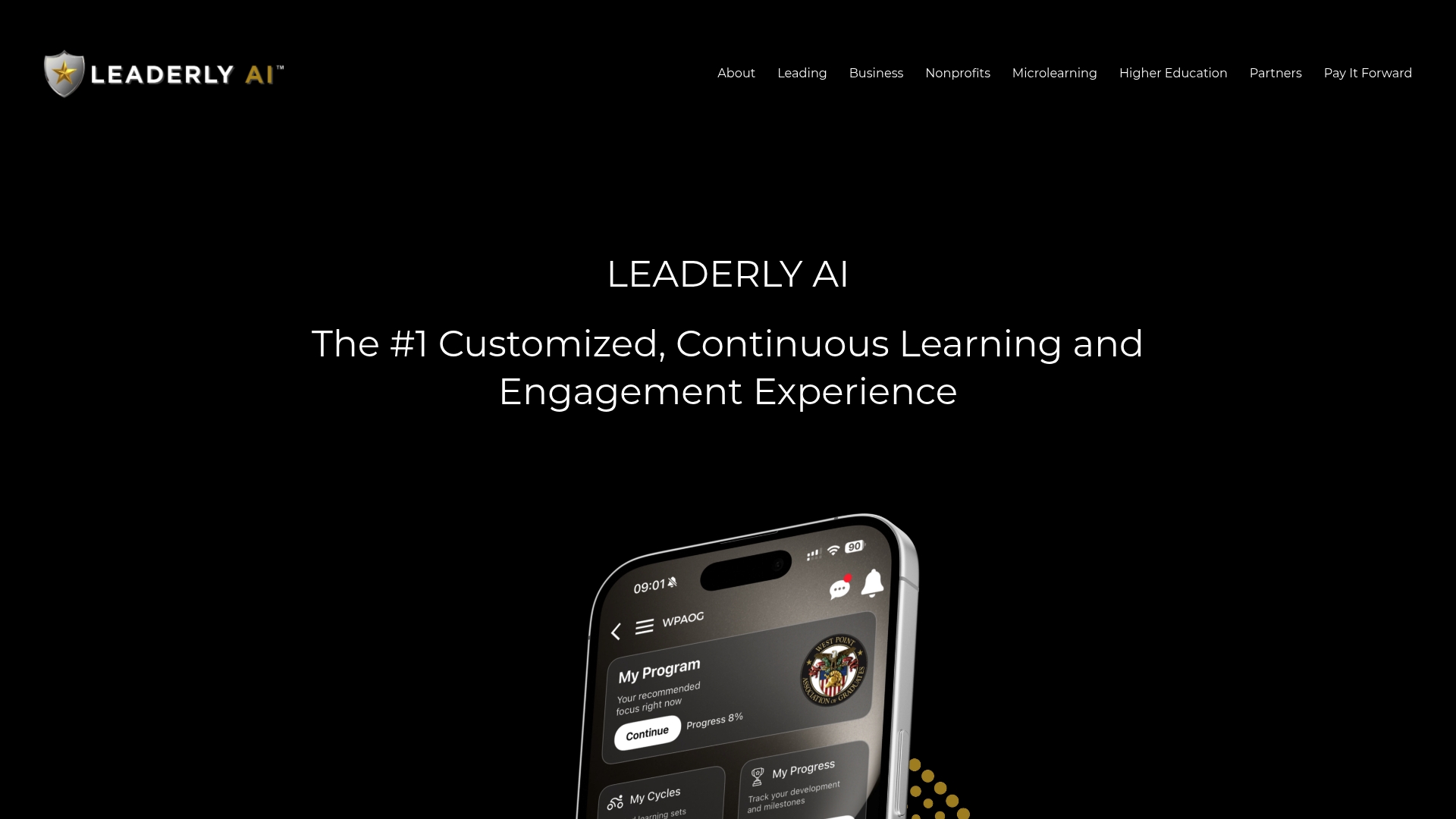
That combination matters because, as the pricing breakdown above shows, facilitation and follow-through are what actually move behavior, not the assessment itself. Machine learning can adapt content to each person's DiSC tendencies as they progress, allowing for different coaching approaches rather than generic modules. Organizations exploring this at scale can review Continuous professional development and leadership engagement for all to see how the platform supports teams past the report stage, and request a demo to pilot it with a single leadership cohort before rolling it out wider.
Sources
- Psychology
- 14 insights into how talents and personality influence leadership performance | Forbes
- DISC assessment cost: $60 to $90, plus $1,895 to certify | SharpAssessment
FAQ
What DiSC style is best for leadership?
No single DiSC style is best for leadership. Leaders who deliberately practice behaviors outside their default style tend to produce better team climates than leaders who stick to one dominant approach regardless of the situation.
What DiSC type are most CEOs?
There's no verified data showing most CEOs cluster into one DiSC type, and high-D and high-I profiles are commonly discussed in leadership contexts because both push toward visible, fast-moving leadership behaviors. Plenty of effective CEOs test as high-C or high-S, particularly in operations-heavy or highly regulated industries.
What DiSC type is Elon Musk?
There's no published or verified DiSC assessment result for Elon Musk, so any specific type attributed to him online is speculation rather than fact. Public behavior patterns are not a substitute for an actual completed assessment.
What is the rarest DiSC personality?
DiSC profiles are combinations of the four dimensions, so "rarest" depends on which blended profile a given publisher's data set is measuring, and that breakdown isn't publicly standardized across vendors. Rather than chasing rarity, focus on identifying your own dominant and secondary dimensions and the blind spots that come with that combination.
What is the difference between DiSC and other leadership assessments?
DiSC focuses specifically on communication and behavioral preference, while frameworks like MBTI measure broader personality typing and some tools measure observed performance from others. DiSC assessment for teams is generally faster to administer and easier to apply to day-to-day management scripts than more clinical personality instruments.