
Leadership presence is the observable pattern of behavior, communication, and emotional steadiness that makes other people trust you, follow your lead, and feel safe enough to do their best work around you. It is not a personality type or a stage trick. It's a set of skills you build, and it shows up the moment you walk into a room, open your mouth in a meeting, or send a two-line email during a crisis.
That distinction changes everything about how you should approach it. If presence were an innate trait, you'd either have it or you wouldn't. Because it is a practiced behavior, anyone at any level, from a first-time team lead to a division president, can strengthen it deliberately. Leaders with real presence tend to produce three concrete outcomes: faster trust, clearer decisions, and enough psychological safety that people speak up before small problems turn into expensive ones.
This article unpacks the elements behind that definition, in the order you'll actually need them:
- Authentic self-expression (not a curated persona)
- Communication clarity, including how you frame and pace what you say
- Emotional regulation under pressure
- Purposeful nonverbal signaling
- A staged practice routine you can start this week
Key Takeaways
Leadership presence is a set of observable, trainable behaviors, not an innate trait, and it improves through staged, repeated practice rather than a single confidence boost.
| Point | Details |
|---|---|
| Presence is behavioral | It shows up in specific verbal, nonverbal, and listening habits you can observe and adjust. |
| It affects real outcomes | Stronger presence correlates with faster trust, better decisions, and higher psychological safety. |
| Practice it in stages | Use the six-stage pathway (anticipation through reinforcement) instead of treating presence as fixed. |
| Track it with simple measures | Use pulse surveys, self-observation logs, and 360 feedback rather than guesswork. |
| Leaderlyapp supports the habit | Its microlearning and assessments give teams a scalable way to practice each element continuously. |
Table of Contents
- What Is Leadership Presence Explained Through Real Behavior?
- Why Does Leadership Presence Matter for Teams and Organizations?
- What Are the Core Elements of Leadership Presence?
- What Frameworks Explain Leadership Presence?
- How Do You Develop Leadership Presence?
- How Do You Know If Your Leadership Presence Is Improving?
- What Are the Biggest Misconceptions About Leadership Presence?
- How Long Does It Take to Build Leadership Presence?
- What Does the Research Say About Leadership Presence?
- A Personal Note on Practicing Presence as a Habit
- A Practical Way to Practice Presence at Scale
- Frequently Asked Questions
- Sources
What Is Leadership Presence Explained Through Real Behavior?
Presence is easiest to spot when you stop thinking about it as a vibe and start watching for specific, repeatable behaviors. Psychology Today's coverage of the topic clusters it around seven trainable skills: self-awareness, humble confidence, active listening, empathy, authenticity, and respectful communication, all of which build trust and motivation rather than simply project confidence.
Here's what those skills look like translated into a normal workday:
- Verbal cues: short, declarative sentences during a crisis update instead of hedged, rambling explanations
- Nonverbal cues: steady eye contact, an unrushed pace, and hands that stay still instead of fidgeting when a tough question lands
- Listening cues: a pause before responding, and a follow-up question that references something the other person actually said
- Interpersonal cues: naming the tension in the room out loud ("I know this feels rushed") instead of pretending it doesn't exist
Picture three scenarios. In a crisis update, a leader with presence says, "Here's what we know, here's what we don't, and here's our next check-in time." A leader without it either over-explains out of anxiety or goes silent and lets rumors fill the gap. In a one-on-one feedback conversation, presence sounds like specific, forward-looking language: "Here's what I saw, here's the impact, here's what I'd like to see next time." Without presence, feedback drifts into vague generalities or gets buried under small talk because the leader is uncomfortable with the discomfort of the moment.
Context also changes the shape of presence. A boardroom rewards brevity and directness. A one-on-one rewards warmth and curiosity. A remote meeting demands more deliberate vocal energy and camera engagement, because half the usual nonverbal channel (posture, spatial presence) simply disappears. Leaders who only know one register tend to read as flat in the settings that don't match it.

Why Does Leadership Presence Matter for Teams and Organizations?
Presence matters because it directly shapes how fast a team moves and how honest people are willing to be with each other. Leaders who project it produce faster alignment, better decisions under ambiguity, and teams willing to raise problems early instead of hiding them until they explode.
Gallup's research on manager effectiveness has repeatedly found that leader behaviors account for a large share of the variation in team engagement scores, which means the quality of a single manager's day-to-day presence ripples through retention and performance far more than most org charts suggest. A concept analysis published in the Nursing Forum journal reached a similar conclusion from a different field: leadership presence correlates with measurable antecedents like emotional intelligence and produces downstream organizational and individual outcomes, not just softer, harder-to-measure "vibes."
The payoff shows up in a few concrete places:
- Faster team alignment because people don't have to guess what the leader actually wants
- Stronger psychological safety, so problems surface while they're still small
- Higher retention, since people rarely quit roles where they feel seen and trusted
- Better decisions, because presence invites dissent instead of silencing it
When presence is absent, the costs compound quietly. A leader who can't hold steady in ambiguity trains their team to stop bringing them bad news. A leader whose messaging is inconsistent between meetings loses credibility fast, and credibility is far more expensive to rebuild than it was to maintain. Psychology Today frames this as especially urgent during periods of uncertainty, when presence becomes the differentiator between teams that freeze and teams that adapt.
What Are the Core Elements of Leadership Presence?
Every credible framework for leadership presence converges on a similar handful of dimensions. Here's how to think about each one, along with where to focus first.
- Authenticity. Your words, actions, and internal state need to line up. When they don't, people notice the mismatch even if they can't name it. Start here if you've ever been told you seem "guarded" or "hard to read."
- Communication clarity. Short sentences, a clear ask, and a defined next step beat eloquence every time. Start here if your meetings tend to end without anyone knowing what happens next.
- Emotional regulation. Your nervous system sets the emotional temperature of the room before you say a word. Start here if you notice your team gets visibly tense when you walk in stressed.
- Purposeful framing. How you introduce a topic determines how people receive it, so "we have a problem" and "we have a decision to make" produce very different rooms. Start here if your updates tend to trigger panic instead of focus.
- Active listening. A genuine pause before you respond signals that you actually processed what was said, not just that you're waiting your turn. Start here if colleagues tell you they feel unheard.
- Consistency over time. Presence built in one great meeting evaporates if your next three are erratic. Start here if your reputation feels like it depends on your mood that day.
- Nonverbal alignment. Posture, pace, and eye contact either reinforce your words or quietly undercut them. Start here if people say you seem tense even when your message is calm.
These elements interact more than they stack. Authenticity amplifies everything else, since a technically correct message delivered without alignment between your words and your actual state reads as hollow. Emotional regulation is the substrate the other six sit on: a leader who is dysregulated cannot sustain clear framing or genuine listening no matter how much they've rehearsed either one.
What Frameworks Explain Leadership Presence?
Several models describe presence, and they split roughly into two camps: trait lists and staged pathways.
- Trait-based lists (the classic "C's" style frameworks) name qualities like confidence, connection, clarity, and character, and they're useful as a quick diagnostic checklist.
- Principle lists, like Strategy+Business's practitioner-oriented set, translate theory into specific behaviors, such as showing up as a whole person and beginning conversations others actually want to continue.
- Executive presence pillars, historically weighted toward gravitas and polish, have shifted meaningfully in recent years. Harvard Business Review's 2024 coverage argues the modern version emphasizes relational skill, inclusion, and adaptability over the older command-and-control image of authority.
- Staged pathway models, like the one from IMD Business School, treat presence as something you build sequentially rather than something you either radiate or don't.
The difference matters practically. A trait list tells you what good presence looks like at the finish line, but it doesn't tell you what to do on a Tuesday. A staged pathway breaks presence into moments you can actually rehearse. IMD's model names six of them: Anticipation, First Impressions, Engagement, Messaging, Consolidation, and Reinforcement, and it argues presence has to be practiced at each stage rather than treated as one fixed trait you either bring into the room or don't. That staged structure is what makes the rest of this article practical instead of aspirational.
How Do You Develop Leadership Presence?
Development works best when you treat each stage of the IMD pathway as its own habit to train, not as a single workshop you attend once and check off. Here's a practical version of that pathway, adapted into steps you can start using this week.
- Anticipation. Before any high-stakes interaction, spend two minutes naming your goal for the room and the emotional tone you want to set. Skipping this step is why leaders walk into meetings reactive instead of intentional.
- First impressions. Practice your opening line out loud, not just in your head. The first fifteen seconds of a meeting set the emotional frame for everything that follows.
- Engagement. During the interaction, track how much you're talking versus asking. A rough target: if you're talking more than 60% of the time in a discussion meant to gather input, you're likely overriding presence with volume.
- Messaging. Cut your key message down to one sentence before you deliver it. If you can't compress it, you probably haven't fully clarified it yourself yet.
- Consolidation. Right after the interaction, write two lines: what landed, and what you'd change. This single habit, done consistently, builds self-awareness faster than almost anything else.
- Reinforcement. Revisit your consolidation notes weekly and look for patterns, not one-off wins or misses.
Layer in a few recurring micro-practices. A short daily breathing exercise before your first meeting regulates your nervous system before it has a chance to leak into your tone. A weekly role-play with a peer, rehearsing a hard conversation before you have it for real, builds the muscle memory that makes real-time composure possible. In virtual meetings specifically, look directly at the camera during your key sentence rather than at the gallery of faces, since that single adjustment reads as far more direct on the other end.
Pro Tip: Practice "regulation first, message second." Before you deliver anything important, take one slow breath and silently name your emotional state. Leaders who skip this and go straight to messaging tend to transmit their anxiety along with their content, even when the words themselves are perfectly composed.
Indeed's career guidance echoes several of these same fundamentals for everyday work contexts, including controlling body language and leading by example as consistent, low-cost habits rather than one-time interventions.
How Do You Know If Your Leadership Presence Is Improving?
Presence is measurable if you track the right behavioral indicators instead of waiting for a vague feeling that you've "arrived." Watch for how often you interrupt versus get interrupted, how clearly people can restate your key message after a meeting, and whether team members bring you bad news proactively or you have to dig for it.
Three simple instruments work well without requiring an HR department:
- A short 360-feedback prompt asking colleagues to rate your clarity and approachability on a 1 to 5 scale, sent quarterly
- A self-observation checklist you fill out right after high-stakes meetings, tracking whether you stayed at your intended emotional tone
- A one-question pulse survey to your direct reports: "Do you feel comfortable raising a concern with me?"
| Measure | How to collect it | What improvement looks like |
|---|---|---|
| Interruption frequency | Peer or self-observation during meetings | Fewer interruptions of others over 4 to 6 weeks |
| Message clarity | Ask two attendees to restate your key point post-meeting | Consistent, accurate restatements without you repeating yourself |
| Psychological safety | One-question pulse survey to direct reports | Rising comfort scores raising concerns, tracked quarterly |
| Emotional consistency | Self-rated log after high-stakes interactions | Smaller gaps between intended and actual tone over time |
The practice-oriented framework published in the Journal of Management and Development in Corporations takes this same approach further, proposing an eight-practice profile designed specifically to make presence observable and teachable rather than left to subjective impression.
What Are the Biggest Misconceptions About Leadership Presence?
The most damaging myth is that presence equals charisma. Charisma is a personality style; presence is a set of behaviors anyone can practice regardless of whether they're naturally extroverted or quiet by nature. A soft-spoken introvert with excellent emotional regulation and clear messaging often carries more real presence than a loud extrovert whose energy is all volume and no substance.
A second myth: presence is reserved for executives. It isn't. The concept analysis in Nursing Forum specifically studied presence among frontline nurse leaders, not C-suite executives, and found the same behavioral antecedents applied regardless of title. A new team lead running their first stand-up meeting needs presence just as much as a CEO addressing the board.
The most common training pitfall is mimicking a persona instead of practicing alignment. Leaders coached to "act more confident" often end up performing a version of confidence that feels hollow to everyone watching, because their words, actions, and internal state don't actually match. Coaching literature on this consistently argues that authentic alignment, not persona-adoption, is the higher-leverage path, since a leader whose signals are internally consistent becomes a clear signal in the noise that others can regulate against, rather than another performance to decode.
- Myth: Presence means being the loudest voice in the room. Correction: Practice pausing before you speak instead of speaking first.
- Myth: Presence is fixed once you reach senior leadership. Correction: Reinforcement is one of the six stages precisely because presence decays without maintenance.
- Myth: Over-polishing your delivery builds presence. Correction: Over-rehearsed delivery often reads as less authentic, not more; aim for clarity, not performance.
Pro Tip: If a coaching program is teaching you to imitate someone else's leadership style word for word, that's a warning sign. The goal is alignment with your own values and voice, not a copy of someone else's.
How Long Does It Take to Build Leadership Presence?
Expect small, noticeable shifts within a few weeks of consistent practice, meaningful behavioral change over a few months, and culture-level shifts, where your whole team's communication norms change, to take anywhere from six months to two years. That range isn't discouraging; it reflects the same timeline organizations report for broader culture change efforts, and presence development is essentially culture change at the individual level.
Your approach should match your budget, role, and urgency:
- Self-directed practice costs nothing but your time and works well for motivated individuals with a clear framework to follow, though it lacks external feedback.
- One-on-one coaching offers the fastest personalized feedback loop but scales poorly across a large organization and carries the highest per-person cost.
- Cohort-based workshops build shared vocabulary across a team at a moderate cost, though the behavior change tends to fade without follow-up reinforcement.
- SaaS-based microlearning scales efficiently across an entire organization at a lower per-person cost than coaching, and it works best when paired with regular practice nudges rather than a one-time course.
If you're an individual leader with a tight timeline before a big presentation, coaching or focused self-practice makes sense. If you're an HR leader trying to build presence across two hundred managers, scalable coaching approaches paired with microlearning tend to outperform a single expensive workshop that everyone forgets within a month.
What Does the Research Say About Leadership Presence?
The IMD Leadership Presence Pathway is the most complete staged model currently available, and it's worth understanding in more depth than the earlier overview. IMD's six stages, Anticipation, First Impressions, Engagement, Messaging, Consolidation, and Reinforcement, exist specifically so organizations can design practice routines and measure incremental improvement stage by stage instead of trying to fix presence all at once.
That staged approach matters because it converts an abstract quality into a training problem. Academic and practitioner literature increasingly agrees on this point. The practice-oriented framework in the Journal of Management and Development in Corporations operationalizes presence as observable behavior rather than personality, and the Nursing Forum concept analysis independently arrived at a similar behavior-focused conclusion from clinical leadership research.
| Research claim | Practice implication |
|---|---|
| Presence is staged, not fixed (IMD) | Train each stage (anticipation, engagement, etc.) as its own habit |
| Presence is behaviorally observable (JMDC) | Use checklists and behavioral logs instead of vague self-assessment |
| Presence has measurable antecedents like emotional intelligence (NUF) | Prioritize emotional regulation training early in development |
| Modern presence favors relational skill over polish (HBR) | Shift coaching emphasis from delivery polish to listening and inclusion |
Taken together, these findings point in one direction: presence responds to deliberate, staged practice a great deal more than it responds to personality coaching or generic confidence-building exercises.
A Personal Note on Practicing Presence as a Habit
Presence isn't something you arrive at and then keep forever. Treating it as a daily practice rather than a personality trait you either have or lack changes how you approach a bad meeting or an off day. The leaders who sustain strong presence over years aren't the ones who never lose their composure. They're the ones who notice quickly when they have, and reset before the next interaction.
That's the philosophy behind how Leaderlyapp approaches habit-building: short, repeatable practices beat a single intensive workshop, because presence decays without reinforcement, exactly as the IMD pathway's final stage suggests. If you want a starting point, try the consolidation exercise from earlier in this piece: after your next important conversation, write two lines about what landed and what you'd change. Do it for two weeks before you judge whether it's working.
A Practical Way to Practice Presence at Scale
Building presence as an individual habit is one thing. Building it consistently across fifty managers, or five hundred, is a different problem entirely, and it's the one Leaderlyapp was built to solve. Instead of a single workshop that fades within weeks, Leaderlyapp delivers personalized microlessons and behavioral exercises that map directly onto the staged practice model covered above: short daily prompts for anticipation and reflection, built-in self-assessments, and nudges that reinforce the habit long after a training session would have been forgotten.
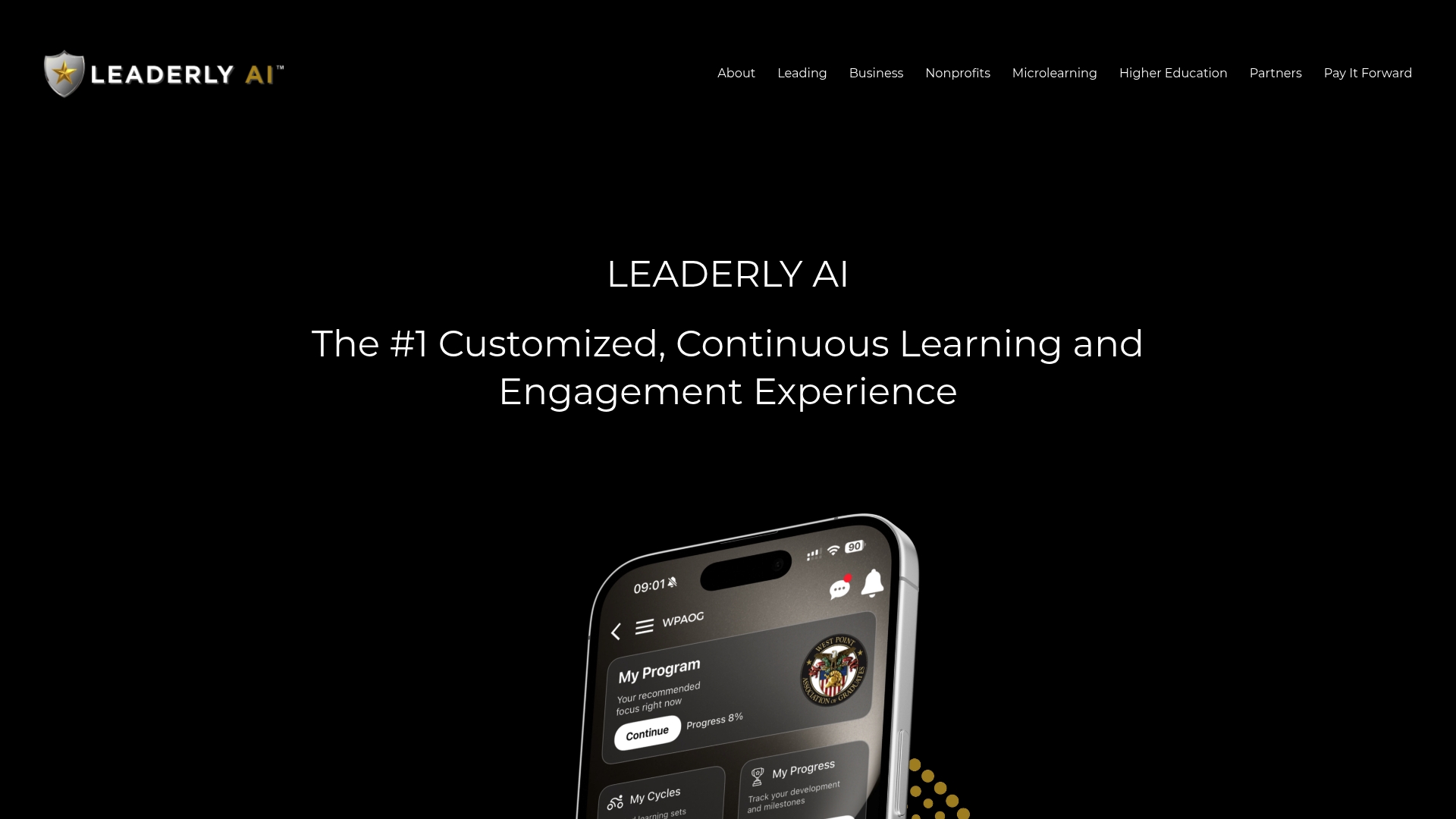
The platform's assessments and people-centric development modules help emerging leaders and seasoned managers alike identify exactly which element of presence, authenticity, communication clarity, or emotional regulation, needs attention first, then delivers practice tailored to that gap instead of a generic curriculum everyone gets regardless of where they're starting from. If you're an HR leader or executive weighing coaching against a scalable alternative, explore Leaderly's approach to leadership development and see what a starter micro-lesson looks like for your team.
Frequently Asked Questions
What is leadership presence, explained in one sentence? Leadership presence is the observable pattern of communication, emotional regulation, and authentic behavior that earns trust and influence, and it's a skill you build through practice, not a trait you're born with.
What is the difference between leadership presence and charisma? Charisma is a personality style built around energy and likability, while presence is a set of behaviors, including active listening and emotional regulation, that anyone can develop regardless of their natural temperament.
What is executive presence, and how does it differ from leadership presence? Executive presence traditionally emphasized gravitas and polish at senior levels, but modern definitions, including HBR's 2024 analysis, have shifted it closer to leadership presence overall: relational, inclusive, and behavior-based rather than reserved for the C-suite.
How long does it take to develop leadership presence? Small shifts are noticeable within a few weeks of consistent practice, meaningful change typically takes a few months, and culture-level shifts across a team can take six months to two years.
Can introverts have strong leadership presence? Yes. Presence depends on clarity, authenticity, and emotional regulation, not volume or extroversion, so a quiet, steady communicator often demonstrates stronger presence than a loud one.
What is the fastest way to start improving leadership presence? Start with the consolidation habit: after each important interaction, write two lines about what landed and what you'd change next time, and revisit those notes weekly.
Sources
If you want to go deeper than this article covers, these sources each add a distinct angle worth exploring.
- A dynamic approach to developing leadership presence - IMD business school for management and leadership courses
- Successful Leaders Cultivate the Power of Presence | Psychology Today
- Leadership Presence at Work: A Practice-Oriented Framework (journal article)
- Leadership presence: A concept analysis (NUF journal)
- The new rules of executive presence | HBR