
The most reliable path to better manager soft skills is not a single workshop. It's a mix of short, repeated microlearning, coached practice, and consistent 1:1 conversations that turn insight into habit over weeks, not hours. This approach works for both brand-new managers and veterans who never got formal training, and most see sharper feedback conversations and more focused 1:1s within a month. Google's People Management Essentials proves foundational content can take under 8 hours, SHRM confirms reinforcement is what makes it stick, and platforms offering microlearning build that reinforcement into daily practice.
TL;DR:
- Microlearning, coaching, and regular 1:1 conversations over weeks are more effective than single workshops for developing lasting soft skills.
- Managers need focused skills like clear communication, active listening, emotional intelligence, goal setting, and conflict resolution, which show up in specific pressure moments.
- Short foundational courses under 8 hours can jumpstart skills, but lasting change requires layered reinforcement over a 90-day cycle with practice and feedback.
- Training programs should be outcome-oriented, include follow-up reinforcement, and be measurable through behavior changes rather than completion certificates.
- Tailor soft skills development to manager level and department, focusing on foundational skills for new managers and judgment skills for experienced leaders.
Table of Contents
- What Soft Skills Do Managers Actually Need?
- How Long Does Manager Training Take to Show Results?
- How Do You Choose the Right Training for Your Team?
- A 90-Day Plan for Practicing Manager Soft Skills
- Customizing Training by Manager Level and Department
- Why Most Manager Training Fails to Change Anything
- Where Leaderly Fits Into Manager Soft Skills Training
- Sources
- FAQ
What Soft Skills Do Managers Actually Need?
Most manager soft skills training programs try to cover too much at once. The research points to a shorter, sharper list, and each one shows up in a specific moment where a manager either handles it well or visibly doesn't.
- Communication: A manager announcing a reorg either explains the "why" clearly or leaves the team filling gaps with anxiety and rumor.
- Active listening: In a skip-level meeting, a manager who paraphrases what an employee said before responding builds trust fast; one who jumps straight to advice does not.
- Emotional intelligence: When a top performer is visibly burned out, an emotionally intelligent manager notices before a resignation letter forces the conversation.
- Coaching and feedback: The difference between "great job this quarter" and a specific breakdown of what worked and what to try next is the difference between a compliment and actual development.
- Conflict resolution: Two team members disagreeing over ownership of a project either get a structured conversation that resolves it, or the tension festers into a hiring problem six months later.
- Adaptability: A manager whose team just lost a key member either recalibrates priorities within days or lets the whole team drift.
- Goal setting: Clear, specific goals beat vague ones almost every time; the manager who writes "increase renewal rate by 4 points by Q3" gets more traction than one who says "focus on retention."
Workhuman's leadership communication research puts clarity, active listening, empathy, and adaptability at the center of effective leadership communication, and SHRM's guidance on cultivating critical soft skills specifically calls out problem solving, time management, and adapting to change as skills that separate managers who retain good employees from those who don't. None of these skills are exotic. What's rare is a manager who's actually practiced them under real pressure, not just heard a definition in a slide deck.
How Long Does Manager Training Take to Show Results?
Training format matters less than most vendors want you to believe. What matters is whether the format includes repetition, and whether someone tracks whether behavior actually changed afterward.
The formats break down roughly like this:
- Microlearning/microlessons: Five to fifteen minutes, delivered regularly, designed to build one habit at a time.
- Self-paced online courses: Structured content a manager works through independently, often with a certificate at the end.
- Instructor-led workshops: Half-day to full-day sessions, usually built around one topic like feedback or conflict.
- Immersive multi-day programs: Deep, intensive experiences that reshape how a manager thinks, not just what they know.
- 1:1 coaching or mentoring: Ongoing, personalized guidance tied to a manager's real situations.
- Blended programs: A combination of the above, sequenced over weeks or months.
Google's People Management Essentials course delivers foundational skills in under 8 hours, aimed squarely at new and aspiring managers who need a fast baseline. At the other extreme, CEDEP's Achieving Managerial Excellence program runs 9 immersive days built around real projects and mindset shifts for managers who already have experience but need to operate at a higher level.
Neither format is wrong. They solve different problems. A short course sets the foundation; it does not, by itself, produce lasting behavior change. That's a consistent theme across HR and training research: knowledge gained in a few hours fades fast unless something reinforces it afterward, whether that's coaching, spaced practice, or a manager returning to the material in smaller doses over months.
How Do You Choose the Right Training for Your Team?
Picking a training approach gets easier once you stop asking "is this good content?" and start asking "will this actually change what my managers do on Monday?" Use this checklist before committing budget:
- Does it map to a specific outcome? Vague goals like "better leadership" produce vague results; "reduce time-to-resolution on team conflicts" is trainable and measurable.
- Is there a reinforcement plan after the course ends? One-off training without follow-up rarely survives past week three.
- Is coaching available, even informally? Peer coaching or a manager of managers checking in counts.
- How will you measure change? Look for a plan that includes self-assessment, team pulse surveys, or manager observation, not just a completion certificate.
- Does it scale across levels and departments? A program that only works for one team is a pilot, not a solution.
- What's the real time cost against the expected payoff? A 9-day immersive program has a different ROI calculation than a 10-minute weekly microlesson.
When you're evaluating a vendor, ask directly: How do you measure behavior change after the course? What reinforcement happens in the following 30, 60, and 90 days? Can managers apply this to a real, current problem on their team, not a hypothetical case study? What does a red flag look like from your side, historically?
Watch for red flags in return: no practice component, no defined outcome, no way to assess before-and-after skill levels, or a program that treats emotional intelligence and conflict resolution as one-time lecture topics instead of ongoing habits.
Pro Tip: Ask a vendor to show you what a manager does differently 90 days after training, not what they learned on day one. If they can't answer that, the program probably ends at "aware," not "changed."
A 90-Day Plan for Practicing Manager Soft Skills
Soft skills improve the same way physical skills do: through repetition under mild pressure, followed by feedback. A structured 90-day cycle gives that repetition a shape.
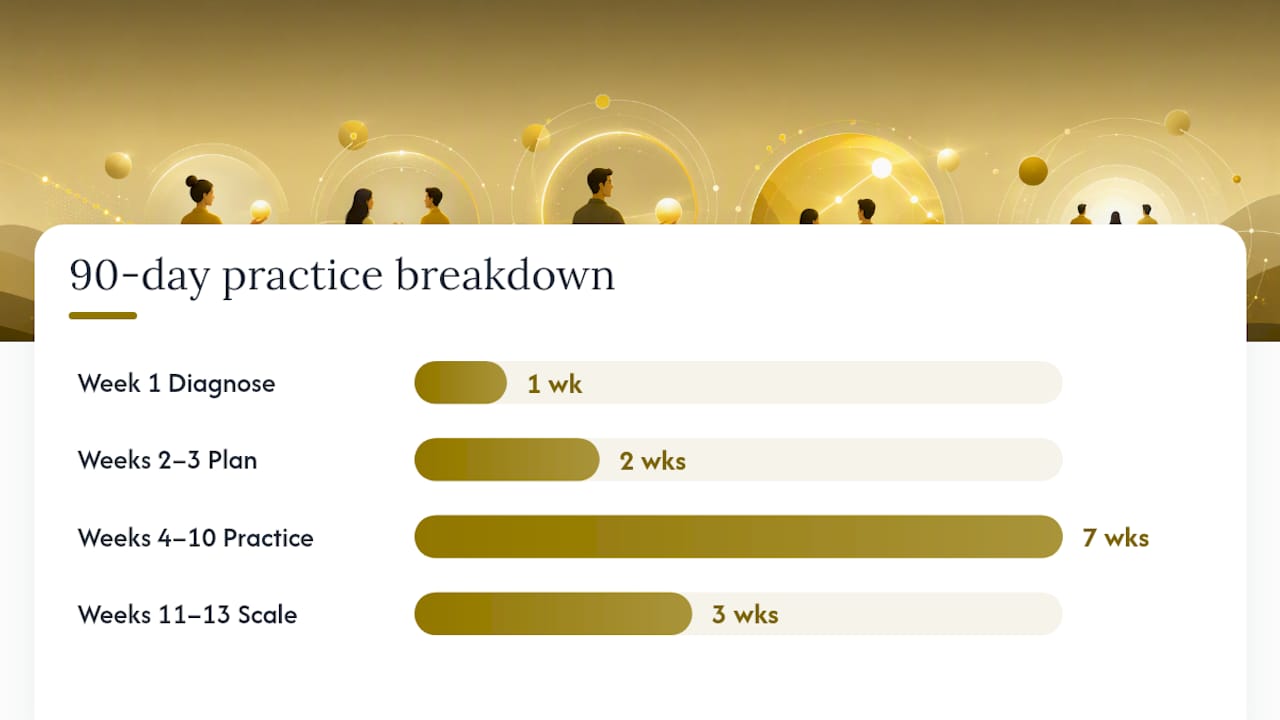
- Week 1: Diagnose. Run a manager self-assessment and a quick team pulse survey to identify the one or two skills causing the most friction, whether that's feedback delivery, listening, or conflict avoidance.
- Weeks 2 to 3: Plan. Pick two habits to build, not six. Build a simple 1:1 agenda template and set a weekly practice cadence.
- Weeks 4 to 10: Practice cycles. Run short, repeated reps: a 10-minute role-play with a peer before a hard conversation, a "feedback sprint" where the manager delivers three pieces of specific feedback in a week, and a two-minute reflection journal entry after each 1:1.
- Weeks 11 to 13: Coached reflection and scale. Review what changed, get coaching on what's still sticking, and expand the practice to a new skill or a wider group of managers.
Guides on practical manager development consistently point to the same core moves: structured 1:1s, feedback practice, and peer observation are the exercises that show up across almost every credible source on the topic. A 90-day diagnose-practice-measure cycle also lines up with how Leaderly structures its own first-time manager programming.
Measurement doesn't need to be complicated. A five-question team pulse survey run monthly, a simple 1:1 quality checklist (did you ask an open question, did you listen without interrupting, did you agree on a next step), and a manager's own before-and-after self-rating are enough to show movement. Expect to see it in behavior first: fewer canceled 1:1s, more specific feedback, faster conflict resolution, before it shows up in engagement scores.
Customizing Training by Manager Level and Department
A first-time manager and a director of ten years need almost opposite starting points. New managers need foundational skills fast: how to run a 1:1, how to give feedback without softening it into mush, how to have a hard conversation without avoiding it. A short course like Google's People Management Essentials fits well here because the gap is knowledge, not experience.
Mid-level managers usually already know the mechanics. Their gap is judgment: when to coach versus direct, how to manage conflict between peers rather than direct reports, how to influence without authority across departments. This group benefits more from coaching and scenario-based practice than from another foundational course.
Senior leaders and department heads often need the least content and the most reflection. Immersive programs, executive coaching, and peer forums tend to fit better than microlessons at this level, because the challenge is rarely "what should I do" but "what am I missing."
Department matters too. A sales manager's conflict resolution scenarios look different from an engineering manager's, and a nonprofit program director juggling volunteers has different feedback dynamics than a corporate team lead. Effective programs let managers apply general frameworks to their own specific situations rather than forcing every department through identical case studies.
Why Most Manager Training Fails to Change Anything
One-off training fails for a boring reason: people forget things they don't practice. A day-long workshop on conflict resolution feels great on the day. Three weeks later, most managers default straight back to whatever behavior they had before the workshop, because nothing in their calendar forced them to try the new approach.
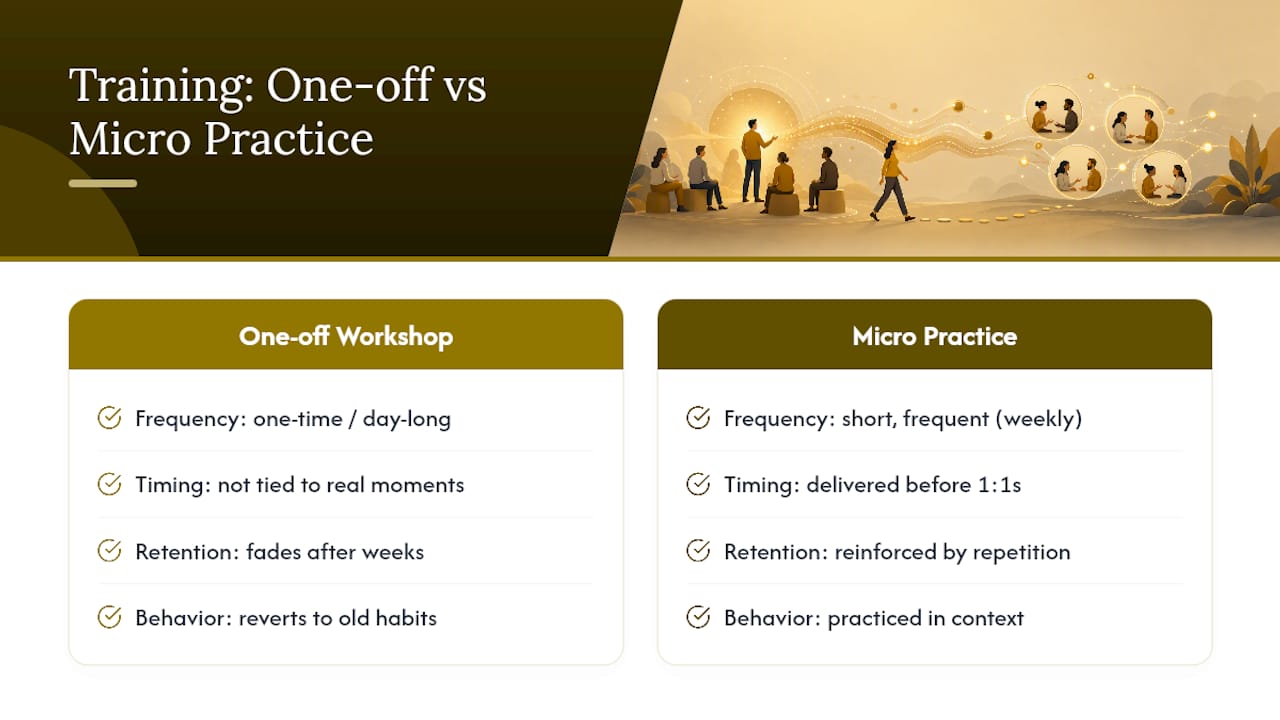
What changes that pattern is repetition tied to real situations, not more content. A manager who gets a two-minute microlesson on active listening right before their Tuesday 1:1, then reflects on how it went, builds the skill faster than one who sat through a three-hour seminar on listening six months ago. This is the logic behind Leaderly's approach to emotional intelligence and relationship management: small, frequent practice tied to the exact moments where the skill gets used.
Getting leadership buy-in for this kind of program is often harder than building the program itself. Executives like the idea of "training" as an event with a clear start and end date. Continuous development doesn't have that clean shape, so it's worth framing it in terms leadership already tracks: retention, manager effectiveness scores, time-to-productivity for new hires. Tie the practice cadence to existing rhythms, weekly 1:1s, monthly skip-levels, quarterly reviews, instead of asking managers to add something new to their week. The programs that survive past the first quarter are the ones that got woven into work managers were already doing.
— Drew
Where Leaderly Fits Into Manager Soft Skills Training
If you've read this far, you already know the formula: short lessons, real practice, consistent coaching. Some platforms build solutions around that formula instead of requiring managers to find the pieces themselves.
These platforms can deliver personalized microlessons on skills like communication, emotional intelligence, coaching, and conflict resolution, often using behavioral science and machine learning to tailor content. It's built to support three common situations: onboarding a first-time manager who needs a fast foundation, reinforcing what people already learned in a workshop so it doesn't evaporate in three weeks, and scaling coaching-style support across an organization where you can't put a human coach in front of every manager.
Leaderly's 90-day first-time manager framework mirrors the diagnose-practice-measure cycle described above, paired with self-assessments and analytics dashboards HR teams can use to actually see whether behavior is shifting. If your team's next step is developing a people-centric leadership approach rather than another one-off seminar, that's the starting point worth exploring.
Sources
- People Management Essentials | Grow with Google
- Cultivating critical soft skills | SHRM
- Mastering leadership communication: skills leaders should develop | Workhuman
FAQ
What are the 5 C's of soft skills?
Definitions vary across sources, but a common version includes communication, collaboration, critical thinking, creativity, and confidence. There's no single official standard, so treat any "5 C's" list as a helpful mnemonic rather than a fixed framework.
What soft skills does a manager need most?
Communication, active listening, emotional intelligence, coaching and feedback, conflict resolution, adaptability, and goal setting cover the core list, with SHRM also emphasizing problem solving and time management. Prioritize whichever one or two are causing the most visible friction on your team right now.
What are the 5 C's of management?
There isn't a universally recognized "5 C's of management" framework the way there is for, say, marketing's 4 P's. If you've seen a specific version cited, treat it as one author's model rather than an industry standard.
What are the 7 major soft skills for leaders?
A practical list drawn from HR and leadership research includes communication, active listening, emotional intelligence, coaching, conflict resolution, adaptability, and goal setting, the same set this guide breaks down above.
How long does manager soft skills training take to show results?
Foundational courses like Google's People Management Essentials take under 8 hours, but real behavior change typically needs a 90-day cycle of practice and coaching layered on top. Expect early signs like better feedback and clearer 1:1s within the first month.
How do you measure the impact of soft skills training?
Track behavior first: 1:1 quality, feedback frequency, and conflict resolution speed, using tools like a monthly team pulse survey or a manager self-assessment. Business metrics like retention and engagement scores tend to move a few months after behavior does, not simultaneously.