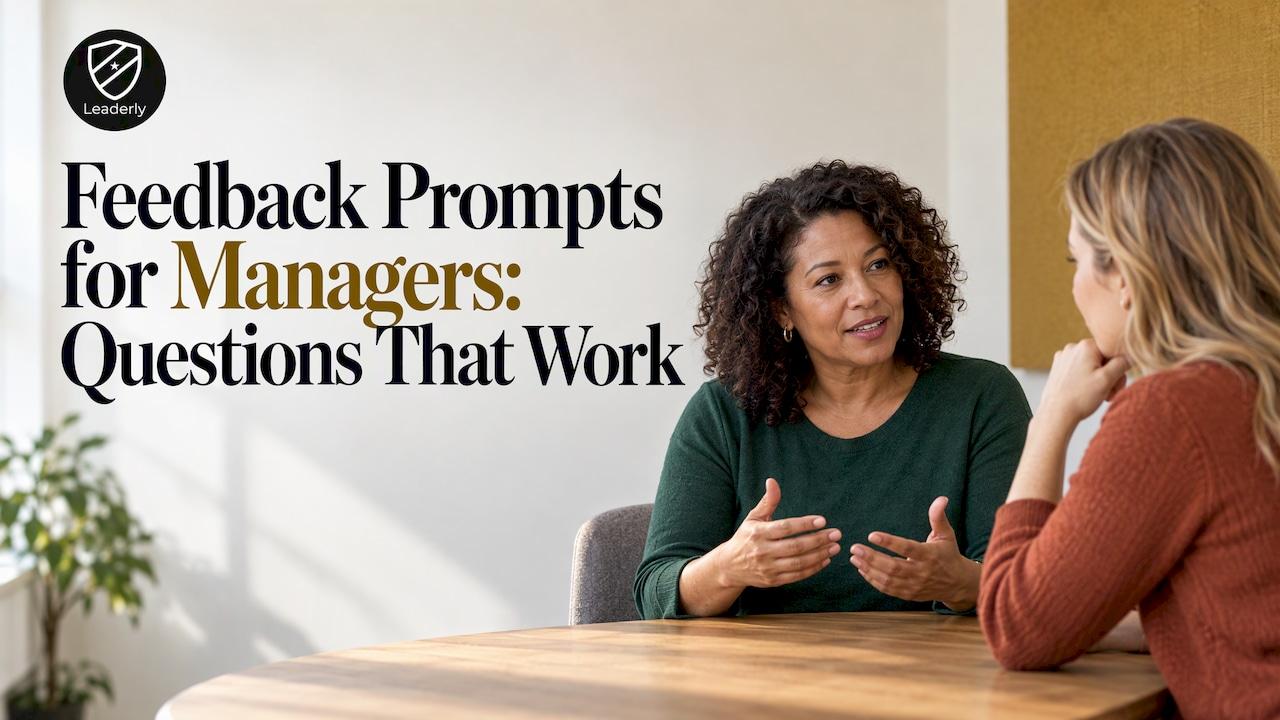
The best feedback prompts for managers are short, open-ended and tied to something specific: a recent project, a meeting, a goal. They work when they are asked often, not once a year. Below you will find prompts for one-on-ones, for asking your team how you are doing, and for giving constructive feedback, drawn from HR guides at US universities. Leaderly AI turns habits like these into short microlessons that reach every employee, not only the people who already manage others.
TL;DR
- Start with open questions that begin with "what" or "how". Avoid "why" when asking someone to explain an action, because it can sound accusatory.
- Ask your team for upward feedback with a start, stop, continue structure. It gives you answers you can act on.
- Give constructive feedback with a framework such as SBI (Situation, Behavior, Impact) or CBIN (Context, Behavior, Impact, Next steps), then ask what the person thinks.
- Make prompts a routine: a monthly informal one-on-one and a structured quarterly conversation.
- Prompts only help if you listen, write down what you hear and follow up.
Table of Contents
- How to use feedback prompts
- Feedback questions for one-on-ones
- Questions that surface strengths, goals and development needs
- Prompts for asking your team how you are doing
- Constructive feedback you give: frameworks and examples
- Listening and following up
- Where Leaderly AI fits
- Our perspective
- FAQ
- Sources
How to use feedback prompts
A prompt is a starting point, not a script. University of Minnesota HR recommends open-ended questions beginning with "what" or "how" to prompt thinking, and warns against "why" questions when you ask someone to explain their actions, since they can cause defensiveness. "Why did you miss the deadline?" becomes "What got in the way of the deadline?"
Cadence matters as much as wording. University of Virginia HR's 2026 guide suggests at least one structured performance-and-development meeting each quarter plus at least one informal one-on-one each month. It also asks employees to arrive with one or two accomplishments, one or two priorities for the next quarter and the support they need from you. The same guide recommends keeping a running record of accomplishments, feedback and development notes through the year, so you can follow up on what you hear.

Feedback questions for one-on-ones
Pick two or three per meeting. Do not run down the list.
Growth in the current role (from MIT HR):
- What's working well?
- What's been challenging?
- What are you most proud of?
- What should we stop, start or continue doing?
Engagement (also MIT HR):
- What keeps you here?
- How do you like to be recognized?
Check-in prompts (University of Virginia HR):
- What have you felt good about accomplishing recently?
- What do you like most about your role?
- How are your professional relationships going?
Skills and aspirations (Baylor University HR):
- Are there skills you have that are not being used in your current role?
- What can I do as your manager to help you reach your goals?
- What are your career aspirations, short and long term?
George Mason University's 2025 guide adds a useful challenge prompt for a 30-minute conversation: what challenges have you faced, how have you worked to overcome them, and how can I help?
Questions that surface strengths, goals and development needs
When the goal is to understand where someone wants to go, listen more than you talk. The University of Minnesota's career conversation guide suggests:
- When you are most engaged in your work, what are you doing?
- What would you describe as your biggest strength?
- What's one skill you would like to develop in your current role?
- What do you see as the next step in your career?
- How can I help you achieve your career goals?
For obstacles, the same university's powerful questions list includes "What's getting in the way of you achieving your goals right now?" and "What's the most challenging part of your work, and why?"
A structure for development conversations: GROW
The University of South Carolina's manager guide uses the GROW model. It keeps the conversation moving from aspiration to action:
| Step | Sample prompt |
|---|---|
| Goal | Considering your future, what would you like to do more of? |
| Reality | What skills do you think you need to work on to reach your goal? |
| Options | What learning opportunities would help you develop that skill? How can I support you? |
| Will | What specific actions will you take? When will you start? When should we follow up? |
When someone is stuck, coach instead of telling. University of Virginia's guide suggests "Have you considered...?" and "What other choices do you have?" so the person finds the solution themselves.
Prompts for asking your team how you are doing
Upward feedback is the hardest kind to ask for and the most useful for a manager's growth. UNC HR's upward-feedback guide recommends three direct questions:
- What is something you would like me to start doing better?
- What is something you would like me to continue doing?
- What is something you would like me to stop doing?
More options from other universities:
- What specifically can I do to better support our team's goals? What's one thing I could do that would make a difference? (MIT HR)
- What do you need from me to do your best work? As a manager, what could I do a little more or less of? (UW–Madison stay interview toolkit)
- Where would you like me involved more or less in your day to day? What's a problem on our team that I might not know about? (Northwestern HR)
To prepare, the University of South Carolina suggests asking yourself how to frame the conversation around what matters most to the employee, and how to use it to learn how you are doing as their leader.
Skip-level conversations
If you lead managers, you can ask their reports directly, for example whether their supervisor listens to their ideas and what the supervisor could do differently to be more effective. Skidmore College's guide advises telling the direct manager in advance and keeping answers confidential. It notes that employees are often wary at first, so be patient and supportive.
Constructive feedback you give: frameworks and examples
Vague praise or criticism teaches nothing. The Center for Creative Leadership describes effective feedback as information about observed actions, not a verdict like "you're a good leader". The person should understand what they did in a situation and its impact, so they can begin, continue or stop a behavior. UCI HR adds that constructive feedback is behavior-focused, specific, forward-looking and timely, private when corrective and public when positive.

SBI-I: Situation, Behavior, Impact, Inquire
Drexel's manager guide teaches four parts, ending with a question:
In yesterday's meeting (situation), you interrupted Kelly at least three times (behavior). Kelly shared that they feel disrespected, and the group missed what Kelly had to say (impact). What are your thoughts about next steps? (inquire)
CBIN: Context, Behavior, Impact, Next steps
MIT HR uses a similar model and closes with a request: next time, make sure the person talking has finished before you start.
Ask-Tell-Ask and "Even Better If"
UCI's deck recommends opening with "How do you think that went?", sharing your view, then asking "What would you do differently next time?" For positive feedback with a nudge, it suggests phrasing such as: your proposal was clear and concise, and it might be even better if you included client quotes to support the key points.
Prompts to complete before you speak
- What exactly did I observe, and when?
- What was the effect on the person, the team or the work?
- What do I want to happen next?
- What question will let them share their view?
If an employee tends to resist input, our article on supporting a team member who fights feedback covers how to approach it.
Listening and following up
Asking is half the job. A few habits make the answers usable:
- Say why you are asking. A short framing line ("I want to hear what would make your work easier") lowers suspicion.
- Stay quiet longer than feels comfortable. Let the answer finish before you respond.
- Write it down. Keep notes on what you heard and what you agreed to.
- Close the loop. Name one thing you will change and tell the team when you did it. Silence after feedback teaches people to stop giving it.
For more on why steady exchanges lift engagement, see why continuous feedback improves engagement at work, and for ways to get honest input yourself, how leaders can get the feedback they need to grow. Teams in technology organizations can also look at how feedback loops are structured in other contexts.
Where Leaderly AI fits
A list of prompts helps one manager. HR leaders need every manager, and every emerging leader, to use them. Leaderly AI is a mobile-first platform that delivers personalized microlessons and habit-building exercises, with self-assessments, simulations and analytics dashboards, so feedback skills are practiced a little at a time and built for all employees, not just those with a title. It serves corporate, nonprofit and higher education settings, and organizations can customize the learning journeys.
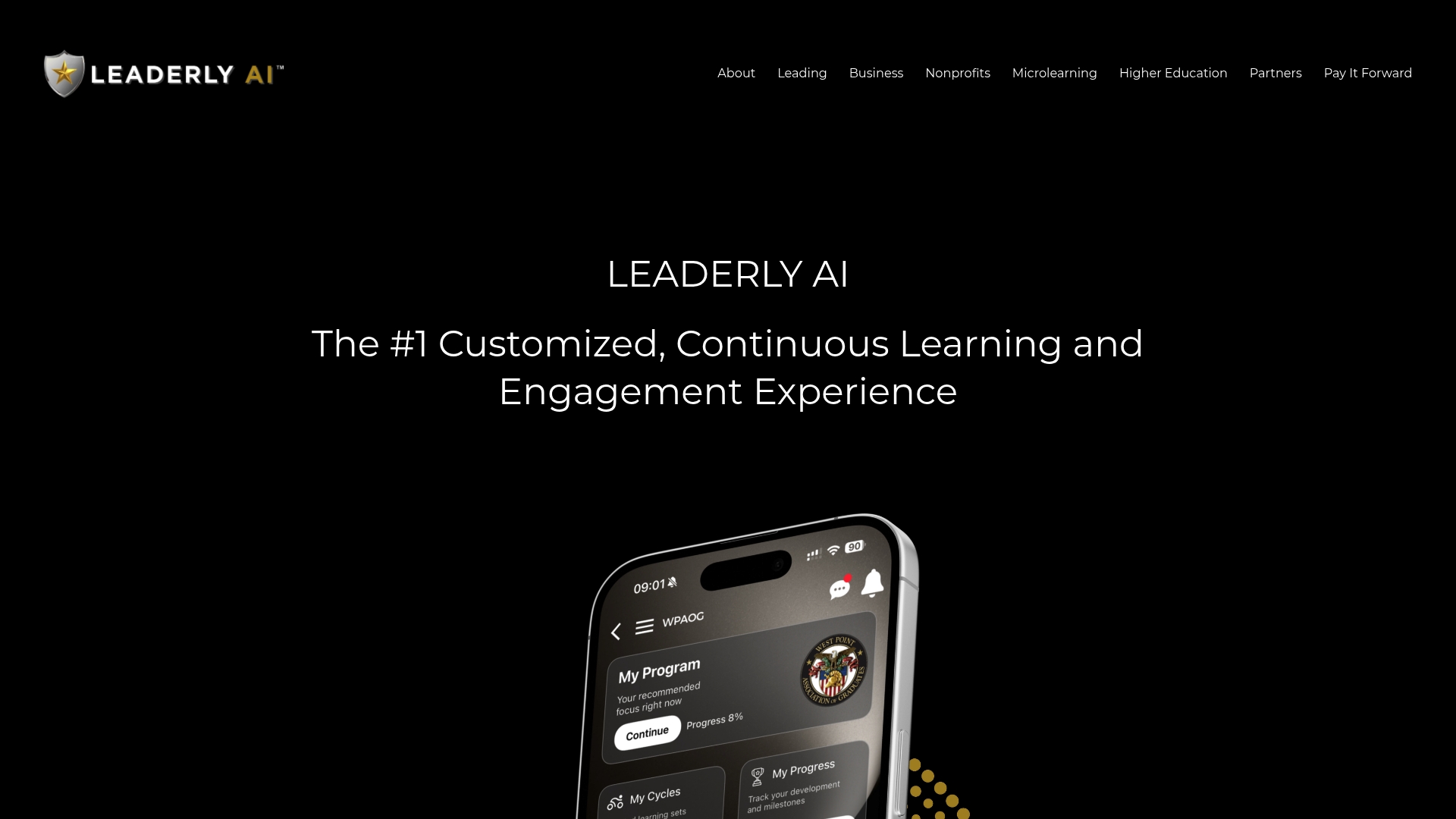
To see how it could support your managers, visit Leaderly AI, or explore microlearning for leadership.
Our perspective
Feedback fails less often for lack of good questions than for lack of repetition. A manager reads a list, asks three questions once, and goes back to the old routine.
We built Leaderly AI around the idea that leadership is a set of habits. Frequent microlessons, practical exercises and personalized content that evolves with each user's journey are designed to make asking, listening and following up feel ordinary. We also believe this development belongs to everyone in the organization, not only to managers, because emerging leaders, volunteers, faculty and veterans moving into civilian roles all need to give and receive feedback well.
If you are an HR professional, start with the prompts above and make them a monthly rhythm. Then give your people a way to practice them.
Drew Bartkiewicz
FAQ
What are good feedback questions to ask my employees?
Start with open questions such as "What's working well?", "What's been challenging?" and "How can I best support you?" These come from MIT HR's coaching guide. Choose two or three per one-on-one and follow up on the answers at the next meeting.
How do I ask my team for feedback about me?
Use start, stop and continue: what would you like me to start doing better, continue, and stop doing? Tell people in advance why you are asking and what you will do with the answers. When you lead managers, a confidential skip-level conversation is another option.
How often should managers have feedback conversations?
One university guide recommends at least one informal one-on-one per month and one structured performance-and-development meeting per quarter. Feedback tied to a specific event is best given soon after it.
What is an example of constructive feedback?
Use the SBI pattern: name the situation, describe the observable behavior, explain its impact, then ask for the employee's view. For example: "In yesterday's meeting you interrupted Kelly three times, and the group missed her input. What are your thoughts on next steps?"
Sources
- Asking Powerful Questions, University of Minnesota
- Career Conversations, University of Minnesota
- Guide to Regular Performance Conversations, University of Virginia
- Ongoing Coaching and Feedback, MIT HR
- One on One Resources, Baylor University
- Meaningful Feedback Conversations, George Mason University
- Facilitating Impactful Performance Conversations, University of South Carolina
- Upward Feedback, UNC HR
- Stay Interview Toolkit, UW–Madison
- Skip-Level Meetings, Skidmore College
- 1:1 Check-In Questions, Northwestern University
- Making Performance Feedback Meaningful, UCI HR
- A Manager's Guide to Performance Conversations, Drexel University
- Feedback, Center for Creative Leadership