
Lead by listening and following through on every promise you make. That's the short answer. If you're stepping into a management role where several of your direct reports have more tenure, more technical depth, or more institutional knowledge than you, the fastest path to credibility isn't proving you're the smartest person in the room. It's showing you're the most reliable.
Here's what you can do today to earn trust managing experienced colleagues:
- Schedule individual listening sessions with each team member this week. Call them "learning conversations," not performance reviews.
- Ask for prior examples: "What's worked here that I shouldn't change?" Write the answers down and refer back to them.
- Make one small, specific promise in each conversation and keep it within 48 hours. Not a big initiative. A fixed meeting time, a forwarded email, a removed obstacle.
- Protect the team from above. When pressure comes from your manager or other departments, absorb it before it hits your team.
- Name their expertise out loud. "You've been doing this for eight years. I want to learn from that" is not weakness. It's the fastest trust signal available to a new manager.
Your 30/60/90 promise in one line: In the first 30 days, listen and keep small promises; in days 31–60, fix one real friction point and clarify decision rules; in days 61–90, propose one meaningful change you've earned the right to make.
Pro Tip: Write down every commitment you make in a 1:1 and send a two-line recap email afterward. That paper trail is your credibility record.
Key Takeaways
Earning trust with experienced colleagues comes down to one repeatable pattern: listen first, keep small promises consistently, and earn the right to lead bigger changes through demonstrated follow-through.
| Point | Details |
|---|---|
| Listen before you lead | Run individual 1:1s in week one using structured prompts; write down what you hear and refer back to it. |
| Keep small promises first | Make one specific commitment per person and close the loop within 48 hours; a 90-day kept-promise record is your credibility baseline. |
| Clarify decision rights early | Share a simple decision matrix by day 45 so experienced colleagues know when they have autonomy and when to loop you in. |
| Recognize judgment, not just effort | Name specific decisions and their impact when you praise tenured colleagues; generic praise lands flat with experienced teams. |
| Leaderlyapp reinforces the habit stack | The platform's microlearning nudges and 1:1 templates help emerging managers sustain the listening and follow-through behaviors past the first month. |
Table of Contents
- How do you earn trust when managing experienced colleagues?
- Your practical 30–60–90 plan for leading experienced teammates
- How should you run early one-on-ones with experienced colleagues?
- Giving feedback and handling pushback from experienced employees
- Delegation and decision rights: turning experience into an asset
- How to demonstrate credibility through small wins and follow-through
- Why these tactics work: trust as a trainable capability
- Leaderlyapp supports the habits this playbook requires
- Sources
How do you earn trust when managing experienced colleagues?
Trust, credibility, and predictability are related but not the same thing. Credibility is what people believe about your competence. Trust is what they're willing to risk based on that belief. Predictability is the engine that builds both. HBS Online frames trust as a capability, not a personality trait, meaning it can be built deliberately through consistent, repeatable behaviors. That framing matters because it removes the "they just don't like me" spiral and replaces it with a question you can actually answer: What did I do, and did I follow through?
Five principles drive this for new managers leading experienced teams:
- Listen first, decide second. Experienced colleagues have pattern recognition you don't yet have. Mining it isn't a sign of weakness; it's efficient leadership.
- Predictable follow-through. Say what you'll do. Do it. Repeat. This single behavior, compounded over 90 days, does more for trust than any speech or vision document.
- Clarify boundaries early. Who decides what? When does the team have autonomy, and when do you need to be in the loop? Ambiguity breeds resentment in tenured employees who've watched unclear managers come and go.
- Protect the team. When organizational pressure lands on your desk, your job is to filter it, not pass it straight down. Experienced employees notice immediately when a manager does this, and they remember.
- Recognize and surface expertise. Specific acknowledgment of judgment and impact, not generic praise, is what experienced employees actually respond to.
The hardest judgment call in the first 90 days is knowing when to defer and when to decide. Defer on method. Decide on direction. When a tenured colleague says "we've always done it this way," your job isn't to agree or overrule. It's to ask why, listen to the answer, and then make a call you can explain.
Admitting a knowledge gap is one of the most underused trust tools available to new managers. The script that works: "I don't have deep background in this area yet. What would you do, and what should I know before I decide?" That phrasing asks for expertise without surrendering the decision. You're still the one who decides. You're just gathering better information first.
Pro Tip: Never fake knowledge with a tenured team. They will know within 48 hours, and the credibility damage takes months to repair. A clean "I don't know, let me find out" lands far better.
Your practical 30–60–90 plan for leading experienced teammates
The phased trust-building path works because it matches the pace at which experienced employees update their mental model of a new manager. Big changes in week one read as reckless. Small, kept commitments in the first month read as reliable. That reliability is what earns you permission to lead bigger changes later.
Days 1–30: Listen, learn, and keep small promises
Activities:
- Conduct individual 1:1s with every direct report (see Section 4 for the full agenda).
- Ask each person: "What's working that I should protect?" and "What's one thing that slows you down?"
- Identify two or three small friction points you can fix within the month.
- Make one specific commitment per person and close the loop within the week.
- Attend team meetings as an observer before you start running them.
Small-promise checklist for days 1–30:
- Send a meeting recap within 24 hours of every 1:1.
- Remove one stated obstacle (a blocked approval, a recurring meeting nobody needs, a missing tool).
- Respond to every direct message within one business day.
- Introduce yourself to one cross-functional partner your team relies on.
- Share one piece of information from leadership that the team didn't have before.
Signal to watch: Are people adding detail to their answers over time? Longer, more candid responses in week three versus week one mean trust is building.
Days 31–60: Fix friction, clarify decision rules, provide air cover
Activities:
- Implement at least one fix from the friction list your team gave you. Announce what you did and why.
- Draft a simple decision matrix: which decisions the team owns, which need your input, and which require escalation. Share it with the team and ask for corrections.
- Start absorbing organizational pressure visibly. When a deadline gets pushed from above, tell the team what happened and what you did about it before they hear it another way.
- Begin a short weekly update (three to five bullet points) so the team always knows where things stand.
How to scope a first fix so it's deliverable in a week: Pick a friction point that (a) the team mentioned more than once, (b) doesn't require budget approval or headcount, and (c) you can close the loop on in five business days. A process step that wastes 30 minutes per week is a better first fix than a structural reorganization.
Days 61–90: Propose earned changes and measure trust signals
Activities:
- Bring one meaningful proposal to the team, framed as: "Based on what I've heard from you over the past two months, here's a change I think is worth trying. Tell me what I'm missing."
- Expand delegation to experienced colleagues on medium-risk work (see Section 6).
- Track trust signals: depth of 1:1 conversations, frequency of volunteered ideas, and whether people bring you problems before they become crises.
Pro Tip: *Keep a private log of every commitment you make and mark it "kept" or "missed." Review it every Friday.
For teams scaling these practices across multiple managers, scalable team management frameworks offer additional structure worth reviewing.
How should you run early one-on-ones with experienced colleagues?
The first 1:1 with a tenured colleague is not a performance conversation. It's a listening session with a clear agenda. Go in with questions, not answers.
Week-one 1:1 agenda (30 minutes)
Opening (5 minutes): Say exactly this, or a version of it: "I'm here to learn, not to change things I don't understand yet. I'd like to use this time to hear your perspective on what's working and where the team has room to get better."
Core questions (20 minutes):
- "What's working here that I should be careful not to disrupt?"
- "What's one friction point you wish someone would fix?"
- "What do you wish your last manager had done differently?"
- "What does success look like for you in this role over the next year?"
- "Is there anything you think I should know that I probably don't yet?"
Close (5 minutes): Name one thing you heard that you'll act on or look into. Say when you'll follow up. Then do it.
Team meeting rules for the first 30 days
- Time-box every agenda item. Experienced employees lose patience with meetings that drift. Assign five or ten minutes per topic and hold it.
- Don't make decisions in the room that you haven't thought through. Say: "I want to think about that before I commit. I'll have an answer by [specific date]."
- Capture input publicly. Write ideas on a shared doc or whiteboard. People contribute more when they see their input recorded.
- Close every meeting with one clear next action and one owner. No ambiguity about who does what.
Follow-up template after a 1:1 or team meeting
Send this within 24 hours:
That template does three things: it proves you listened, it creates accountability, and it gives the other person a chance to correct your understanding before you act on it.
Pro Tip: Ask for advice, not just information. "How have you handled this before?" signals respect and builds a collaborative work environment far faster than any team-building exercise. The Cyber Guild notes that tenured employees read advice-seeking as respect, not weakness.
Giving feedback and handling pushback from experienced employees
Feedback with a tenured colleague requires more precision, not more softness. The SBI model (Situation, Behavior, Impact) gives you that precision without sounding like you're reading from an HR manual.
SBI feedback script for a senior colleague:
"In yesterday's client call [Situation], when you interrupted the client's question before they finished [Behavior], I noticed the client pulled back for the rest of the meeting [Impact]. I'd like to talk about how we handle that going forward."
That's it. No preamble about how much you value them. No "sandwich" of compliments. Just the specific situation, the specific behavior, and the specific result. Then stop talking and let them respond.
How to handle pushback
When an experienced colleague pushes back on a decision, the instinct is to defend or defer. Neither works. The sequence that does:
- Listen fully. Don't interrupt. Let them finish.
- Reframe what you heard. "So what you're saying is [X]. Is that right?"
- Ask a clarifying question. "What would need to be true for this approach to work for you?"
- State your rationale. "Here's why I'm going in this direction: [specific reason]. I hear your concern, and I'm keeping it in mind."
- Name the decision. "I'm going to move forward with [X]. If it doesn't work, I want to hear about it."
Red flags that require escalation: A colleague who actively undermines decisions with the broader team, refuses to follow through after a direct conversation, or creates a pattern of public disagreement after private resolution. Those situations need HR or your own manager in the loop. Most pushback doesn't reach that level.
Feedback documentation template:
| Field | What to write |
|---|---|
| Date and setting | Where and when the conversation happened |
| Behavior observed | Specific, observable action (not interpretation) |
| Impact stated | What effect it had on the team, client, or outcome |
| Employee response | What they said or committed to |
| Follow-up date | When you'll check back |
Pro Tip: Document feedback conversations the same day. Memory degrades fast, and a written record protects both you and the employee if the pattern continues.
Delegation and decision rights: turning experience into an asset
The Management Center is direct on this: manage outcomes, not methods. When you delegate to an experienced colleague, you're handing them the "how" while keeping ownership of the "what" and "why." That distinction is what separates delegation from abdication.
RACI-style delegation framework
| Task or decision | Responsible (does the work) | Accountable (owns the outcome) | Consulted | Informed |
|---|---|---|---|---|
| Day-to-day process decisions | Experienced colleague | Experienced colleague | Manager if needed | Manager weekly |
| Client-facing deliverables | Experienced colleague | Manager | Team | Stakeholders |
| Budget or resource requests | Manager | Manager | Experienced colleague | Team |
| Escalated conflicts | Manager | Manager | HR if needed | Relevant parties |
Decision rules by risk level
Low risk (full autonomy): The colleague has done this before, the stakes are contained, and a mistake is recoverable in a day or two. Let them run it. Check in at the end.
Medium risk (check-in cadence): New territory or meaningful stakes. Agree on a midpoint check-in before the deadline. Ask: "What's your plan, and where do you want my input?"
High risk (manager decides): Irreversible decisions, significant budget, or cross-functional impact. Gather input from the experienced colleague, then make the call yourself and explain why.
Converting senior colleagues into advisors
Ask one experienced colleague per quarter to take point on a specific knowledge area. Frame it as: "You know this better than anyone on the team. I'd like you to be the person I go to first when [topic] comes up. Would you be willing to do that?" That conversation does two things: it gives them formal recognition of expertise, and it builds a structured mentoring relationship without the awkward "will you be my mentor?" ask.
Experienced employees respond to managers who set priorities, remove friction, and enforce fair standards rather than trying to be the most technically skilled person in the room.
How to demonstrate credibility through small wins and follow-through
Credibility with a tenured team is built in small increments, not announced. The manager who says "I'm going to make big changes" in week one and delivers nothing by week six has a harder trust problem than the one who said nothing and fixed the broken printer in week two.
Quick-win selection template
Step 1: List every friction point your team mentioned in the first two weeks. Step 2: Filter for items that meet all three criteria: no budget required, completable in five business days, and mentioned by more than one person. Step 3: Pick the one with the highest visibility to the team (something they'll notice without you announcing it). Step 4: Fix it. Then mention it once, briefly, in the next team meeting: "You mentioned [X] was a problem. I took care of it. Let me know if it's working."
Progress update format
Send a brief team update every Friday, structured as:
- What moved forward this week (one to three items, specific)
- What's blocked and why (honest, no spin)
- What I'm focused on next week (one to two priorities)
That cadence, kept consistently for 90 days, does more for trust than any all-hands presentation.
Recognizing experienced colleagues the right way
Generic praise ("great job everyone") lands flat with tenured employees. Specific acknowledgment of judgment lands differently. Try: "The way you handled the client's objection in that meeting showed exactly the kind of judgment this team needs. That's not something I could have coached in a day." That sentence recognizes a specific decision, attributes it to the person's experience, and signals that you're paying attention.
When you can't do something a team member asks for, say so plainly: "I can't approve that right now because [specific constraint]. Here's what I can do instead: [alternative]." Experienced employees respect a clear "no with a reason" far more than a vague "let me look into it" that never resolves.
Pro Tip: Leadership habits for emerging managers consistently show that transparency about constraints builds more trust than optimism that doesn't pan out. Say what's true, even when it's limiting.
Why these tactics work: trust as a trainable capability
The research behind this playbook isn't complicated, but it's worth understanding so you can explain it to a skeptical stakeholder or apply it when a situation doesn't fit the script.
HBS Online's framework treats trust as a capability built through predictable behavior, not a feeling that either exists or doesn't. That reframe is significant. It means trust can be trained, measured, and improved deliberately. The specific behaviors that build it: clarifying your strengths and limits early, setting clear boundaries, and following through consistently.
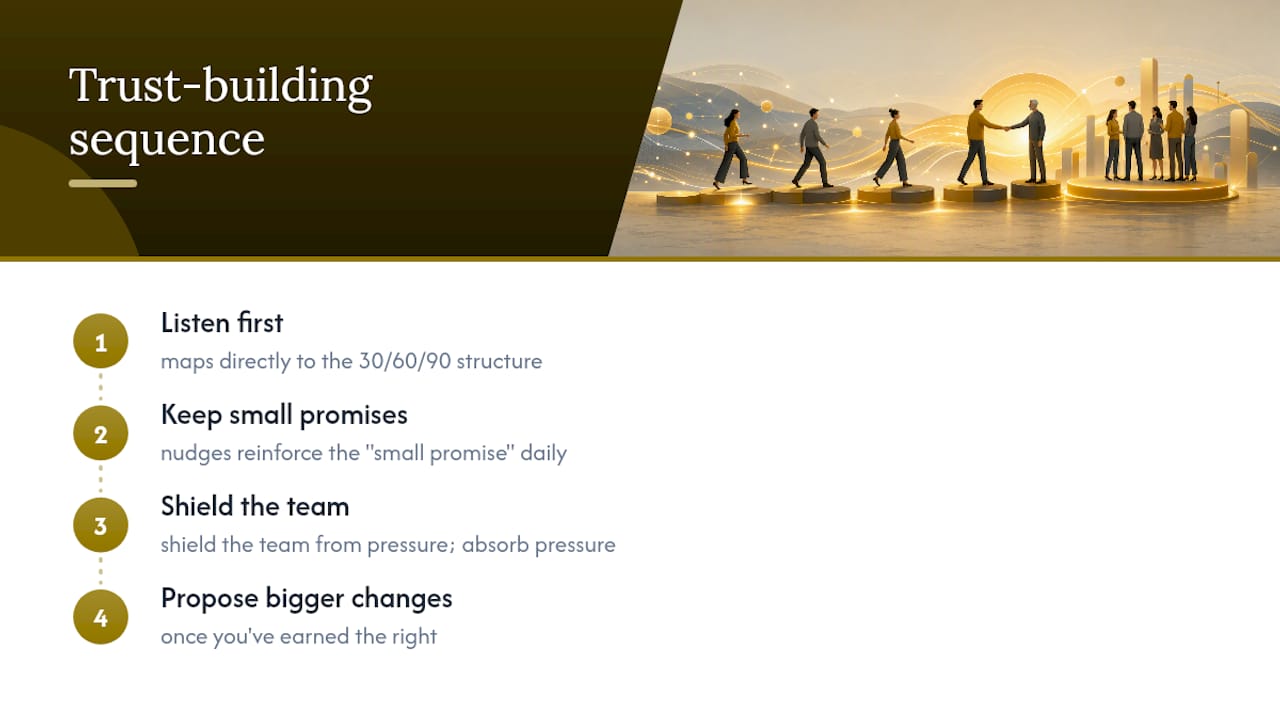
The trust path described by Datarekha maps directly to the 30/60/90 structure above. Listen first, keep small promises, shield the team from pressure, and then propose bigger changes once you've earned the right. That sequence works because it matches how experienced employees update their trust assessments. They don't trust on introduction. They trust on evidence.
Indeed's guidance reinforces the same behaviors from a different angle: follow through on promises, communicate clearly, admit mistakes, and build consistent routines. None of those behaviors require authority or tenure. They require discipline.
Psychological safety is the downstream result. When a team knows their manager will follow through, absorb pressure, and acknowledge expertise, they stop spending cognitive energy on self-protection and start spending it on the work.
Pro Tip: Leaderlyapp's microlearning loops are built around exactly this habit stack. The platform delivers short, timed nudges that reinforce the "small promise" behavior daily, with tracking so you can see your kept-commitment rate over time. That feedback loop is what turns a good intention into a durable habit.
Leaderlyapp supports the habits this playbook requires
The playbook in this article works. The harder problem is sustaining it past week three, when the novelty fades and the pressure of the actual job crowds out the deliberate behaviors.

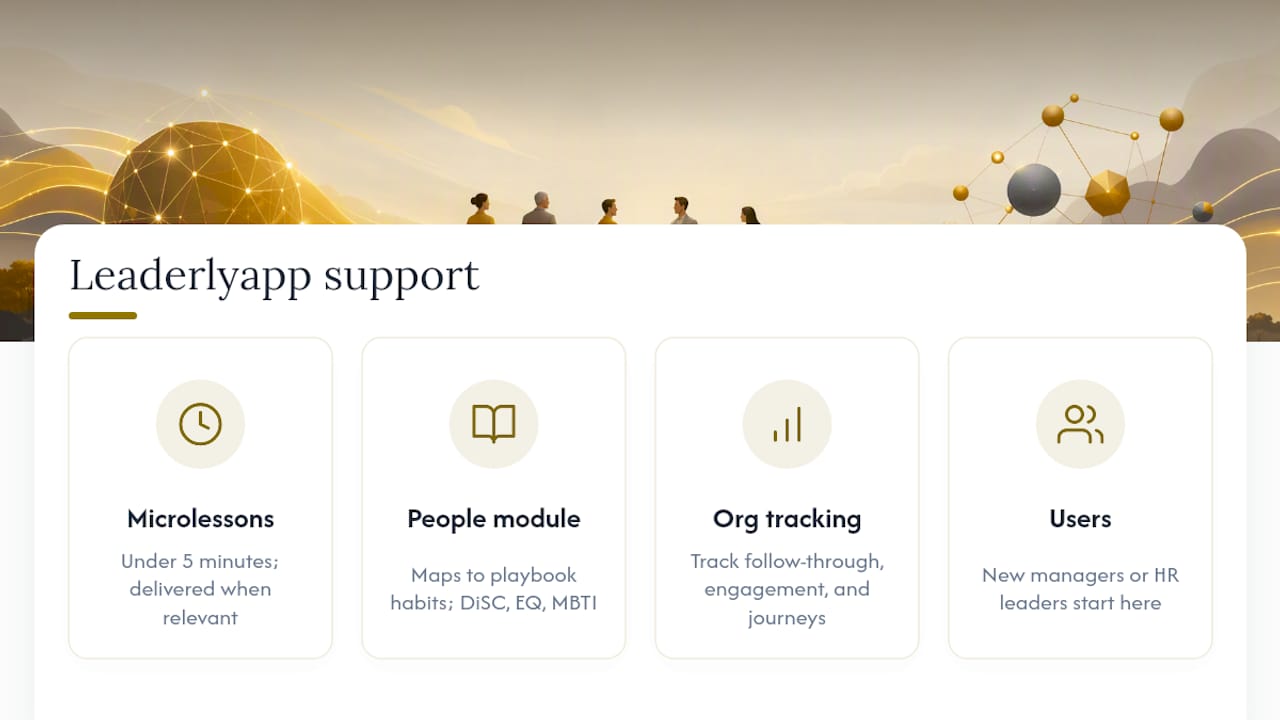
Leaderlyapp is built for exactly that gap. The platform delivers personalized microlessons tied to the specific habits this article covers: running effective 1:1s, keeping commitments, delegating with clarity, and giving feedback that lands. Each lesson takes under five minutes and arrives at the moment it's most relevant, not in a quarterly training block you'll forget by Monday. The people-centric leadership module maps directly to the listening-first and credibility-building behaviors in this playbook, with built-in assessments (DiSC, EQ, MBTI) that help you understand your own defaults before you walk into a difficult 1:1.
Organizations using Leaderlyapp can track manager follow-through, monitor engagement signals, and customize learning journeys for emerging leaders at scale. If you're a new manager working through this playbook on your own, or an HR leader trying to support a cohort of them, start with the leadership development platform and see how the habit reinforcement layer changes what sticks.
What an experienced leadership coach would tell you first
Most new managers read articles like this one and then wait for the perfect moment to apply the scripts. There is no perfect moment. The first 1:1 is awkward. The first feedback conversation is uncomfortable. The first time you say "I don't know" to someone who's been doing this longer than you, it feels like a concession.
It isn't. The managers who earn trust fastest with experienced teams are the ones who start before they feel ready. Ask three questions in your first week. Keep one promise before Friday. Notice what changes in the room by week two.
The scripts in this article aren't magic. They're just precise enough to get you out of your own head and into the conversation. Try them. Adjust them. The team will tell you, one way or another, whether they're working.
Sources
- How to Build Trust in Workplace Relationships | HBS Online
- Building trust as a new manager — datarekha
- How to Manage Someone More Experienced Than You — Management Center