
Communication is the instrument through which leaders create alignment, trust, and motivation, and those three effects determine whether a leader succeeds or fails. A 50-year review of leadership communication research treats communication as the connective tissue between leadership style and organizational results, not a soft skill layered on top of "real" leadership work. A peer-reviewed study on leader communication techniques breaks this down further into a cognitive, affective, and behavioral framework: what followers think, what they feel, and what they do in response to how a leader talks to them.
Success in this framework isn't abstract. It shows up as:
- Higher trust scores and lower turnover intent among direct reports
- Faster alignment on goals, with fewer clarifying meetings needed
- Measurable upticks in motivation and discretionary effort
- Better performance on the metrics tied to a team's actual output
Key Takeaways
Leadership success depends less on vision or charisma than on whether a leader's communication reliably produces trust, alignment, and motivated action.
| Point | Details |
|---|---|
| Communication drives outcomes | Trust, motivation, and alignment trace directly back to how leaders communicate, not just what they decide. |
| Three tracks matter | Cognitive, affective, and behavioral responses each need a different kind of message to land correctly. |
| Nonverbal signals carry weight | Tone and pacing change how identical words are received, especially in written or remote communication. |
| Small habits compound | A daily two-question check-in or a single-topic meeting rule can show measurable results within weeks. |
| Leaderlyapp builds the habit | Leaderlyapp's microlessons and analytics dashboards turn these skills into a trackable, repeatable practice. |
Table of Contents
- Why Communication Defines Leadership Success
- The Cognitive, Affective, and Behavioral Framework Behind Leader Communication
- Core Communication Skills Every Leader Should Practice
- What Strong Leadership Communication Looks Like in Practice
- How to Build Better Leadership Communication Habits This Week
- Measuring Whether Your Communication Is Actually Improving
- What the Research Gets Right and What It Leaves Out
- How Leaderlyapp Turns These Habits Into Daily Practice
- Frequently Asked Questions
- Sources
Why Communication Defines Leadership Success
The mechanism is simpler than most leadership books make it sound. Every directive, piece of feedback, or offhand comment a leader delivers gets processed by a follower's brain along three tracks at once: understanding, feeling, and acting. Get the message wrong on any one track and the whole chain breaks down, even if the leader's intentions were good.
Here's how that plays out in practice.
- Clarity reduces errors. When a leader states expectations in specific, unambiguous terms, followers spend less mental energy guessing and more executing. Vague direction ("just make it better") produces rework; specific direction ("cut the load time under two seconds by Friday") produces action.
- Transparency builds trust. Leaders who explain the reasoning behind a decision, even an unpopular one, get more buy-in than leaders who simply announce it. The 50-year review frames this as communication signaling values and character, not just information. Followers aren't only parsing what you said. They're reading who you are.
- Recognition boosts motivation. A specific, timely acknowledgment ("the way you handled that client call saved the account") does more for discretionary effort than a general "good job." Practitioner research on manager behavior suggests recognition and communication quality account for a substantial share of the variance in employee engagement, according to Workhuman's analysis of leadership communication skills.
Picture two managers rolling out the same policy change. One sends a two-line email: "New process starts Monday. Questions to HR." The other holds a ten-minute stand-up, explains the business reason, takes two questions, and asks one person to repeat back their understanding. Same policy, same effort in terms of the underlying decision. The second manager's team implements it correctly by Wednesday. The first manager's team is still confused by Friday, and morale has taken a small, avoidable hit.
The Cognitive, Affective, and Behavioral Framework Behind Leader Communication
Researchers studying leader communication techniques don't lump every conversation into one bucket. They sort leader messages by the kind of follower response they're built to produce, and that sorting is what makes the leader communication techniques study useful for anyone trying to actually change behavior, not just talk about it.
- Cognitive outcomes cover what followers understand and believe. Asking a clarifying question, framing a problem, or offering a rationale shapes this track.
- Affective outcomes cover what followers feel: trust, safety, resentment, enthusiasm. Praise, empathy, and tone shape this track more than word choice does.
- Behavioral outcomes cover what followers actually do next. Clear instructions, deadlines, and follow-up questions drive this track directly.
The mapping matters because leaders often default to one channel and wonder why it isn't working. A leader who only issues instructions (behavioral) without ever explaining reasoning (cognitive) gets compliance without commitment. A leader who only offers warmth (affective) without clear direction (behavioral) gets a well-liked team that's still confused about priorities.
Nonverbal and paraverbal signals matter more than most leaders assume. Tone, pace, pauses, and posture change how a message lands even when the words themselves don't change at all. The same feedback delivered in a rushed, flat tone reads as dismissive; delivered with a measured pace and eye contact, it reads as considered. This is where digital communication runs into trouble: email and chat strip out nearly all of these cues, which is part of why research on leader communication over five decades flags remote and written channels as a distinct risk zone for misread intent.
Statistic to know: manager communication and recognition behavior explains a meaningful share of employee engagement variance, per practitioner data cited in the Workhuman review of leadership communication skills, supporting the view that communication quality can serve as a performance lever rather than a personality trait.
Core Communication Skills Every Leader Should Practice
Most leadership communication advice lists ten skills and leaves you to figure out how to actually build them. Here's the shorter, more usable version.
- Active listening. This means listening to understand, not to formulate your next response. Practice by paraphrasing what someone said before you respond ("So what I'm hearing is..."). This single habit catches most misunderstandings before they become problems, a point covered in more depth in Leaderly's piece on the challenge of active listening.
- Clarity and simplicity. Say the specific thing, not the diplomatic version of the thing. Replace "let's circle back on resourcing" with "I need two more people on this by Thursday or the deadline slips."
- Empathy. Acknowledge the emotional weight of a situation before jumping to solutions. A quick "I know this reorg is disruptive" before explaining the reasoning changes how the rest of the message is received.
- Transparency. Share the reasoning, not just the decision. Even a brief "here's why" turns a directive into something people can actually get behind.
- Feedback. Balance specific praise with specific correction, and deliver both close to the event they're describing, not weeks later.
- Tone and pacing. Slow down for important points. A rushed delivery reads as impatience even when that's not the intent.
- Nonverbal signals. Eye contact, open posture, and matching your facial expression to your message content all reinforce (or undercut) what you're saying.
Digital adjustment: written communication loses tone entirely, so over-signpost. Use a short line at the top of an email stating intent ("Quick heads up, no action needed" versus "Need your input by 3pm") so readers aren't guessing at urgency or mood.
Pro Tip: Record yourself in a practice run-through of a difficult conversation, then watch it back with the sound off. If your posture and expression don't match your message, your audience is getting two conflicting signals at once, and they'll usually believe the nonverbal one.

For a fuller rundown of these behaviors in action, Leaderly's guide to communication in leadership walks through fifteen specific techniques.
What Strong Leadership Communication Looks Like in Practice
Frameworks help, but they don't stick until you see them in motion.
- Vision setting: A department head trying to unify three siloed teams didn't lean on a slide deck full of KPIs. She used one metaphor: "We're building a bridge, not three separate docks." That phrase showed up in team retros for the next six months because it gave people a shared mental model, not just a shared deadline.
- Feedback that moved a number: A sales manager noticed close rates dipping on a specific product line. Instead of a general "push harder" note, he gave one rep specific, balanced feedback: "Your discovery calls are strong, but you're skipping the objection-handling step on pricing pushback. Try this exact phrase next time." Close rate on that product line improved within the next full sales cycle.
- Repairing a miscommunication: A project lead sent a terse message that read as a public callout instead of the private note it was meant to be. Rather than let it fester, she followed up within the hour with a direct acknowledgment: "That came across wrong, and I own that. Here's what I actually meant." Trust dented but not broken, because the repair came fast and specific, not vague and delayed.
None of these moments required charisma. They required someone who'd thought about the message before sending it.
How to Build Better Leadership Communication Habits This Week
Improvement here comes from repetition, not inspiration. Structure beats willpower.
- Adopt a single-topic meeting rule. Meetings that wander across five unrelated updates produce worse decisions than meetings built around one clear question, a principle echoed in Harvard Business Review's guidance on shaping conversations intentionally rather than letting them drift.
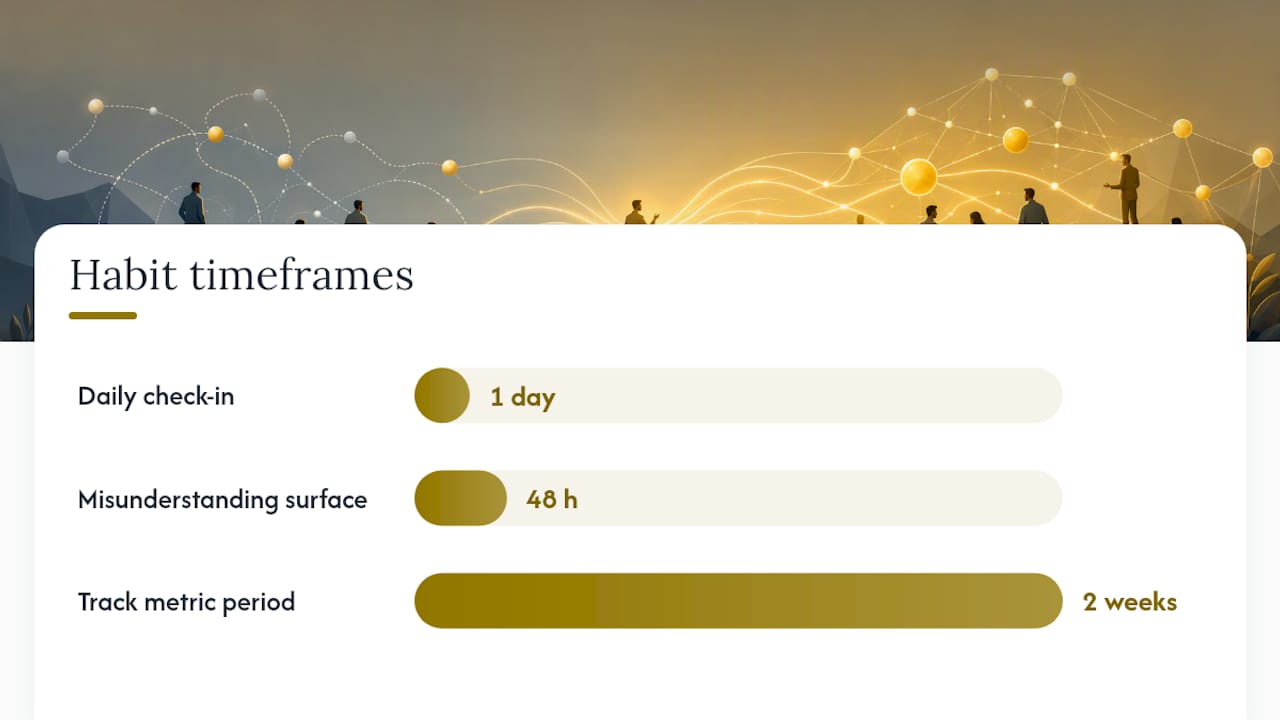
- Run a daily two-question check-in. Ask one comprehension question ("What's your read on the priority here?") and invite one suggestion. This small habit surfaces misunderstandings within 48 hours instead of weeks later, based on how leader communication techniques map to near-term follower response.
- Practice feedback scripting. Before a hard conversation, write out the specific behavior, its impact, and the requested change in one sentence each. This turns a vague dread into a concrete, deliverable message.
- Drill active listening in low-stakes settings. Paraphrase a colleague's point in casual conversation before you ever need the skill in a high-stakes one. It gets easier with repetition, and Leaderly's active listening resource breaks down common failure points.
- Coach at the team level, not just individually. After a meeting, ask the group directly: "Was that clear? What's still unresolved?" Measuring team-level comprehension, not just your own confidence in the message, catches gaps individual coaching misses.
Pro Tip: Track one metric for two weeks after you change a communication habit, whether that's meeting length, follow-up questions asked, or how often people volunteer ideas unprompted. A habit that doesn't move any observable number probably isn't the habit that matters.
For feedback specifically, Leaderly's resource on feedback and performance offers a more detailed script structure.
Measuring Whether Your Communication Is Actually Improving
You don't need a full engagement survey to know if a change is working. Watch for:
- Quantitative signals: meeting length trending down while decisions made per meeting trend up, project completion rates, and voluntary participation in optional discussions.
- Qualitative signals: whether people ask clarifying questions in the room instead of after, whether feedback flows upward as well as down, and whether people admit mistakes without prompting.
Run a simple before-and-after test: measure one signal for two weeks (baseline), change one specific habit like the single-topic meeting rule, then measure the same signal for two more weeks. Manager communication behavior has been linked to a substantial share of the variance in employee engagement scores, so even a small, deliberate shift tends to show up somewhere measurable within a month.
What the Research Gets Right and What It Leaves Out
The cognitive-affective-behavioral framework is useful, but it undersells how much context changes everything. The same "direct feedback" technique that builds trust with one employee reads as harsh with another, and no framework tells you which employee you're talking to in the moment. That's a judgment call, not a formula.
What the research does get right, and what most leadership advice skips, is the idea that communication style differences across a diverse team aren't a nuisance to manage around. They're the actual terrain you're operating in. A leader who communicates the same way with everyone isn't being consistent. They're being lazy about a skill that rewards adaptation. The same goes for crisis moments: everyday leadership communication tolerates some ambiguity and back-and-forth, but a crisis compresses the timeline and raises the stakes, which means over-explaining and repeating the plan out loud matters far more than it does on a normal Tuesday.
How Leaderlyapp Turns These Habits Into Daily Practice
Reading about active listening and running a feedback drill for the first time on a live, high-stakes conversation are two very different experiences. Leaderlyapp closes that gap with personalized microlessons that break the skills covered here into short, practical exercises rather than a one-time workshop that fades in a month.

The platform pairs behavioral science with self-assessments, so a leader working on tone control or feedback delivery gets exercises matched to where they're actually weak, not a generic module everyone in the company gets. Analytics dashboards let HR teams and managers see whether communication habits are actually shifting at the team level, not just whether someone finished a course. If you want a structured way to build the exact skills covered in this article, active listening, feedback scripting, tone control, Leaderly's leadership skills program is built to turn a one-time read into a repeatable habit. Start there to see how the microlessons map to your team's current gaps.
Frequently Asked Questions
Why does communication define leadership success more than other skills? Communication is the delivery mechanism for every other leadership skill. Vision, strategy, and decision making only produce results once they're communicated clearly enough for a team to act on them, which is why research reviews treat communication as a central mediating factor in leadership outcomes.
What is the biggest communication mistake new leaders make? Defaulting to one channel, usually instructions, without pairing it with the reasoning behind a decision or acknowledgment of how people feel about it. That produces compliance without real buy-in.
How does communication affect employee motivation specifically? Specific, timely recognition and transparent reasoning both increase discretionary effort. Vague praise or unexplained directives tend to produce the opposite effect, even when the underlying decision is a good one.
Does crisis communication require different skills than everyday leadership communication? The core skills stay the same, but the tolerance for ambiguity drops sharply. Crisis moments call for more repetition, more explicit signposting, and faster follow-up on unclear points than a routine update would need.
Can digital communication tools replace face-to-face leadership communication? Not fully. Digital channels strip out most nonverbal cues, so leaders need to over-signpost intent and tone in writing to avoid the misreads that come easily in email or chat.
Sources
The 50-year review of leadership communication research and the PMC study on leader communication techniques form the academic backbone of this article. For office culture connections, see Improving Office Culture. For structured practice, explore Leaderly's leadership resources hub and The Future of Leadership Development.
- What can 50 years of leadership communication research tell us?
- Leader Communication Techniques: Analyzing the Effects on Followers’ Cognitions, Affect, and Behavior
- 10 Effective Leadership Communication Skills Every Leader Should Master
- How the Best Leaders Shape Conversations