
Active listening for leaders means deliberately focusing on what someone says, reflecting it back, and responding in a way that proves you understood before you react or advise. The World Economic Forum ranks it among the skills most vital to career success through 2027. Three moves to try in your next conversation:
- Paraphrase the last thing your team member said before you respond.
- Ask one open question instead of jumping to a fix.
- Put your phone face down and close the laptop lid.
A study cited by Forbes found active listening techniques correlated with a 120% jump in sales revenue among the professionals studied. That's a sales number, but the underlying behavior travels well into any leadership role.
Key Takeaways
Active listening works for leaders because it turns passive attention into paraphrased, verified understanding that builds trust and surfaces problems early.
| Point | Details |
|---|---|
| Definition anchors the practice | Active listening means paraphrasing and confirming understanding, not just nodding along. |
| Behaviors are observable | Paraphrase, ask open questions, and summarize forward before ending a conversation. |
| Impact is measurable | The WEF ranks it a top skill, and Forbes cites a 120% sales revenue lift tied to it. |
| Barriers have quick fixes | Overestimating listening and multitasking are the two most common failures. |
| Leaderly supports scale | Microlessons, nudges, and analytics help cohorts build and track the habit over a 30-day pilot. |
Table of Contents
- What Active Listening Looks Like for Leaders
- Why Active Listening Matters for Leaders
- Common Barriers Leaders Face and Quick Fixes
- How to Practice Active Listening: A 30-Day Plan
- How to Measure Progress and Make It Stick
- When Deep Active Listening Isn't the Right Move
- How Leaderly Supports Active Listening at Scale
- A Note on Building Listening as a Habit, Not a Trait
- Give Your Managers a Structured Way to Practice
- Sources
What Active Listening Looks Like for Leaders
Real active listening shows up in specific, repeatable moves, not vague warmth. Verbally, that means paraphrasing what you heard, asking open questions, and closing with a forward-looking summary ("So next week you'll own the client call, and I'll follow up on budget"). Nonverbally, it's leaning in, holding eye contact, silencing your phone, and pausing two seconds before you answer instead of interrupting.
Here's a short exchange that shows the difference:
Employee: "I'm worried the timeline slipped because marketing didn't send assets." Leader: "So the delay traces back to marketing, not your team. What do you need from me to get back on track?"
That's paraphrase plus alignment in two lines. Practitioners studying the gap between perceived and actual listening note that nodding and eye contact often get mistaken for the real thing when summarizing and asking follow-ups is what actually lands, according to David Burkus.

Do: paraphrase before advising, ask "what else," take visible notes. Don't: multitask, finish their sentences, or jump straight to solving.
Pro Tip: Before responding in your next 1:1, silently count to two. That pause alone forces you out of reaction mode and into actual comprehension.

Why Active Listening Matters for Leaders
Teams led by attentive listeners take more risks, not fewer. Prioritizing understanding over being understood is what UC Berkeley Executive Education ties directly to psychological safety, the condition that lets people flag a bad idea or a real mistake before it becomes expensive.
- Trust rises when people feel heard, which shortens the distance between a problem occurring and a leader learning about it.
- Innovation improves because employees who feel safe surface half-formed ideas instead of sitting on them.
- Retention benefits when people believe their concerns actually register with someone above them.
The WEF's Future of Jobs Report lists active listening as a top skill organizations need through the decade, and the 120% sales revenue increase cited by Forbes is worth reading as a proxy: if listening moves numbers that directly, it's reasonable to expect it moves engagement and error rates too, even outside sales.
Common Barriers Leaders Face and Quick Fixes
Most leaders think they already listen well. Their teams often disagree, and that gap is the first barrier worth naming.
- Overestimating your own listening: you nod and maintain eye contact but skip the paraphrase. Fix: add one explicit alignment sentence before every response.
- Multitasking during conversations: checking a phone or scanning email mid-conversation. Fix: close the laptop, phone face down, every time.
- Rushing to solve: jumping to advice before the person finishes the problem. Fix: ask "what else?" once before offering a fix.
- Empathy fatigue: listening deeply all day drains your own reserves. Cleveland Clinic treats listening as a trainable skill that can wear down without recovery time built in.
Pro Tip: Block five minutes of silence between back-to-back 1:1s. It's not wasted time, it's what lets the next conversation get your full attention instead of your leftovers.
How to Practice Active Listening: A 30-Day Plan
Skill retention favors short, frequent reps over occasional long sessions, which is why Cleveland Clinic frames listening as a muscle you train daily, not a seminar you attend once. The REAL framework, which stands for Receive, Engage, Align, Learn more, gives you a sequence to run in almost any conversation.
Try these in real conversations this week:
- In 1:1s: paraphrase the main point before responding. "What I'm hearing is..."
- In team meetings: summarize what the group agreed on before moving to the next topic.
- In feedback conversations: ask "What did I get wrong?" and actually wait for the answer.
Scripts worth copying: "Tell me more about that." "What would help most right now?" "Before I respond, let me check I've got this right."
A simple 30-day plan:
- Week 1: Pause two seconds before every response. Note how often you catch yourself about to interrupt.
- Week 2: Paraphrase once per conversation, minimum. Track how people react when you do.
- Week 3: Close every 1:1 with a forward-looking summary of what was agreed.
- Week 4: Ask a peer or direct report for one honest piece of feedback on how you listened this month.
Print a short checklist for your meeting notes: phone away, paraphrase once, ask one open question, summarize before closing. Building this into a structured practice routine beats relying on willpower alone.
How to Measure Progress and Make It Stick
Listening improvement needs a number attached to it, or it quietly slides. A quick pulse question like "Did your manager understand your point this week?" on a 1 to 5 scale gives you a trend line worth tracking over a quarter. Add one 360 feedback item specifically about listening, separate from general communication scores, since the two get conflated too easily.
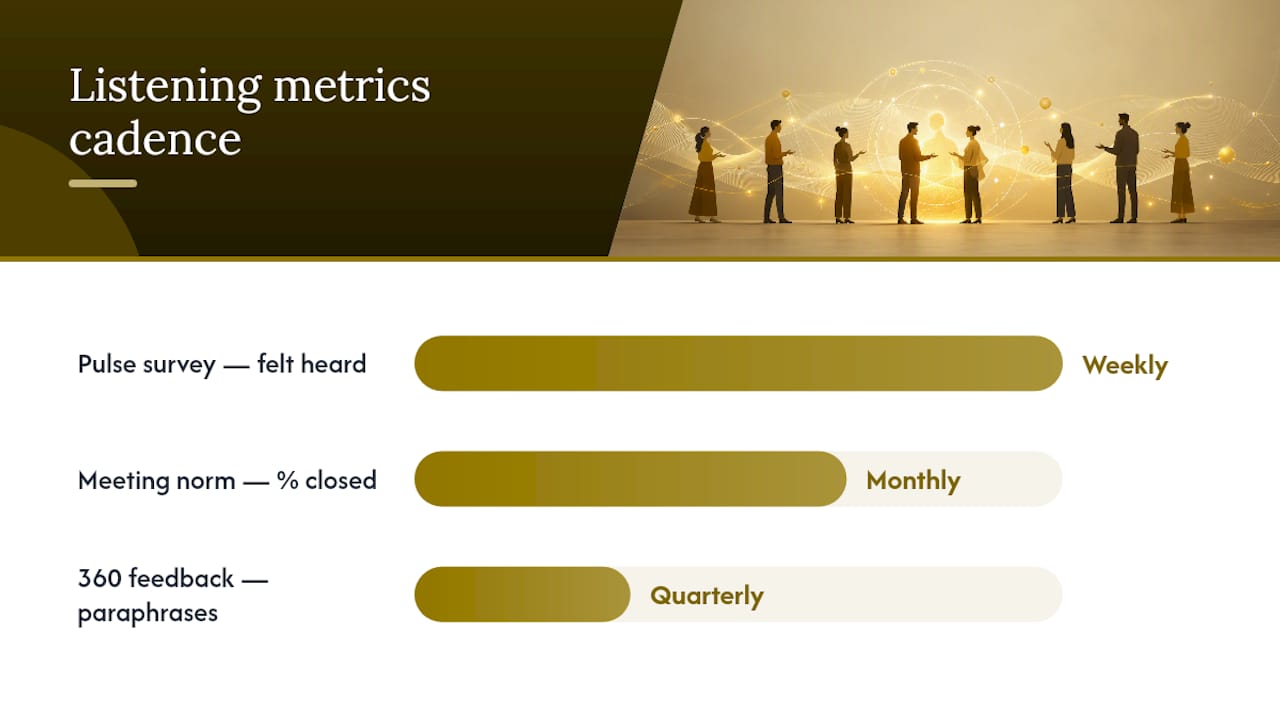
| Metric type | Example item | Cadence |
|---|---|---|
| Pulse survey | "I felt heard in my last 1:1" (1 to 5) | Weekly |
| 360 feedback | "This leader paraphrases before responding" | Quarterly |
| Meeting norm check | Percent of meetings closed with a summary | Monthly |
Embedding tactics matter as much as the metrics. Add "no phones" and "summarize before closing" as written meeting norms. Have senior leaders model paraphrasing visibly, since teams copy what they see modeled, not what gets stated in a policy doc.
When Deep Active Listening Isn't the Right Move
Active listening has limits. In a genuine emergency, a safety issue, or a time-critical call, stop, decide, and act. Save the deep exploration for after the immediate risk passes.
- HR-reportable or legal issues: document and escalate rather than exploring feelings in depth.
- Time-critical decisions: give a clear directive, then circle back to process it later.
- Confidentiality boundaries: acknowledge what you can't discuss instead of probing further.
How Leaderly Supports Active Listening at Scale
Building the habit individually is one thing. Making it consistent across fifty managers is another problem entirely, and it's the one a microlearning platform is built to solve. Leaderly delivers short listening-focused microlessons, sends behavioral nudges tied to real calendar events like upcoming 1:1s, and includes assessments that surface listening gaps a manager might not see in themselves.
- Microlessons reinforce one behavior at a time (paraphrasing, open questions, pausing) instead of dumping a full course on someone at once.
- Analytics dashboards let HR track completion and self-reported confidence across a cohort, not just one manager.
- A structured 30-day listening pilot for new managers ties directly into the metrics and norms described above.
Pro Tip: Pair a Leaderly microlesson with one weekly team meeting norm. The lesson builds the skill, the norm forces you to use it.
A Note on Building Listening as a Habit, Not a Trait
Treat active listening less like a personality feature and more like a rep you log. The leaders who improve fastest aren't the naturally warm ones. They're the ones who tried a script, noticed it landed badly, and adjusted the next day. Expect early attempts at paraphrasing to feel stiff. That's fine. Keep the reps going.
Give Your Managers a Structured Way to Practice
The techniques above work, but they fade fast without repetition and feedback built into the week, not bolted on as an annual training day. Leaderly turns the 30-day plan and measurement approach in this guide into short daily microlessons and nudges tied to your calendar, so managers practice paraphrasing and open questions inside the meetings they already run instead of a separate workshop.
A pilot cohort of new managers running a structured listening development track gets weekly microlessons, a self-assessment to spot gaps early, and dashboard data HR can actually report on. If you're deciding whether to run this for a team, start a pilot with Leaderly and see how a cohort responds over a month.
Sources
- The Future of Jobs Report 2023 — World Economic Forum
- Active Listening Skills: What They Are And Why They're Important — Forbes
- The art of active listening — UC Berkeley Executive Education
- What Is Active Listening? 7 Techniques — Cleveland Clinic