
Communication style determines whether a transition succeeds or stalls, because it controls how fast people trust the message, how clearly they understand what changes, and how quickly they act on it. The role of communication style in transition is not decoration on top of good strategy. It is the mechanism that turns a plan into behavior. Get the style wrong for the moment, and even a well-designed change initiative meets silent resistance or slow, halfhearted compliance.
Here's a working checklist before you write your next announcement, memo, or all-hands script:
- Task-focused/direct style: use it when facts must land fast and ambiguity creates risk (layoffs, safety changes, compliance deadlines).
- Human-oriented/supportive style: use it when people need reassurance before they can process logistics, especially in personal or emotionally loaded transitions.
- Participative/co-creative style: use it when the solution isn't fully formed and buy-in matters more than speed.
- Charismatic/envisioning style: use it when you need to break inertia and give people a reason to move, not just instructions.
Each style also lines up with a distinct communication purpose. Disrupting old routines calls for directness. Envisioning a future state calls for charisma. Legitimizing a decision calls for supportive, credible tone. Co-creating solutions calls for a participative approach. Match the purpose to the moment, and the style follows naturally.
Key Takeaways
Communication style determines transition outcomes because it signals intent, reduces uncertainty, and shapes whether people trust and act on a message before they even absorb its content.
| Point | Details |
|---|---|
| Style signals intent first | Recipients read tone and structure for trust cues before processing message content. |
| Match style to purpose | Disrupting needs precision, envisioning needs warmth, legitimizing needs credibility, co-creating needs openness. |
| Behaviors are teachable | Precision, emotionality, and questioningness are specific, trainable skills, not fixed traits. |
| Structure prevents breakdowns | Timing, privacy, and follow-up ownership matter as much as message wording. |
| Practice drives adoption | Leaderlyapp pairs microlessons with practice prompts and feedback loops to build style flexibility over time. |
Table of Contents
- What Is the Role of Communication Style in Transition?
- What Are the Four Purposes of Change Communication?
- Which Communication Styles Actually Change Adaptation Outcomes?
- How Do You Choose the Right Communication Style?
- How Do You Put the Right Style Into Practice?
- How Do You Measure Communication Effectiveness During Change?
- What Communication Mistakes Sabotage Transitions?
- What Evidence and Frameworks Support This Approach?
- How Does Behavior-Focused Training Change Communication Style?
- Why Most Style Advice Misses the Point
- How Leaderlyapp Helps Teams Practice These Communication Behaviors
- Sources
What Is the Role of Communication Style in Transition?
Communication style works because it functions as a signal, not just a container for information. Before your audience processes the content of a message, they read the style for clues about your intent, your confidence, and how much they can trust what comes next. That reading happens fast, often before the specifics of the announcement even register.
Four mechanisms explain why style has this much leverage:
- Uncertainty reduction. Transitions spike ambiguity, and people default to filling gaps with worst-case assumptions unless a style provides clear, repeated signals.
- Cognitive load. A precise, well-structured message frees mental bandwidth for action instead of decoding.
- Affiliation and trust. Warmth and authenticity in tone build the psychological safety needed for people to ask questions instead of quietly disengaging.
- Information accuracy. Style affects whether a message gets passed along correctly or degrades as it moves through informal networks.
A study of 152 working professionals found that specific style behaviors, precision, emotionality, and questioningness, explained meaningful variance in communication effectiveness and task proficiency, independent of broader personality traits. That distinction matters for training design: you don't need to reshape someone's personality to change their communication effectiveness. You need to change specific, teachable behaviors.
Communication styles emphasizing informality, precision, authenticity, and attention to reducing others' costs are linked to higher-quality adaptation in projects facing disruption, whereas self-focused and less precise styles are linked to weaker outcomes.
That finding comes from a qualitative study of seven U.K. construction projects examining communication style and adaptation under real disruption, not a lab simulation. The pattern holds at the individual level too: cooperative communication reduces knowledge hiding among colleagues, while competitive tone increases it, an effect that online channels can amplify or dampen depending on how the exchange is mediated.
The mechanism can be understood as sender intent encoded into stylistic cues which recipients interpret prior to message content, influencing behaviors such as compliance, resistance, or adoption. Skip a link in that chain, say the sender's intent is good but the style reads as cold and rushed, and the outcome breaks down regardless of how sound the underlying plan is.
What Are the Four Purposes of Change Communication?
Every transition message serves one of four purposes, and naming the purpose before you write a word of the message is the single most useful discipline in this whole guide.
Disrupting breaks old routines. Its behavioral objective is interruption: getting people to stop doing something automatically and start paying attention. Envisioning builds a compelling picture of what comes next, aiming to generate energy and direction rather than compliance. Legitimizing answers the question "why should I trust this decision," reducing resistance by demonstrating fairness and rationale. Co-creating invites input, with the objective of surfacing solutions and building ownership before a final decision locks in.
| Purpose | Behavioral goal | Best stylistic properties |
|---|---|---|
| Disrupting | Break old routines fast | High precision, direct tone, minimal warmth needed |
| Envisioning | Generate energy and direction | Warmth, narrative pacing, confident framing |
| Legitimizing | Reduce resistance and distrust | Formality balanced with authenticity, evidence-based tone |
| Co-creating | Gather input and buy-in | Participative cues, open questions, informal register |
Research linking communication purpose to cultural orientation and change readiness found that mismatches between purpose and delivery, for instance, trying to co-create with a directive tone, are a major source of communication breakdown during change efforts.
Pro Tip: Never mix purposes in a single message. If you're disrupting a routine and legitimizing a decision in the same email, split it into two communications with two distinct tones. Readers can't process "urgent, act now" and "let's talk this through together" at the same time without one signal drowning out the other.
Timing matters as much as tone. Disrupting works best early and briefly. Envisioning needs room to breathe, so save it for a forum where people can ask questions. Legitimizing should follow disruption almost immediately, before the trust vacuum fills with rumor. Co-creating belongs earlier than most leaders think, ideally before the plan is finalized, not after.
Which Communication Styles Actually Change Adaptation Outcomes?
Five styles show up consistently in transition communication, and each produces a distinct signature of effects on trust, speed, accuracy, and commitment.
Task-focused/direct style relies on short sentences, explicit instructions, and minimal hedging. It moves fast and reduces ambiguity, which makes it strong for compliance-driven changes. Its weakness: overused, it reads as cold, and commitment tends to lag even when compliance is high.
Human-oriented/supportive style leads with empathy, acknowledges disruption's emotional cost, and invites questions before giving instructions. A human-chatbot study found that a friendly, supportive style increased satisfaction and task completion, particularly for emotionally weighted interactions, while direct style stayed more efficient for pure information delivery. The lesson transfers directly to human leadership communication: match the style to whether the moment needs comfort or clarity.

Charismatic/envisioning style uses narrative, metaphor, and confident framing to generate momentum. It's the style most likely to break inertia in a stalled transition, but it can backfire fast if the vision isn't backed by credible follow-through. Watch for a gap between stated vision and visible action. That gap is what kills trust in a charismatic leader faster than almost anything else.
Participative/co-creative style asks more than it tells. It slows initial decision-making but tends to produce more durable buy-in, since people who help shape a solution defend it later. It works poorly under real time pressure, where people want direction, not deliberation.
Directive style overlaps with task-focused communication but adds a hierarchical edge, explicit authority, minimal room for pushback. Use it sparingly, in genuine emergencies or safety-critical moments, where research on structured handoff communication shows clear, authoritative instructions reduce errors under pressure.
- Use task-focused when the task is well-defined and time is short.
- Use supportive when the emotional stakes outweigh the informational complexity.
- Use charismatic when inertia, not confusion, is the barrier.
- Use participative when the solution isn't finalized and ownership matters more than speed.
- Avoid directive outside genuine emergencies. It erodes trust quickly when overused in routine change.
Pro Tip: Most leaders default to whichever style feels most natural to them personally, not the one the moment actually needs. Ask a colleague to flag when your default style doesn't match the purpose of the message you're about to send.
How Do You Choose the Right Communication Style?
Picking a style isn't guesswork if you run it through a short decision sequence every time.
- Identify the purpose first. Are you disrupting, envisioning, legitimizing, or co-creating? Write that word down before drafting anything.
- Assess the audience. Consider cultural orientation, current emotional state, and how much detail they actually need versus how much reassurance.
- Pick a primary style and a backup. Most real messages blend two, a supportive opener followed by a task-focused body, for example.
- Check timing and channel fit. A charismatic vision statement delivered by email loses most of its power; it needs a live forum.
Audience assessment deserves its own checklist, because skipping it is where most style mismatches happen:
- Is this audience already primed for change, or still in denial about the need for it?
- Does their cultural background favor direct or indirect communication norms?
- Are they currently anxious, skeptical, or simply uninformed? Each state calls for a different opening line.
- How much technical detail do they need to act, versus how much would just add noise?
A quick example of shifting style mid-conversation: a manager opens a team huddle with a supportive line ("I know this news is unsettling, and I want to walk through it with you"), then pivots to task-focused clarity ("Here's exactly what changes starting Monday"), then closes with a participative invitation ("What questions do you have before we finalize the rollout plan?"). That sequence hits three purposes in under two minutes without confusing the audience about what's happening.
Pro Tip: Draft the participative close before you write anything else. Leaders who write the invitation for feedback last often skip it under time pressure, and that's exactly the moment co-creation matters most.
How Do You Put the Right Style Into Practice?
Style only matters if it shows up consistently across the actual messages people receive. Here are templates for the four moments that make or break most transitions.
Announcement message: Open with the headline change in one sentence, follow with the reason (legitimizing), then state what happens next and when. Keep it under 150 words. Save nuance for the Q&A.
Q&A session script: Start with "here's what we know," acknowledge "here's what we're still figuring out," and end with a specific commitment to follow up by a named date. Never bluff an answer you don't have.
Small-team huddle: Lead with acknowledgment of impact on this specific team, not the organization broadly. Generic language here reads as indifference.
Follow-up message: Restate what changed, confirm what stayed the same (people forget this matters as much as the change itself), and name the next checkpoint.
Channel choice deserves as much thought as wording:
- Synchronous channels (all-hands meetings, team huddles) work best for envisioning and legitimizing, where tone and body language carry real weight.
- Asynchronous channels (email, written memos) suit disrupting and detailed logistics, where people need to reread and process at their own pace.
- Mediated channels (pulse surveys, anonymous chat, suggestion tools) work best for co-creating, especially when hierarchy might otherwise suppress honest input.
A closed-loop feedback script closes the gap between broadcasting a message and confirming it landed: "Here's what changed. Here's what we heard from you last time. Here's what we're doing about it." Repeat that loop on a cadence, not just once.
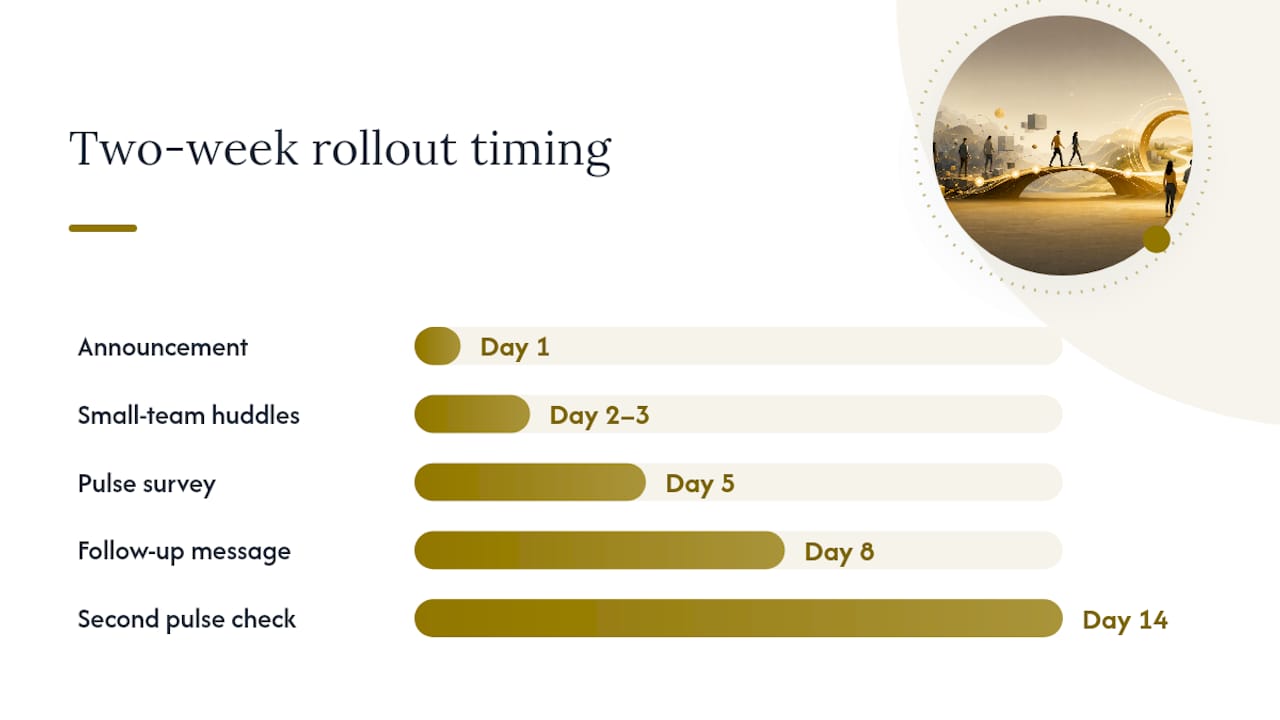
A simple two-week staged calendar: Day 1, disrupting announcement. Day 2 to 3, small-team huddles for legitimizing and initial Q&A. Day 5, pulse survey to gauge comprehension. Day 8, follow-up addressing top concerns. Day 12, co-creative session to refine implementation details. Day 14, second pulse check to confirm the message landed.
Our internal guide on communication styles for effective leaders breaks down the observable behaviors behind each of these templates in more depth.
How Do You Measure Communication Effectiveness During Change?
Measurement has to happen while the transition is unfolding, not just in a postmortem after it's over.
Track five signals: comprehension (do people accurately describe what's changing when asked cold), perceived transparency, trust in leadership, stated intention to comply, and observed behavior change. The first four come from surveys; the fifth comes from watching what people actually do.
- Run a short pulse survey within 48 hours of any major announcement, asking three questions: "What do you understand is changing?", "How clear was the reasoning behind this decision?", and "What's your biggest remaining concern?"
- Track behavioral indicators alongside survey data: meeting attendance, message open rates, task completion rates tied to the new process.
- Set a measurement cadence of weekly pulses during the first month of a major transition, then monthly through stabilization.
Structured communication tools produced measurable results in high-stakes settings: one clinical adaptation of the I-PASS handoff framework cut perceived loss of key information nearly in half. That level of improvement came from structure and consistency, not from any single well-written message. If comprehension scores stay flat after two pulse checks, intensify the frequency and simplify the message. If trust scores drop despite clear messaging, the problem usually isn't the words, it's a credibility gap between what's said and what people see happening.
What Communication Mistakes Sabotage Transitions?
The failures that derail transitions repeat across industries and rarely involve a single catastrophic message. They accumulate.
- Inconsistent messaging across leaders or channels breeds distrust faster than any single bad announcement. Fix: designate one source of truth and require every leader to reference it verbatim on key facts.
- Poor timing (announcing changes right before a weekend or holiday, for instance) leaves people stewing without access to answers. Fix: schedule disruptive news early in the week, with follow-up windows built in.
- Overload buries the actual change under too much context or too many simultaneous initiatives. Fix: one primary message per communication, always.
- Ignoring informal networks lets rumors fill gaps faster than official channels can correct them. Fix: identify and brief informal influencers before the broad announcement, not after.
- Mismatched tone to purpose, using directive language to legitimize a decision, for example, undermines the very trust legitimizing communication is supposed to build.
Structural processes for timing, privacy, and follow-up ownership prevent most of these failures before they start, and research on transition communication consistently finds that even well-phrased messages fail without that structural backbone.
What Evidence and Frameworks Support This Approach?
The recommendations in this guide rest on a handful of well-established frameworks and a small but consistent body of empirical research.
Lewin's change model (unfreeze, change, refreeze) maps directly onto the four communication purposes: disrupting corresponds to unfreezing, envisioning and co-creating drive the change phase, and legitimizing supports refreezing by cementing the rationale for the new normal.
Uncertainty Reduction Theory explains why style matters so much in the early stages of any transition: people seek information to reduce anxiety, and the style of that information, not just its content, determines how much anxiety actually gets resolved.
TeamSTEPPS and I-PASS, developed for clinical handoffs, demonstrate that structured, style-consistent communication tools produce measurable reductions in error and information loss, evidence that transfers directly to organizational transitions where handoffs (a departing manager, a shifting team structure) carry similar risk.
- The DePaul study of 152 professionals: style variables predict task proficiency independent of personality.
- The Tilburg construction study: precision and low self-focus predict adaptation quality under disruption.
- The Nature Communications study: cooperative style reduces knowledge hiding, with online channels moderating the effect.
The consistent thread across these studies is that communication style is measurable and teachable at the behavior level, not a fixed personality trait leaders either have or lack.
How Does Behavior-Focused Training Change Communication Style?
Style change happens through repetition of specific behaviors, not through a single workshop or a personality overhaul, as explained in how to improve your communication skills. Leadership development research consistently favors focusing on concrete, actionable behaviors over abstract categories, because behaviors map directly to what a leader does on a Tuesday morning.
A practical learning path looks like this:
- Assessment identifies a leader's default style and where it mismatches common transition demands.
- Microlessons target one specific behavior at a time, framing a disruptive announcement, softening a directive tone, running a co-creative huddle.
- Practice prompts put the leader in a low-stakes scenario to rehearse the behavior before a real transition demands it.
- Feedback loops confirm whether the behavior actually shifted, using pulse survey data or peer observation.
Track outcomes with the same metrics covered earlier: pulse survey comprehension scores, adoption rate of new scripts, and manager self-reports on which style they defaulted to under pressure. The tighter the loop between practice and real application, the faster the shift sticks.
Pro Tip: Pair every microlesson with one real upcoming communication moment. Practicing a supportive opener in the abstract rarely transfers; practicing it the day before an actual team huddle almost always does.
Why Most Style Advice Misses the Point
Most guidance on communication style treats it as a personality question, are you naturally warm or naturally blunt, when the research says otherwise. Style is a set of behaviors you choose per situation, and the leaders who handle transitions well aren't the most charismatic or the most direct by default. They're the ones who can read a moment and switch.
What gets underestimated is how much damage comes from a style that's technically well-executed but wrong for the purpose. A beautifully written vision statement delivered when people need blunt logistics reads as tone-deaf. A crisp, directive memo delivered when people need reassurance reads as cold. The failure isn't skill. It's a mismatch between purpose and delivery, and that mismatch is entirely preventable once you name the purpose before you draft the message.
The gap between what most change-management advice promises and what actually moves the needle comes down to specificity. General advice to "communicate more" or "be transparent" doesn't tell a manager what to say in the two minutes before a team huddle. Behavior-level guidance does.
How Leaderlyapp Helps Teams Practice These Communication Behaviors
Most leaders don't fail at transition communication because they lack good intentions. They fail because there's no structured way to practice switching styles before the stakes are real. Leaderlyapp closes that gap with microlessons built around specific communication behaviors, task-focused framing, supportive openers, co-creative scripts, paired with practice prompts and feedback loops that show whether the behavior actually changed.
A low-friction way to test this: run a two to four week pilot with one team facing an actual transition. Pair short microlearning modules on communication style with a pulse survey before and after key announcements. Expected outcomes to watch: improved comprehension scores, more consistent tone across the leaders involved, and faster adoption of the scripts your team actually needs. If you're planning a leadership development push tied to an organizational change, Developing Leadership Skills: How to Cultivate People Centricity is the right place to start scoping a pilot for your team.
Sources
- Communication during transitions of care (PSNet, AHRQ)
- Communication style and knowledge hiding behavior (Nature Communications)
- Communication style behaviors and performance (DePaul repository thesis)
- Communication style and adaptation in interorganizational projects (Tilburg University repository)
- Linking communication purpose to change readiness (Emerald)