
When the path forward is unclear, name what you know, what you don't, and what you'll test first, then say it out loud to your team within the hour. That single move, treating uncertainty as a problem to structure rather than a fog to wait out, is what separates leaders who keep their teams moving from leaders who freeze everyone in place.
First hour:
- Write down three things you know, three you don't, and one small action you'll take today.
- Tell your closest collaborator or manager what you're testing first.
First day:
- Send a short message to your team naming the ambiguity directly, without pretending you have answers you don't.
- Pick one low-risk decision to make today, even if it's reversible.
First week:
- Schedule a recurring check-in built specifically around what's still unknown.
- Ask one person outside your usual circle what they're seeing that you might be missing.
Pro Tip: Frame your first move as an experiment, not a commitment. "Let's test X for a week" removes the pressure of being right and gets people moving.
Key Takeaways
Handling ambiguity well comes down to acting on incomplete information deliberately, communicating honestly about what's unknown, and treating decisions as small, reversible experiments rather than final verdicts.
| Point | Details |
|---|---|
| Act within the hour | Name what you know, don't know, and are testing, then tell someone before the day ends. |
| Treat decisions as experiments | Frame choices as hypotheses with small tests to reduce freezing and speed learning. |
| Share unknowns openly | Structure updates around confirmed, likely, and unknown categories to prevent rumor. |
| Build cognitive complexity | Seek differing viewpoints and integrate them rather than defaulting to one leadership style. |
| Practice with Leaderlyapp | Microlearning and behavioral assessments turn ambiguity frameworks into repeated daily habits. |
Table of Contents
- What Handling Ambiguity in Civilian Leadership Actually Means
- Five Daily Habits That Keep Your Team Moving
- How Do You Make Decisions Without Enough Information?
- What Does the Research Say About Leading Through Uncertainty?
- Building Shared Understanding Across the Team
- Templates and Scripts You Can Use Today
- A 30, 60, 90 Day Plan for Handling Ambiguity
- Be Transparent: Share What You Know and What You Don't
- How Do You Build Leadership Versatility When Situations Keep Changing?
- Build Team Resilience and Normalize Discomfort
- Managing Fear and Anxiety on Your Team
- Fostering Psychological Safety for Honest Dialogue
- Balancing Short-Term Action With Long-Term Vision
- Leading Through the Fog Is a Practice, Not a Skill You Finish
- How Leaderly Helps You Build These Habits Into Daily Practice
- Sources
What Handling Ambiguity in Civilian Leadership Actually Means
Ambiguity is different from complexity. Complexity means many moving parts you could eventually map. Ambiguity means the information itself is incomplete, contradictory, or actively shifting, so no amount of analysis alone will resolve it. That distinction matters for how you lead.
Two situations show up constantly in civilian workplaces:
- A reorg shifts your team's priorities mid-quarter, and leadership hasn't finalized what success looks like yet.
- A client or stakeholder gives requirements that contradict each other, and nobody above you has clarified which one wins.
Left unmanaged, ambiguity slows decisions, erodes morale as people quietly start guessing, and causes teams to hoard resources out of fear they'll need them later. Recognizing which situation you're in, ambiguous versus merely complicated, tells you whether to analyze harder or start experimenting.
Five Daily Habits That Keep Your Team Moving
You don't fix ambiguity with one big speech. You fix it with small, repeated behaviors that give your team something solid to stand on even when the bigger picture keeps shifting.
- Expand your inputs. Talk to people outside your usual reporting chain, customers, frontline staff, other departments, before you form a view.
- Name what stays constant. Even when priorities shift, something usually doesn't: your budget ceiling, a compliance deadline, a customer commitment. Say it plainly: "Our deadline with the client isn't moving, even if the scope is."
- Model curiosity out loud. Say "I don't know yet, here's how we'll find out" instead of guessing to sound confident.
- Set guardrails, not scripts. Tell people what they can decide without you, so they're not waiting on you for every call.
- Coach toward decisions, don't make them all. Ask "what would you try first?" before offering your own answer.
Pro Tip: Pick one behavior and practice it in every meeting for two weeks before adding the next. Trying to install all five at once is how leaders abandon the habit by week two.
How Do You Make Decisions Without Enough Information?
You treat the decision as an experiment instead of a verdict. Framing a choice as a hypothesis rather than a final answer measurably reduces the freezing that happens when leaders feel they need certainty before acting, according to MIT Sloan Management Review.
- State a hypothesis. "We believe shifting the campaign budget to X will improve conversion within two weeks."
- Design a small test. Limit scope, budget, or time so a wrong guess costs little.
- Set a measurement window. Decide in advance what you're watching and when you'll check it.
- Extract the lesson. Whether it worked or not, write down what you learned before moving to the next test.
When weighing options, score each on three criteria: reversibility (can you undo it), cost of delay (what does waiting cost you), and information gain (will this test teach you something useful either way). Weight reversibility heaviest, since it's what makes fast action safe. A useful decision-making framework from Optio Station walks through similar prioritization logic for teams juggling competing demands.
Stop, scale, or iterate:
- Stop if the test cost more than planned and taught you little.
- Scale if the result was clearly positive and repeatable.
- Iterate if results were mixed but you learned something worth testing again.
What Does the Research Say About Leading Through Uncertainty?
Uncertainty isn't a passing phase leaders can wait out. Global measures of economic policy uncertainty hit their five highest readings in the past five years, and mentions of the word "uncertainty" in earnings statements and workplace reviews have climbed sharply, according to Harvard Business Review. Tolerance for ambiguity is now a core leadership skill, not a soft add-on.
High-performing professionals often default to a "know-it-all" mindset that spikes stress the moment answers aren't available. Shifting deliberately to a "learn-it-all" mindset lowers that stress response and opens room to experiment, according to Harvard Business School Publishing.
Two exercises make that shift concrete:
- Replace "I think the answer is" with "my current hypothesis is" in team discussions.
- Run one deliberately low-stakes probe each week, something small enough that a wrong guess costs almost nothing.
Building Shared Understanding Across the Team
No single leader sees the whole picture during genuine ambiguity. Distributed sensemaking spreads that job across the team instead of stacking it entirely on you.
A workable rhythm: a short daily huddle (10 minutes, what changed, what we're watching), a weekly working session (45 minutes, review test results, decide next probes), and a biweekly stakeholder update (what we know, don't know, and are testing).
Assign roles explicitly:
- Sensemakers watch for patterns across conversations and flag when the picture shifts.
- Data scouts track specific signals, a metric, a client mood, a competitor move.
- Decision owners hold authority to act on what the group learns, so momentum doesn't stall waiting for consensus.
Ask your team three questions regularly: "What's changed since we last talked?" "What are we assuming that we haven't tested?" and "What would tell us we're wrong?" Those questions surface the connection and clarity leaders need to keep a team oriented even when the destination keeps moving.
Templates and Scripts You Can Use Today
Borrowing from military mission command, Commander's Intent gives teams a way to act without waiting for every detail, because it separates purpose from method:
- Purpose: why this matters, in one sentence.
- Key constraints: budget, timeline, or compliance limits that won't move.
- Desired effect: what success looks like, described concretely enough that a team member could recognize it without you present.
Update email opener: "Here's what we know, what we don't, and what we're testing this week." Then three short bullets under each.
Huddle opener when you don't have answers: "I don't have the full picture yet. Here's what we're watching and what I need from you."
Meeting agenda for ambiguous projects: what changed, what we tested, what we're testing next, what's blocking us.
Red flags to watch: decisions stalling for more than a week, team members guessing rather than asking, silence from leadership lasting longer than your last update.
Pro Tip: Use these templates as starting points, not scripts to read verbatim. A Commander's Intent statement that sounds like a form letter loses the trust it's supposed to build.
A 30, 60, 90 Day Plan for Handling Ambiguity
- Days 1 to 30: Introduce the "know/don't know/testing" framing in every team update. Owner: you. Track how many decisions get made without escalation.
- Days 31 to 60: Assign sensemaker and data scout roles. Run your first three deliberate experiments. Track test completion rate and time-to-decision.
- Days 61 to 90: Review what worked, retire habits that didn't stick, and formalize the meeting rhythm as a standing calendar block. Track team-reported confidence in a short pulse survey.
Review progress every two weeks rather than waiting for the 90 day mark. Ambiguous situations shift fast enough that a monthly check risks correcting a problem that's already changed shape.
Be Transparent: Share What You Know and What You Don't
Transparency during ambiguity isn't about having answers. It's about being honest regarding the absence of them. Leaders who try to project false certainty usually get found out fast, and the cost is trust that's hard to rebuild.
Structure transparency around three categories: what's confirmed, what's likely but unconfirmed, and what's genuinely unknown. Share all three, not just the first. A team told "budget is confirmed, timeline is likely to shift, and we don't yet know who owns the new client relationship" can plan around real conditions. A team told only the confirmed piece fills the gaps with speculation, usually worse than the truth.
MIT Sloan Management Review puts it directly: leaders should "say something before the silence does." Silence doesn't read as calm. It reads as leaders hiding something, and teams fill that vacuum with rumor almost immediately.
Transparency also means admitting when you were wrong. If last week's update said the project timeline was safe and it isn't anymore, say so plainly rather than quietly revising history. Teams forgive incorrect information delivered honestly far more readily than they forgive being managed.
One practical habit: end every update, written or spoken, with an "unknowns" section, even if it's short. Making the unknown a standing agenda item normalizes it as part of how your team operates, rather than an occasional confession.
How Do You Build Leadership Versatility When Situations Keep Changing?
Versatility means adjusting your leadership style to what a specific moment requires, not defaulting to whichever style feels most natural to you. A leader who only knows how to direct struggles when a team needs space to explore. A leader who only knows how to facilitate struggles when a crisis needs a fast, unilateral call.
Academic research on leader development points to something deeper than style switching: cognitive complexity, the capacity to hold multiple, sometimes contradictory perspectives at once and still act coherently. Leaders with higher self-complexity and cognitive complexity handle unpredictable environments more effectively, according to a review published in the Journal of Business Research. That complexity comes from two linked skills: differentiation, deliberately seeking out viewpoints unlike your own, and integration, weaving those different views into one workable decision rather than picking a side.
Build versatility deliberately rather than waiting for it to develop by accident:
- Rotate which decision-making style you default to across different meetings, sometimes directive, sometimes exploratory, and notice which one the moment actually called for.
- Ask a colleague with a different working style to challenge your read on a situation before you commit to a direction.
- After a hard call, ask yourself which of three or four other approaches might have worked better, even if your choice was fine.
Versatility isn't about being unpredictable to your team. It's about matching your response to what the specific ambiguity requires.
Build Team Resilience and Normalize Discomfort
Resilience isn't a personality trait some people have and others don't. It's built through repeated, survivable exposure to discomfort, which is exactly what ambiguous situations provide if a leader handles them well.

Start by naming discomfort out loud instead of pretending it isn't there. Saying "this is uncomfortable, and that's expected right now" does more to steady a team than false reassurance that everything's fine. People trust leaders who acknowledge reality over leaders who paper over it.
Build small wins deliberately. When the bigger outcome is unclear, manufacture short-term progress your team can see: a completed test, a resolved question, a small decision made and acted on. Momentum, even modest momentum, counters the paralysis that ambiguity tends to produce.
Normalize failed experiments as data, not embarrassment. If a test didn't pan out, walk through what was learned in the same tone you'd use for a success. Teams watch how leaders react to failure far more closely than they listen to what leaders say about failure being okay.
Protect recovery time. Constant ambiguity without any settled ground burns people out fast. Build in moments, a finished project phase, a stable week, a completed milestone, where the team gets to feel solid footing again, even briefly.
Finally, resist the urge to over-explain every setback. A brief, honest account of what happened and what's next does more for resilience than a long justification that reads as defensive. Short, direct, and repeated beats elaborate and occasional.
Managing Fear and Anxiety on Your Team
Ambiguity produces anxiety because uncertainty about the future activates the same threat response as a concrete danger. Your team isn't overreacting when ambiguity makes them anxious. Their nervous systems are doing exactly what they evolved to do.
Emotional intelligence starts with naming the emotion rather than talking around it. If a team member seems withdrawn or short with colleagues, a direct, low-pressure check-in ("how are you doing with all the change lately?") usually surfaces more than waiting for them to bring it up unprompted.
Separate signal from noise in your own reactions first. If you're anxious, your team will read that anxiety regardless of what you say, so managing your own state is a prerequisite for managing theirs. That doesn't mean faking calm. It means processing your own reaction before you walk into the room, so what you bring is steadiness rather than transferred stress.
Give people permission to feel uncertain without treating it as a performance problem. A team member who says "I don't know how to plan my work this week" isn't failing. They're accurately describing the situation. Respond with a concrete next step, not reassurance that dismisses the concern.
Watch for physical signs of accumulated stress across the team: rising sick days, shorter tempers in meetings, disengagement from discussions that used to draw more input. These are earlier warning signs than a formal survey will ever catch, and they're worth acting on before they show up in retention numbers.
Fostering Psychological Safety for Honest Dialogue
Psychological safety means people believe they can raise a concern, admit a mistake, or challenge an idea without being punished for it. Under ambiguity, that safety matters more than usual, because the information a team needs most often comes from someone willing to say "I think we're wrong about this."
Respond visibly well to bad news. The first time someone brings you an uncomfortable truth and you react with curiosity instead of blame, you set the tone for every disclosure after it. React badly once, and people quietly stop telling you things.
Ask questions that invite disagreement directly: "What am I missing?" or "Who sees this differently?" rather than "Does everyone agree?" The second question invites silence. The first invites the information you actually need.
Separate the idea from the person when a suggestion doesn't work out. "That approach didn't pan out" keeps the conversation about the work. "You were wrong about that" makes the next person less likely to speak up at all.
Make space for junior voices specifically. In ambiguous situations, the person closest to the problem, often not the most senior person in the room, frequently has the clearest read on what's actually happening.
Balancing Short-Term Action With Long-Term Vision
Ambiguity tempts leaders toward one of two failure modes: freezing until the picture clears, or scrambling reactively without any throughline connecting the day's actions to where the team is actually headed. Both erode trust, just on different timelines.
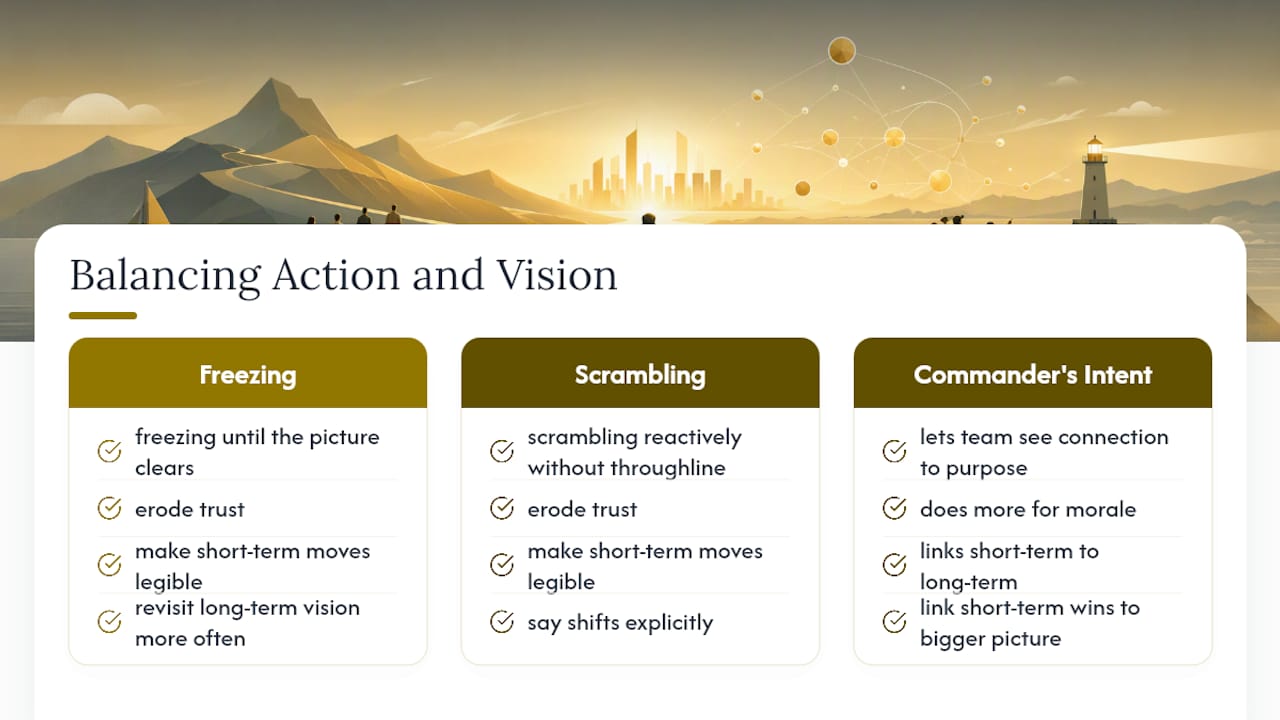
The fix isn't choosing between short-term action and long-term vision. It's making sure every short-term move is legible against a long-term direction, even a rough one. Your Commander's Intent statement does exactly this work: it lets the team see how today's decision connects to the broader purpose, even when specifics keep shifting underneath it.
Revisit your long-term vision more often than feels necessary during ambiguous stretches, not to change it constantly, but to confirm it still holds. If it needs to shift, say so explicitly rather than letting people notice on their own that the destination quietly moved.
Give short-term wins a visible link to the bigger picture. "This test moves us toward the goal we set last quarter" does more for morale than a win that feels disconnected from anything larger. Ambiguity makes people crave that connective thread, even a thin one, more than they crave certainty itself.
Leading Through the Fog Is a Practice, Not a Skill You Finish
I don't think anyone gets fully comfortable with ambiguity. The leaders who handle it best have simply built the habit of acting anyway, testing small, saying what they don't know, and adjusting without waiting for permission to be wrong. That's the whole practice behind the daily behaviors and the 30/60/90 plan above: repetition, not mastery.
How Leaderly Helps You Build These Habits Into Daily Practice
Reading a framework and actually installing it as a habit are two different problems, and the gap between them is where most good leadership advice quietly dies. Leaderlyapp closes that gap with personalized microlessons that turn concepts like decision-as-experiment and Commander's Intent into short, repeated exercises your team actually finishes.
- Habit-building microlearning reinforces the "know/don't know/testing" framing until it becomes automatic rather than something you have to remember to do.
- Behavioral assessments (including DiSC and EQ) help leaders identify where their own mindset defaults to know-it-all under pressure.
- Analytics dashboards let organizations track adoption of these behaviors across teams, not just individual leaders.
If you're ready to move past reading about ambiguity and start practicing it, explore how Leaderlyapp builds people-centered leadership skills.
Sources
- Leaders, It’s Time to Build Your Tolerance for Uncertainty
- 10 strategies for leading in uncertain times
- Leading through uncertainty (Harvard Business School Publishing)
- Navigating complex environments requires complex leaders
- How to lead through change and uncertainty: a human-centered leadership framework