A growth mindset at work is the working belief that skills, talent and judgment can be developed through effort, good strategies and help from others, so a mistake becomes information instead of a verdict. It spreads through a team when people see leaders model it, when feedback is routine, and when learning happens in small, repeated steps instead of one annual workshop. That last point is why we build leadership development around frequent microlessons that reach every employee, not only managers.
This guide covers what the mindset means in daily work, what the research supports, the exercises that work for individuals, managers and teams, and how HR can make it stick across an organization.
TL;DR
- A growth mindset is the belief that abilities can be developed. A fixed mindset treats them as static. Both show up in how people react to mistakes and feedback.
- Research links growth-mindset cultures to more trust, commitment and a sense of empowerment, and a short intervention raised job performance and satisfaction in one randomized study.
- Individuals practice it by adding "yet" to skill gaps, reporting mistakes with a fix, and treating feedback as data.
- Managers build it by sharing their own feedback and development goals, which creates psychological safety.
- Organizations make it last by running small experiments, giving continuous feedback and building habits through short, repeated learning.
Table of Contents
- What a growth mindset at work actually means
- An example of a growth mindset at work
- What the research says about results
- Growth mindset exercises for individual employees
- Growth mindset for managers
- Team exercises that build the habit
- How HR can make a growth mindset stick
- Our perspective
- Build the habit across your organization
- FAQ
- Sources
What a growth mindset at work actually means
The term comes from psychologist Carol Dweck's research. In a review of mindsets at work, Mary Murphy and Stephanie Reeves describe a growth mindset as the belief that traits like intelligence, talent and ability can be developed through learning, effort, persistence, good strategies and help-seeking. A fixed mindset holds that such traits are relatively static: you either have it or you don't.
The World Economic Forum, summarizing Dweck's work, puts the day-to-day difference this way: people with fixed mindsets view talent as an innate gift and spend their time proving rather than improving their abilities, while people with growth mindsets work at developing them by learning from others and from their mistakes.
Microsoft's Joe Whittinghill describes the practical side. In a Business Insider report on Microsoft's management strategy, he explains that growth-minded professionals spend extra time understanding why they failed and rebound quickly, while fixed-minded professionals tie successes and failures to who they are. The useful shift is from judging ability to examining process.
So a growth mindset is not positivity and not "trying harder." It is a specific response pattern:
| Situation | Fixed-mindset response | Growth-mindset response |
|---|---|---|
| A project misses its target | Find who or what to blame | Review the process and decide what to change |
| Critical feedback arrives | Defend, or take it as a judgment of ability | Ask for specifics and treat it as data |
| A colleague excels | Feel threatened | Ask what they do differently |
| A skill gap appears | "I'm not a numbers person" | "I'm not good at this yet" |
An example of a growth mindset at work
The clearest real-world example comes from Stanford. Researcher Justin Berg and colleagues ran career workshops with 149 employees at a Fortune 500 tech company. One salesperson who pitched mostly by phone and email set a goal of pitching in person at conferences, and began by working on public speaking. Peers and managers rated the group that learned this approach as happier at work six months later.
Berg's finding has a useful twist for managers and HR. One growth mindset is not enough. He explains that people inevitably have to change either themselves or their job to sustain progress, so they need a "dual-growth mindset": seeing room to grow in both themselves and their role. For you as a manager, that means development conversations should cover the person's skills and the shape of the job.
Other everyday examples follow the same pattern:
- A new manager who struggles with delegation treats it as a skill to practice, not a personality flaw.
- A team that misses a deadline holds a review about the process, not about who was late.
- A veteran moving into a civilian leadership role treats unfamiliar corporate norms as something to learn, not proof of a poor fit.
- A faculty member or program coordinator tries a new teaching or facilitation format, then adjusts based on participant reactions.
What the research says about results
The evidence is encouraging, with a few details worth knowing before you build a program.
Culture matters. Murphy's review reports that employees express greater trust and commitment to companies that espouse growth over fixed mindset beliefs and practices. In a study of hundreds of employees at seven Fortune 1000 companies, Dweck and Murphy reported that workers at growth-mindset companies felt more empowered and committed, said their organizations valued innovation and would support reasonable risks that failed, and were more often seen by managers as having potential to rise.
A short intervention can move outcomes. A 2024 study by Yaqi Yang, Oi Ling Siu and Yi Huang used a randomized controlled design with 79 participants. A one-hour growth mindset intervention increased job performance and job satisfaction by first raising growth mindset and then work engagement. A survey of 801 people supported work engagement as the link.
Mindset needs structure around it. A scoping review of growth mindset research for human resource development found that most of the studies came from outside the U.S., and that team-level and organizational-level research is thin. The authors recommend building interventions around career development, training and development, and organizational development. That is a practical map for HR: mindset work belongs inside your development systems, not beside them.
Avoid the "false growth mindset"
Murphy's review warns about a false growth mindset: beliefs and behaviors that don't match what the research says. In teacher training institutes run by a group of researchers, most teachers believed they had a growth mindset when they did not, and some felt that acknowledging fixed-mindset beliefs was almost a slur.
The practical lesson: don't label people "growth" or "fixed." Everyone has fixed-mindset triggers, such as a senior audience, a skill they take pride in, or a harsh critique. Teams do better when they name those triggers openly and practice a different response, which is what the exercises below are for.
Growth mindset exercises for individual employees
These take minutes and need no budget. Each one builds a response habit.
1. Add "yet" to the gap
When you catch yourself saying "I'm bad at presentations," finish it with "yet," then write the next small step: one practice talk, one request for observation, one resource. The word works because it turns a fixed label into a work in progress.
2. Report mistakes quickly, with a fix
The professional association CASE advises not hiding an error. Tell your boss promptly in a few sentences, such as "I did X. As a result, Y happened," then suggest a fix. Later, once time has passed, discuss how you would handle similar situations in future. That follow-up shows you are not wasting the learning opportunity.
Our article on strategies for learning from failure goes deeper on turning a setback into a repeatable lesson.
3. Treat feedback as data
Stanford's Cardinal at Work guidance says to treat feedback as a dialogue: ask clarifying questions for specifics, co-create action steps with your manager, and see areas for improvement as "data" and opportunities to learn instead of as failing at your job.
When criticism stings, SHRM's Johnny C. Taylor, Jr. suggests a short sequence: pause before reacting, ask clarifying questions, move to solutions with an improvement plan, and separate your work performance from your self-worth.

4. Make your job a growth project too
Using Berg's dual-growth idea, once a quarter ask two questions: "What skill do I want to build?" and "What part of my role could change so I can use or build it?" Then bring one concrete proposal to your manager.
Growth mindset for managers
Employees copy what leaders do under pressure. Three behaviors have evidence behind them.
Share your own development goals
Organizational psychologist Adam Grant ran an experiment in which managers shared past experiences of receiving feedback and their future development goals. That produced sustainable psychological safety gains a year later, while simply asking for feedback produced gains only over the following week. His argument is that safety comes from managers openly admitting imperfection, not from one-time requests that fade when a manager gets defensive. For a closer look at how leaders build lasting psychological safety this way, see this piece on building psychological safety through shared feedback.
To practice it, open your next team meeting with one thing you are working on and one piece of feedback you recently received, including what you did with it. Our guide on how leaders can get the feedback they need to grow is a good companion.

Coach, don't only evaluate
Microsoft's "Model Coach Care" framework, rolled out to 3,300 managers, defines the manager's role as delivering success through empowerment and accountability by modeling, coaching and caring. Coaching there explicitly creates space for employees to learn from mistakes. In practice, end one-on-ones with "What did you try this week, and what did you learn?" in place of status questions only.
Reframe with questions
A Forbes Coaches Council piece describes a manager who explained growth versus fixed mindset at a staff meeting and ran reframing exercises, using the power of "not yet" and prompts such as "What are the possibilities here?" to move people toward curiosity. Questions work better than reassurance because they invite the person to do the thinking.
Feedback is where managers most often slip back into fixed-mindset habits. Our guide to giving feedback with a growth-mindset approach covers the wording, and supporting a team member who fights feedback covers the harder conversations.
Team exercises that build the habit
Score the decision process, not only the outcome
Grant describes an expanded scorecard: a good outcome from a shallow process is luck, a bad outcome from a thorough process is a smart experiment, and failure counts only when the decision process was shallow. In your next project review, rate the process and the result separately and talk about both.
Run small, time-limited experiments
Tony Schwartz, drawing on research on deliberately developmental cultures, argues that growth cultures need time-limited, manageable experiments with new behaviors to test the unconscious assumption that changing the status quo is dangerous. Try a two-week trial of a new meeting format or handoff process, then decide together whether to keep it.
Hold blameless retrospectives
Ask three questions after any miss: what happened, what did we learn, what will we change? Keep names out of the first answer. The aim is a shared record of cause and fix.
Practice feedback in every direction
Schwartz's framework also calls for continuous feedback up, down and across the organization, grounded in a shared commitment to helping each other grow. A simple start is a monthly "one thing to keep, one thing to try" exchange between peers.
How HR can make a growth mindset stick
A workshop can introduce the idea, but the research points to systems. Here is a practical order of work.
- Start with leaders. Because psychological safety rises when managers share their own goals and imperfections, begin with the people others watch.
- Reach everyone, not just managers. Culture shows up in how frontline staff, volunteers and students react to setbacks. A program limited to management levels leaves most of the organization out. See our ideas for creating growth opportunities for your employees.
- Use short, repeated practice. Mindset is a response habit, and habits form through repetition in real situations. Five-minute lessons tied to daily work fit calendars that a day-long course does not.
- Build feedback into routines. Put feedback prompts into one-on-ones, project reviews and onboarding so they are not left to chance.
- Reward learning behaviors. Recognize people who share a lesson from a failure, ask for help or try an experiment, not only people who hit targets.
- Measure it. Use pulse surveys on psychological safety and engagement, and look at participation trends over time.
For a wider view of the investment case, read why it matters that you're always improving and cultivating a culture that grows high-potential employees.
If you are an emerging leader or a veteran moving into civilian work
You do not have to wait for a company program. Start with the individual exercises above, pick one skill gap and write it with "yet," and ask a trusted colleague for specific feedback on it each week. In a new civilian environment, treat unfamiliar vocabulary, meeting styles and decision norms as skills in progress. Ask your manager what good looks like, then check your progress against it every few weeks.
Our perspective
Most growth mindset programs fail for a simple reason: they teach the idea once and expect behavior to change. Mindset is a habit, and habits need frequent, small, practical repetitions in the moments where people actually react to a mistake or a piece of feedback.
That is why we built Leaderly AI around behavioral science, short microlessons and practical exercises, with personalization that evolves with each user's journey. A new manager and a seasoned director do not need the same next step, and a learning journey should reflect that.
We also believe leadership development should not stop at the management layer. Growth culture is built by everyone, so HR teams, educators and nonprofit leaders need an affordable way to reach all employees, volunteers or students, with assessments, analytics and customizable content to match their own programs.
When people practice the habits of a growth mindset a few minutes at a time, the culture follows.
Drew Bartkiewicz
Build the habit across your organization
If you are responsible for developing people at scale, Leaderly AI is a mobile-first platform that delivers personalized leadership microlessons, behavioral habit-building exercises, self-assessments including DiSC, EQ and MBTI, and analytics dashboards. You can customize learning journeys for your organization, and it serves corporate, nonprofit and higher education settings.
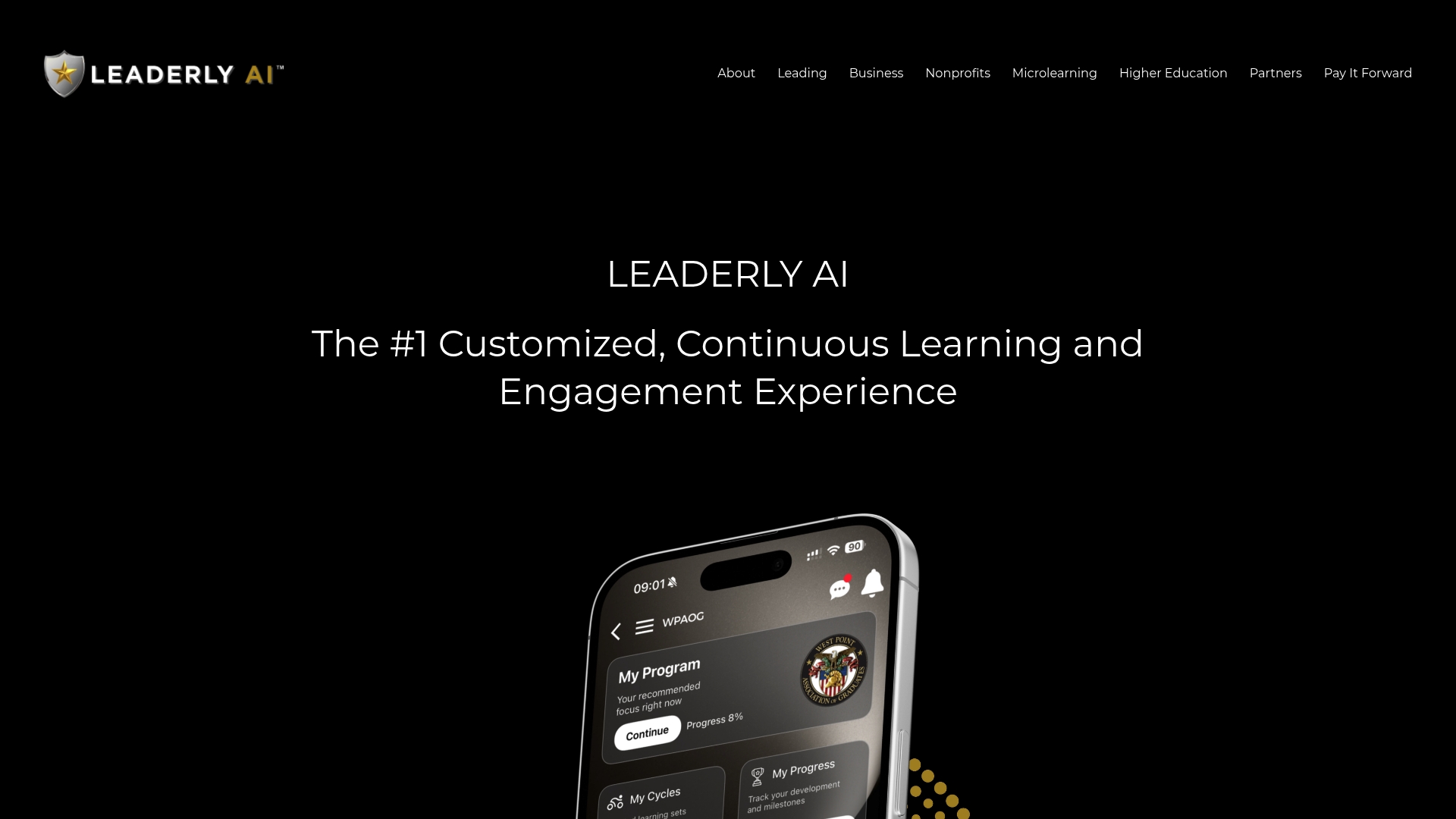
Explore how it works for business teams, nonprofits and higher education, or start at the Leaderly AI home page to see the full platform.
FAQ
What is an example of a growth mindset at work?
A salesperson who relied on phone and email pitches set a goal of pitching in person at conferences and first worked on public speaking. In a Stanford-led study, employees who took this approach were rated happier at work six months later. Everyday versions include adding "yet" to a skill gap and reviewing a missed deadline for process fixes.
How do managers encourage a growth mindset?
Share your own development goals and past feedback experiences, coach with questions about what people tried and learned, and review decisions by process as well as outcome. Grant's research found that sharing goals and feedback experiences produced psychological safety gains that lasted a year.
How do I respond to criticism with a growth mindset?
Pause before reacting, ask clarifying questions to get specifics, then agree on action steps with the person giving the feedback. SHRM's guidance adds separating your work performance from your self-worth, so criticism becomes information about the work.
Can a growth mindset be taught in a short time?
A 2024 randomized study with 79 participants found that a one-hour growth mindset intervention raised job performance and satisfaction through higher work engagement. Lasting change comes from repeating the habits in real work situations, so short, regular practice tends to serve better than a single session.
Sources
- Personal and organizational mindsets at work (Murphy and Reeves)
- Growth vs fixed mindset: which does your workplace have? (World Economic Forum)
- Microsoft Is Using Growth Mindset to Power Management Strategy (Business Insider)
- Take This Job and Love It: How a Growth Mindset Can Boost Happiness at Work (Stanford GSB)
- The Remarkable Reach of Growth Mindsets (Scientific American)
- Growth mindset at workplace: A new way to improve employees' job performance
- Growth Mindset for Human Resource Development: A Scoping Review
- How to Handle a Work Mistake (CASE)
- The power of ongoing communication and feedback (Cardinal at Work, Stanford)
- Ask HR: How to Respond to Criticism Constructively (SHRM)
- Building a culture of learning at work (strategy+business)
- 18 Ways To Help Team Members Embrace A Growth Mindset (Forbes Coaches Council)
- Create a Growth Culture, Not a Performance-Obsessed One (Harvard Business Review)