
Start one visible weekly commitment ritual and model it yourself. That single move drives faster results than adding another policy, another meeting, or another dashboard.
Here's the immediate playbook: post your own top three commitments in your team channel every Monday, ask each person to do the same by end of day, and review what got done every Friday in under ten minutes. Say it plainly in your next team meeting: "I'm doing this too, starting now." This matters because only 44% of managers have received formal training on how to run these conversations, which is exactly why leader modeling has to come first, not policy.
- Post your Monday commitments publicly before asking your team to.
- Tell your team directly why you're starting this and what "done" means.
- Hold the first Friday close-out to fewer than ten minutes.
Leaderlyapp's microlearning nudges can reinforce these habits once you've started them by hand.
Key Takeaways
Building an accountability culture requires leader modeling first, clear ownership second, and consistent consequences applied without exception to sustain it.
| Point | Details |
|---|---|
| Start with leader modeling | Post your own commitments publicly before asking your team to do the same. |
| Sequence clarity before consequences | Document roles and "done" definitions in the first 30 days, before adding pressure. |
| Distribute feedback across peers | A significant portion of managers do not receive formal training, so peer feedback can help prevent bottlenecks. |
| Run low-cost weekly rituals | Monday commits and Friday close-outs build the habit within two to three weeks. |
| Scale with tailored microlearning | Leaderlyapp reinforces feedback and modeling habits as your team grows past what one manager can track alone. |
Table of Contents
- Why Building Accountability in Teams Actually Pays Off
- What Are the Core Components of an Accountability Framework?
- How Do You Build Accountability in 30, 60, and 90 Days?
- What Daily and Weekly Rituals Keep Accountability Alive?
- How Do You Measure and Sustain an Accountability Culture?
- How Can You Scale Accountability Across a Growing Team?
- Why Leader Modeling Is the Part Everyone Skips
- Build the Habit Faster With Leaderlyapp
- Frequently Asked Questions
- Sources
Why Building Accountability in Teams Actually Pays Off
Teams with clear accountability deliver more predictably, catch problems earlier, and keep good people longer. Reliability compounds: when commitments are visible and consequences are consistent, people stop wasting energy guessing who owns what.
The cost of skipping it: 44% of managers lack formal training in exactly the skills accountability requires, which turns untrained managers into bottlenecks for feedback and follow-through.
The failure modes are predictable once you've seen them a few times:
- Vague ownership ("the team" owns it, so no one does).
- Senior leaders quietly exempting themselves from the same standards.
- Feedback that only flows downward, never peer to peer.
- Consequences that appear for some people and not others.
Establishing a culture of accountability works because it focuses the team's attention on clear expectations and outcomes, not on blame after the fact.
What Are the Core Components of an Accountability Framework?
Five elements hold up every durable accountability system, and you can check all five in a five-minute team review.
- Clarity. People need a specific, written definition of "done" for their role and their current work, not a general job description. Ask: Can each person state, in one sentence, what their team expects of them this week?
- Ownership. One name attached to each outcome, not a group. Ask: If this slips, whose name is on it?
- Feedback. Regular, two-way conversation, not an annual review. Ask: When did this person last get specific input on their work, from a peer or from you?
- Consequences. Predictable responses, positive and negative, applied evenly. Ask: Would this same slip get the same response if a top performer did it?
- Psychological safety. People need to be able to admit a miss without fear of humiliation. Ask: Did someone flag a risk late because they were afraid to flag it early?
The fifth component is what makes the other four sustainable. The Center for Creative Leadership found that leaders increase accountability most effectively by reducing fear and building trust through five actions: giving support, providing freedom, sharing information, providing resources, and being clear.
Leader modeling sits underneath all five components. One senior leader who skips a deadline without consequence, or who exempts themselves from the same commit ritual they demand of others, can undo months of work. Teams notice exceptions faster than they notice policies.
Pro Tip: Run the five diagnostic questions above as a private self-check before you roll anything out to your team. If you can't answer all five honestly, fix that first.
How Do You Build Accountability in 30, 60, and 90 Days?
Rolling out every component at once overwhelms teams and usually collapses within a month. Sequence it instead. Practitioner frameworks consistently point to the same order: clarity before consequences.
Days 1 to 30: document clarity.
- Write down roles and decision rights for every person on the team, in one shared document.
- Define what "done" looks like for the team's three most common types of work.
- Announce the change directly: "Starting Monday, we're going to be explicit about ownership and deadlines. Here's why, and here's what changes for you."
Days 31 to 60: hand over ownership and install feedback rhythms.
- Assign a single owner to every recurring workflow, replacing shared or unclear ownership.
- Start weekly commit posts (Monday) and close-outs (Friday).
- Add a short weekly 1:1 focused on blockers, not status updates: "What's in your way, and what do you need from me?"
Days 61 to 90: operationalize consequences and recognition.
- Apply the same response to a missed commitment regardless of who missed it, whether that's a direct conversation or a public acknowledgment when someone flags a risk early.
- Run a monthly retrospective: what worked, what didn't, what changes next.
- Co-create a short team operating agreement, one page, listing how the team commits, reviews, and handles misses.
Behavioral change from this sequence tends to show up within two to three weeks, with a fuller cultural shift closer to the three or four month mark. Expect the first few weeks to feel a little mechanical. That's normal.
What Daily and Weekly Rituals Keep Accountability Alive?
The system survives on cheap, repeatable habits, not big annual programs. Here's what to run and who owns it:
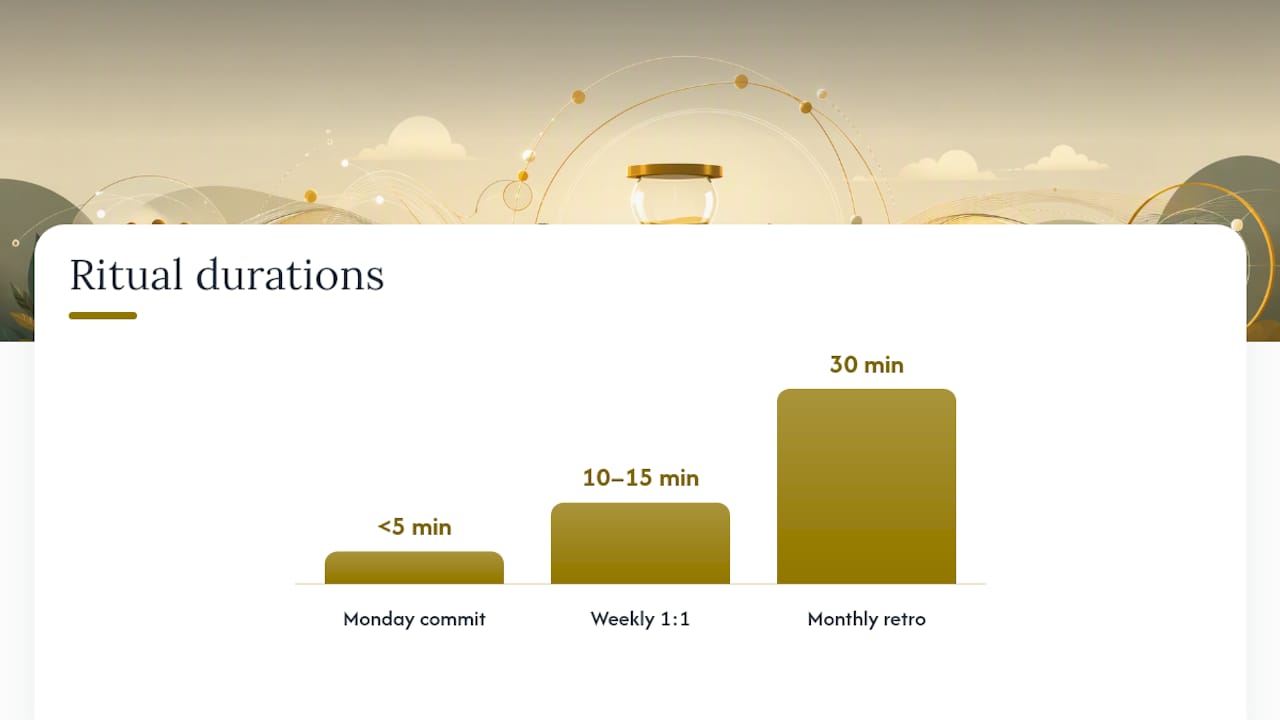
- Monday commit post. Each person posts their top three priorities in a shared channel by 10 a.m. Owner: each team member. Success looks like: fewer than five minutes per person, no exceptions.
- Friday close-out. A short written or spoken review of what got done against Monday's commits. Owner: the team lead facilitates, but everyone reports their own.
- Weekly 1:1 blocker check. Ten to fifteen minutes, focused only on what's stuck. Owner: manager and direct report.
- Monthly retro. Thirty minutes reviewing patterns across the month, not individual misses. Owner: rotates among team members.
- Public commitment board. A shared doc or single channel that holds the record, so no one has to ask "wait, who owns this?"
Remote teams benefit even more from this structure, because ambient office visibility disappears when people aren't physically together, and public commits have to do the work that hallway conversations used to do.
Pro Tip: Keep the artifact simple. A single pinned channel post beats a complex tracking tool every time when you're building the habit. Add tooling only after the ritual sticks.
How Do You Measure and Sustain an Accountability Culture?
Track two kinds of signals. Leading indicators tell you if the system is running: commit completion rate and how fast blockers get resolved once flagged. Lagging indicators tell you if it's working: delivery against key outcomes and engagement scores over time.
Review cadence matters as much as the metrics themselves:
- Weekly: a quick health check on commit completion.
- Monthly: a trend review looking for slippage or uneven application.
- Quarterly: a full retrospective on whether the system still fits how the team works.
The most common way these systems break down isn't lack of effort. It's inconsistency. Peer-based feedback and shared-outcome metrics tend to hold up better over time because they don't depend entirely on one manager remembering to enforce them, and they survive a leader's absence or a busy quarter better than top-down enforcement does. The gap in manager training noted by HR Dive is exactly why distributing feedback across peers, rather than routing it all through one manager, holds up longer.
How Can You Scale Accountability Across a Growing Team?
Once the rituals are running by hand, the challenge shifts from starting the habit to keeping it consistent as your team grows past the size where one manager can personally track every commitment.

Two situations show this clearly. A manager promoted into their first leadership role often knows the accountability framework in theory but has never practiced the specific coaching language that turns a missed commitment into a useful conversation instead of a confrontation, as explained in How to Help Your Supervisors Be More Effective in Their Roles ! - Stacyknows. And a team that's doubled in size in a year needs the same clarity and feedback rhythms it had at half the size, applied consistently instead of informally.
Leaderlyapp's microlearning approach to accountability delivers short, personalized exercises that reinforce exactly this kind of leader modeling and feedback practice between the rituals you're already running.
- Map new managers to short habit-building lessons tied to your existing commit rhythm.
- Use behavioral nudges to reinforce feedback conversations before they lapse.
Why Leader Modeling Is the Part Everyone Skips
Most accountability advice focuses on tracking systems and consequence charts. The part that actually determines whether any of it survives contact with a busy quarter is whether the leader does the same thing they're asking everyone else to do, in public, without an exception clause.
I've seen the reverse consistently undo good frameworks: a well designed system, undone the first time a senior leader quietly skips their own deadline and nobody says anything.
Post your own commitment this Monday, before you ask anyone else to.
Build the Habit Faster With Leaderlyapp
Running weekly rituals by hand works, until your team doubles and a single manager can't personally reinforce every commit, every 1:1, and every feedback moment across a growing organization. Leaderlyapp closes that gap with personalized microlessons that reinforce leader modeling and feedback habits between the rituals you've already built, without adding another meeting to anyone's calendar.

It fits managers who've started the 30/60/90 plan and need the habit to hold as headcount grows, and HR teams rolling out consistent leadership behavior across multiple departments at once. The platform adapts each person's microlessons to where they actually struggle, whether that's giving direct feedback or following through on their own commitments. If you're ready to see how tailored habit-building supports the accountability system you're building, explore Leaderly's leadership development platform and start a plan for your team.
Frequently Asked Questions
What is the fastest way to create an accountability culture on your team? Start a visible weekly commitment ritual, like a Monday post and Friday close-out, and model it yourself before asking anyone else to participate.
How long does it take to build team accountability best practices? Behavioral change often shows up within two to three weeks of consistent rituals, with a broader cultural shift closer to three or four months.
What's the difference between accountability and micromanagement? Accountability relies on visible commitments and peer feedback that hold up without constant oversight; micromanagement relies on one person checking every task, which doesn't scale and tends to erode trust.
Why do accountability initiatives fail even with good intentions? Most fail because leaders apply consequences before making expectations clear, or because a senior leader exempts themselves from the same standard everyone else is held to.
How do you promote accountability among team members without creating fear? Focus on support, freedom, and clear information rather than blame. The Center for Creative Leadership found this approach increases accountability by building trust instead of fear.
Sources
- Managers say they lack training and 44% feel overwhelmed at work | HR Dive
- Establishing a Culture of Accountability | University of Minnesota Office of Human Resources