
Say one clear sentence about where the team is going and why it matters, translate that sentence into three team-level priorities, repeat it in every forum you run, and back it with decisions and budget. That's the whole job. Most leaders skip straight to slogans and wonder why nothing changes on the floor six weeks later.
Here's the minimum viable plan:
- Write the vision as one sentence: future state plus the reason it matters.
- Convert it into three measurable priorities each team can act on this quarter.
- Repeat it weekly, connect it to at least one real decision, and check whether people two levels down can restate it in their own words.
Everything below fills in the mechanics. But if you only read one paragraph, that was it.
Key Takeaways
Vision communication works when leaders state one clear sentence, translate it into team-level priorities, repeat it across every regular forum, and let real decisions prove it's true.
| Point | Details |
|---|---|
| Write one testable sentence | Combine destination, reason, and constraint, then check whether a team member can repeat it an hour later. |
| Cascade means translation | Managers must restate the vision in local terms and produce team-specific priorities, not relay it word for word. |
| Repeat across every channel | Use all-hands, team meetings, one-on-ones, and onboarding on a set cadence, not a single launch event. |
| Tie it to real decisions | Connect vision to OKRs, hiring, and budget choices so the message survives contact with daily trade-offs. |
| Train managers to translate reliably | Leaderly's microlearning and analytics help managers practice the cascade and let leaders measure whether it's working. |
Table of Contents
- Why You Need to Communicate Vision to Your Team, Not Just State It
- How Do You Write a Vision Message People Can Actually Repeat?
- How Do You Translate the Vision for Each Team?
- Where and How Often Should You Repeat the Vision?
- How Do You Connect Vision to Goals, OKRs, and Daily Decisions?
- How Do You Get the Team to Help Shape the Vision?
- What Mistakes Kill Vision Communication, and How Do You Fix Them?
- Can Manager Training Make Vision Communication Reliable at Scale?
- How Do You Turn Your Vision Into a Story People Remember?
- How Do You Communicate the Same Vision to Different Kinds of People?
- How Do You Respond to a Team That Doesn't Buy the Vision?
- What Do Real Examples of Successful Vision Communication Look Like?
- How Do You Know If Your Team Actually Understands and Believes the Vision?
- The Habit That Actually Moves the Needle
- Turn Vision Communication Into a Manager Habit, Not a One-Time Event
- Sources
Why You Need to Communicate Vision to Your Team, Not Just State It
There's a difference between announcing a vision and communicating it, and most organizations only do the first one. Gallup's research on leadership challenges ties weak leadership communication directly to the engagement problems plaguing so many companies, and practical tactics for building sustained team engagement can help address these issues, as explained in the team engagement guide, because people who don't understand where the organization is headed can't see how their work connects to it.
The bigger issue is drop-off. A vision stated clearly at the top rarely survives contact with three or four layers of management intact. Harvard Business Review's research on corporate vision communication found that the common failure isn't a bad vision statement. It's under-communication: leaders say it once, assume it landed, and move on. By the time the message reaches a frontline team, it's been relayed, not translated, and relay is where meaning dies.
How Do You Write a Vision Message People Can Actually Repeat?
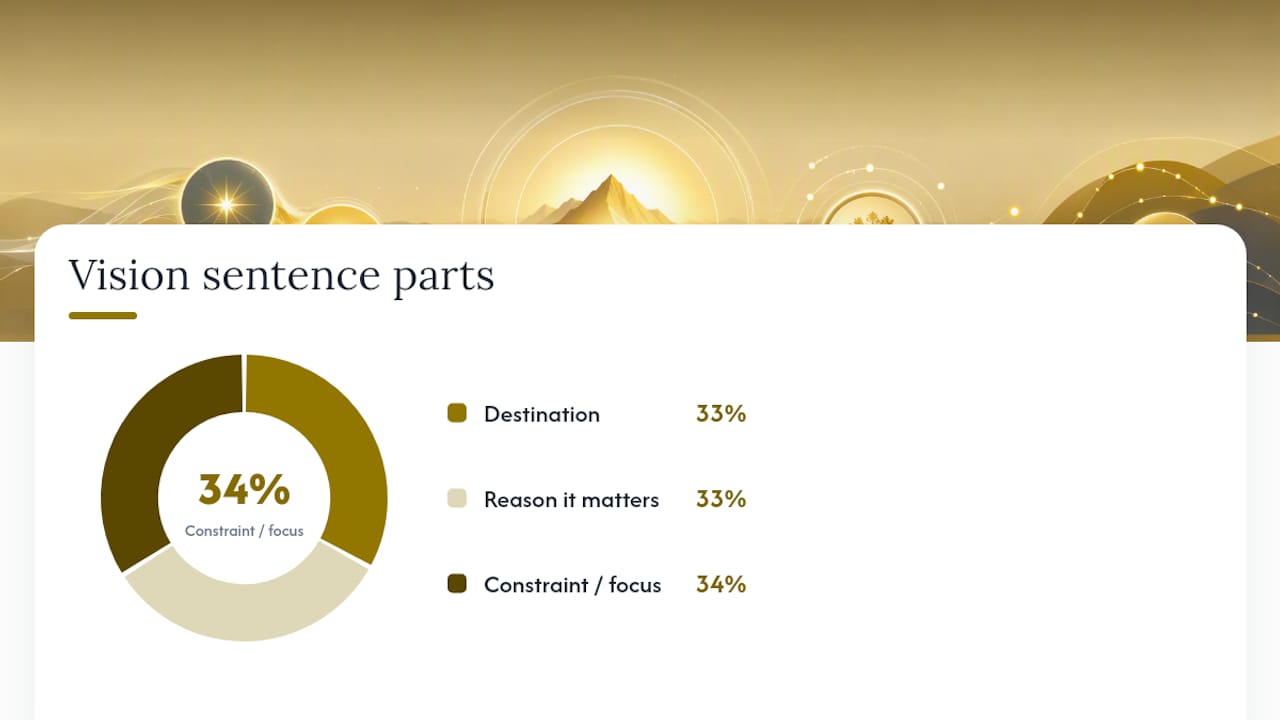
A vision sentence has three working parts: the destination, the reason it matters, and a constraint or focus that tells people what to say no to. Skip any one of them and you get a slogan instead of a tool. "Be the best in the industry" fails on all three counts. "Cut customer onboarding time in half by 2027 because slow onboarding is our top churn driver" gives people something to test decisions against.
Keep it to one sentence. If you need a paragraph, you haven't finished editing. Test it on three team members from different levels and ask them to repeat it back in their own words an hour later. If they can't, revise the sentence, not their memory.
Quick before/after:
- Weak: "We want to be customer obsessed."
- Usable: "We win by cutting response time to under two hours, because speed is the one thing competitors can't easily copy."
Run every draft through this checklist:
- Does it name a specific future state, not a mood?
- Does it state why that future matters to the business or the customer?
- Does it imply what the team should stop doing?
- Can someone repeat it verbatim after hearing it once?
Pro Tip: Read your vision sentence out loud to someone outside your industry. If they ask "what does that actually mean," it's not ready.
How Do You Translate the Vision for Each Team?
Cascade only works as translation, never as relay. A manager who simply forwards the CEO's words hasn't done their job; they've outsourced it. The Community Tool Box's framework for developing shared vision treats this restating step as core leadership work, not an optional add-on.
Here's a workshop managers can run in under 30 minutes:
- Read the company vision sentence aloud, unedited.
- Ask the team: "What does this mean for the work we do this quarter?"
- Draft three to five measurable priorities that connect the team's actual output to that vision.
- Assign one person to write the team's version in one paragraph and circulate it within 48 hours.
- Revisit it at the next team meeting and ask what's changed.
Translation prompts worth stealing for that session:
- "If we succeed at this vision, what would our team stop doing by next quarter?"
- "Which of our current projects moves us toward this, and which doesn't?"
- "What would a customer notice differently in six months?"
A LeadersLoop framework offers a useful gut check here: ask someone two rungs below the vision's origin to restate it and list two local priorities tied to it. If they can't, the cascade failed somewhere between you and them.
Where and How Often Should You Repeat the Vision?
Repetition is not redundancy. It's how a sentence becomes a shared reflex instead of a memory of something you heard once in an all-hands.
Use every channel you already have instead of inventing a new one:
- All-hands meetings for the formal, unedited version.
- Team meetings for the translated, local version managers build together.
- One-on-ones for connecting individual work to the bigger picture.
- Onboarding materials so new hires get it before they absorb informal culture instead.
- Internal docs and planning templates as a passive, always-visible reminder.
A workable cadence looks like: launch it wide, reinforce it in weekly team huddles for the first month, revisit it at every quarterly planning cycle, and bake it into onboarding permanently. Practitioner guidance from Startupik recommends pairing repetition with a visible decision, not just repeating words. If the vision says "speed matters" and you just approved a slower but cheaper vendor, say so out loud and explain the trade off. Silence there reads as hypocrisy.
How Do You Connect Vision to Goals, OKRs, and Daily Decisions?
A vision that never touches a goal-setting document is decoration. The real work is building a visible chain: vision, then strategy, then quarterly outcomes, then individual objectives, each one a narrower answer to the same question.
Bring these questions into every planning session and every one-on-one:
- Does this project move us toward the stated vision, or just toward a convenient metric?
- If we had to cut one initiative this quarter, would it be one that supports the vision or one that doesn't?
- What would we need to stop funding to take this seriously?
PMI's guidance on building shared vision on project teams makes a point worth repeating here: a vision becomes motivational only when it's discussed regularly and tied to real decisions, not filed away after the kickoff meeting.
Hiring, recognition, and budget are the loudest signals you have. Promote someone who embodies the vision and people notice. Fund a project that contradicts it and people notice that too, faster.
Pro Tip: Add one line to every quarterly planning template: "How does this initiative connect to our vision?" A blank answer is your early warning system.
How Do You Get the Team to Help Shape the Vision?
A vision announced without input rarely earns commitment; a vision people helped shape rarely needs selling. That's not a soft observation, it's the practical reason listening sessions outperform broadcast memos.
Three formats do most of the work:
- Short listening sessions where you ask people what excites and worries them about the direction, before you finalize the wording.
- Quick pulse surveys asking whether people can restate the vision and whether their daily work connects to it.
- Small co-creation workshops where a cross-functional group edits the draft sentence together.
Useful prompts for surfacing personal connection: "What part of this vision genuinely excites you?" and "Where does this feel disconnected from what you actually do all day?" Treating vision communication as a dialogue rather than a broadcast is what turns organizational language into something people say unprompted. Run a small experiment, like piloting the new sentence with one team for two weeks, and adjust based on what sticks before rolling it out wider.
What Mistakes Kill Vision Communication, and How Do You Fix Them?
Most failures trace back to a handful of repeat offenders.
- Vague slogans: fix by forcing the destination-reason-focus structure above.
- One-off launches: fix by scheduling repetition into existing meetings, not a special campaign.
- No translation layer: fix by requiring managers to write their own team version.
- Contradictory decisions: fix by naming the contradiction out loud when it happens.
Watch for red flags: a manager who can't repeat the vision unprompted, spending patterns that contradict the stated priorities, or a team that treats "the vision" as a poster rather than a reference point. Any one of these means the cascade broke somewhere between the top and the floor.
Can Manager Training Make Vision Communication Reliable at Scale?
Translation is a skill, and most managers were never taught it. Short, repeated practice, the kind built into microlearning formats, gives managers a low-stakes way to rehearse restating a vision before they do it live in front of a team.
A platform like Leaderly structures that practice through short behavioral exercises and tracks whether managers actually apply it. A useful pilot: pick two teams, run a translation workshop, then measure a month later whether managers and their reports can independently repeat the same three local priorities.
- Practice translation in short, repeatable exercises rather than a single training day.
- Track manager fluency with a simple recall check, not just a satisfaction survey.
- Compare a pilot group against a control team before scaling company-wide.
How Do You Turn Your Vision Into a Story People Remember?
Facts inform, but stories move people to act, and vision communication depends on both. An elevator-pitch version of your vision should survive being told at a bus stop with no slides, no charts, and no jargon.

The structure that works: name the current problem in one sentence, describe what the future looks like once it's solved, and give one concrete detail that makes it real. "Right now, customers wait three days for a callback and we lose a third of them before we ever speak. In two years, every customer gets a response within an hour, because speed is the one advantage a smaller company can actually win on" does more work than a mission statement full of adjectives.
Practitioner writing on vision communication consistently points to the same pattern: short messages beat comprehensive ones, and specific images beat abstract nouns. "Excellence" means nothing concrete. "No customer waits more than an hour" means everything to the person answering the phone.
Build your elevator pitch in three passes. First, write the unedited version, as long as it needs to be. Second, cut every sentence that doesn't name a person, a number, or a concrete outcome. Third, read it aloud and cut again until it fits in the time it takes to walk someone to the elevator.
One habit worth building into your own repetition: tell a two-sentence story every time you restate the vision, not just the sentence itself. "Last month, a rep cut a customer's wait time from four days to two hours by trying the new triage process. That's the vision working." A single concrete example does more to move skeptics than another repetition of the abstract goal.
How Do You Communicate the Same Vision to Different Kinds of People?
The vision sentence stays constant. How you deliver it should not.
Engineers and analytically minded team members often respond better to the vision framed around a specific metric or constraint. Show them the number that has to move and why the current approach caps it. Customer-facing teams respond better to a story about a real customer interaction, because that's the world they already live in. Senior leaders want to see the vision connected to competitive positioning and resource trade-offs, since that's the language their own decisions run on.
Personality matters as much as role. Some people need the big picture stated explicitly before details make sense to them; walk them through the destination first, then the mechanics. Others distrust anything that sounds aspirational until you show them the plan; lead with the concrete priorities and let the vision sentence follow as context, not as the opening line.
Culture and geography add another layer. A vision framed around individual achievement lands differently on a team where collective outcomes carry more weight. A direct, blunt framing that works in one office can read as aggressive in another. None of this means writing five different vision statements. It means adjusting the order of delivery, the supporting example, and the level of directness while keeping the sentence itself identical everywhere it's said.
The test is simple: after hearing your version, tailored to their role or context, can that person still repeat the same core sentence a colleague from a completely different team would give you? If yes, you've adapted the delivery without fragmenting the message. If everyone gives you a slightly different vision, you've drifted into telling people what they want to hear instead of what's actually true.
How Do You Respond to a Team That Doesn't Buy the Vision?
Skepticism is data, not defiance. Teams that have lived through a previous vision that fizzled have every reason to wait and see whether this one is different, and treating their doubt as a morale problem instead of a legitimate signal just confirms their suspicion.
Name the skepticism out loud instead of talking around it. "I know we've said something like this before and it didn't change much day to day. Here's specifically what's different this time" disarms more resistance than another confident restatement of the same sentence. People trust acknowledgment more than enthusiasm.
Separate the loud skeptics from the quiet ones. A vocal critic in a team meeting is often easier to work with than the person who nods along and does nothing differently afterward. Ask direct questions in one-on-ones: "What would need to be true for you to believe this is real?" Their answer usually points straight at the fix, whether that's a resourcing decision, a leadership behavior, or a metric they don't trust.
Resistance rooted in past broken promises needs proof, not persuasion. Pick one small, visible decision in the first month that clearly supports the new vision, even if it's costly or inconvenient, and make sure people see the connection. That single data point does more than a month of reassuring language.
Some resistance is really disagreement about direction, not distrust of the process. Give that feedback a real channel, a listening session, a survey, a standing agenda item, and actually change something in response to it occasionally. A vision that never bends to legitimate pushback starts to look like a decision people are informed of rather than one they're part of, and that distinction shapes how hard they'll work for it.
What Do Real Examples of Successful Vision Communication Look Like?
Abstract advice lands better next to a concrete pattern. Vision efforts that hold up over time share a few traits regardless of industry.
The strongest examples treat the vision statement as a working sentence people quote unprompted in meetings, not a line copied from a values page. That only happens when the sentence is specific enough to argue with. A vague vision generates polite nodding. A specific one generates pushback, questions, and eventually adoption, because people can actually test it against their daily decisions.
Teams that translate the vision successfully tend to produce visibly different local versions across departments that still trace back to the same sentence. A sales team's translated priorities look nothing like an engineering team's, and that's the sign the translation step happened rather than a copy-paste relay down the org chart.
The pattern practitioner research keeps surfacing is straightforward: vision sticks when it's discussed regularly, tied to real trade-offs, and revisited at planning cycles instead of filed away after a launch event. PMI's research on project team vision makes the same point in a narrower context. A vision built through a group exercise, then referenced at every subsequent decision point, keeps its motivational pull far longer than one announced from a stage and never mentioned again.
The failure pattern is just as consistent. Vision efforts that fade usually launched with energy, generated no follow-up mechanism, and left middle managers guessing how to connect it to daily work. Six months later, nobody can recite the sentence, and the poster is still on the wall.
How Do You Know If Your Team Actually Understands and Believes the Vision?
You can't manage what you never measure, and vision buy-in is measurable if you're willing to ask direct questions instead of relying on applause at the all-hands.
The simplest test: ask a random sample of people, across levels, to restate the vision in their own words and name one priority it implies for their role. If answers vary wildly or come back blank, you have your answer regardless of how the last town hall felt.
Build a short pulse check into your existing survey cadence rather than creating a new one:
- Can you state our current vision in one sentence?
- Can you name one thing your team is doing differently because of it?
- Do recent decisions you've seen support or contradict it?
Track manager fluency separately from individual contributor fluency. Managers are the translation layer, and if they can't repeat the vision confidently, their teams have almost no chance of getting it right either. The two-rungs-down test from LeadersLoop works well here: pick someone two levels below the vision's origin point and ask them to restate it cold.
Watch behavioral signals too, not just survey answers. Are people citing the vision unprompted when they explain a decision? Are project proposals referencing it, or does it only come up when leadership brings it up first? The second pattern means the vision is still yours, not theirs.
The Habit That Actually Moves the Needle
Pick one team meeting this week and run the translation exercise: read the vision sentence, ask what it means for their work, and write down three priorities together. Then check back in a month and ask two people to repeat those priorities cold. If they can't, the exercise needs repeating, not abandoning. That single habit, done consistently, does more than any all-hands speech.
— Drew
Turn Vision Communication Into a Manager Habit, Not a One-Time Event
The gap between a great vision sentence and a team that actually lives it is almost always manager skill, not leadership intent. Leaderly closes that gap with short, personalized microlessons that give managers repeated practice translating a vision into local priorities, plus behavioral exercises built around real leadership scenarios instead of generic training modules.
Rather than a one-off workshop that fades in a month, Leaderly's platform tracks whether managers actually apply what they practice, giving HR and leadership teams a way to see manager fluency improve over time instead of guessing at it. The analytics dashboards show where the cascade is working and where it's stalling, so you can fix the gap before it shows up in engagement scores.
If you're rolling out a new vision this quarter, a short pilot with two or three manager cohorts is enough to see whether the approach fits your organization. Start by exploring Leaderly's leadership development platform and see what a focused microlearning pilot could look like for your management layer.
Sources
- Develop and communicate vision - Community Tool Box (CTB/University of Kansas)
- Creating a shared vision for project team - PMI
- Communicating a corporate vision to your team - HBR